CBD Supplement Manufacturing Guide: Extracts, Formats & Compliance
How to formulate, manufacture, and launch a compliant CBD supplement brand with GMP-certified production
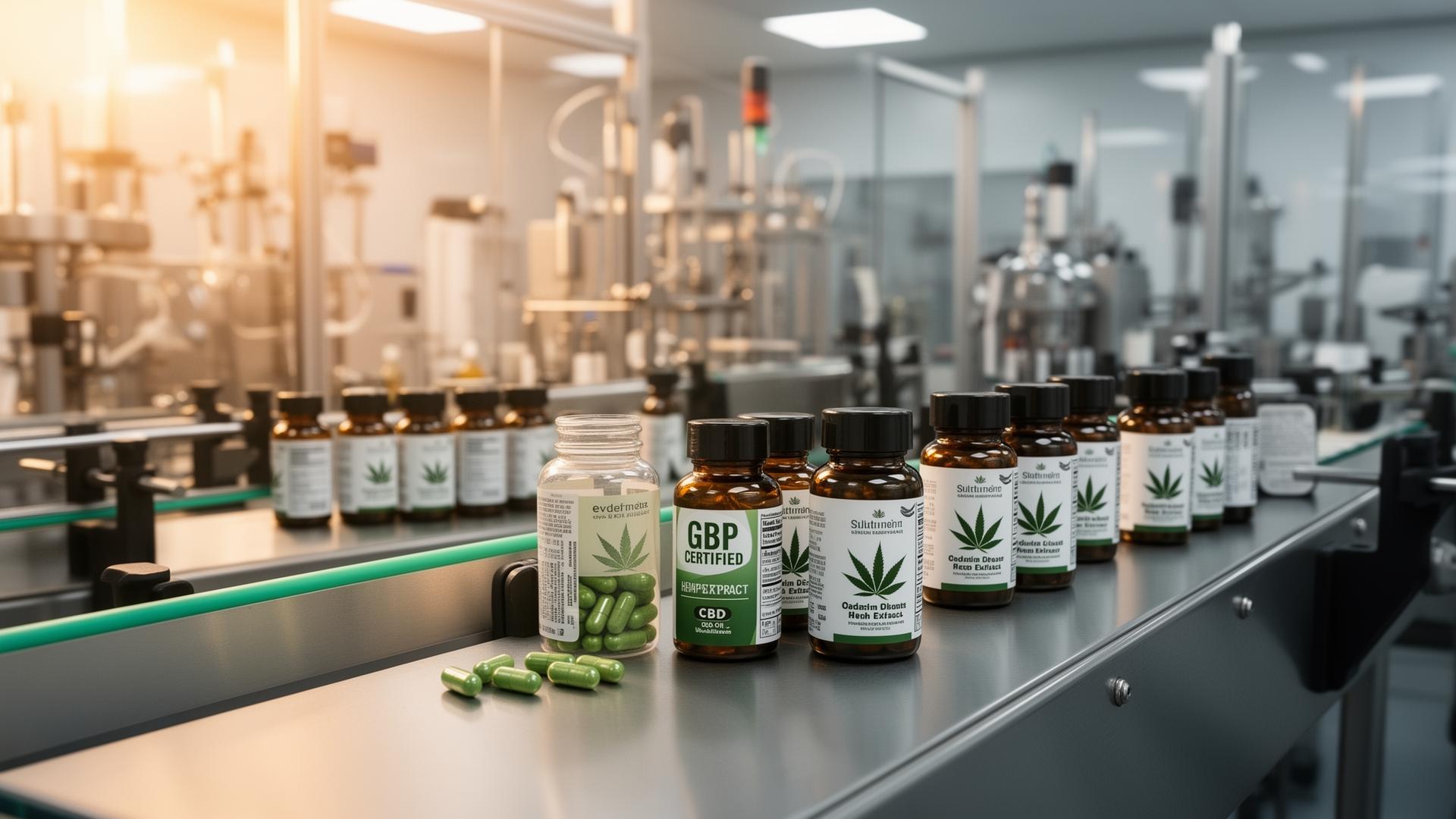
- 1Hemp-derived CBD supplements are legal federally under the 2018 Farm Bill, but state regulations vary significantly
- 2Full-spectrum, broad-spectrum, and CBD isolate each serve different market segments and compliance requirements
- 3Third-party COAs with cannabinoid profiles and heavy metals testing are essential for consumer trust and retail placement
- 4Softgels and tinctures dominate the CBD supplement market, with gummies as the fastest-growing format
- 5Low MOQ runs of 2,000 units let you validate your CBD formula before scaling
Why CBD Supplements Remain a Growth Category
CBD supplements have evolved from a niche wellness trend into a mainstream category generating over $6 billion annually in the US alone. Despite regulatory complexity, consumer demand for natural stress relief, sleep support, and pain management continues to drive market growth. For brand founders selling through Shopify DTC or TikTok Shop, CBD offers high margins, strong repeat purchase rates, and loyal customer bases.
This guide covers essential manufacturing decisions—from extract selection and format choice to regulatory compliance and GMP-certified production. Understanding manufacturing costs and packaging requirements is critical for CBD brands.
CBD Supplement Market in 2026
| Segment | Key Products | Target Consumer | Growth Rate |
|---|---|---|---|
| Daily Wellness CBD | Low-dose capsules, gummies | General wellness consumers | 12–15% CAGR |
| Sleep CBD | CBD + CBN + melatonin blends | Sleep-challenged adults | 18–22% CAGR |
| Sport Recovery CBD | Topicals + oral softgels | Athletes, fitness enthusiasts | 15–18% CAGR |
| Pet CBD | Soft chews, tinctures for dogs/cats | Pet owners | 20–25% CAGR |
| Senior Wellness CBD | Joint + inflammation support | Adults 55+ | 14–17% CAGR |
Niche Opportunity
Types of CBD Extract: Full-Spectrum vs Broad-Spectrum vs Isolate
| Extract Type | Cannabinoid Profile | THC Content | Best For | Cost/kg |
|---|---|---|---|---|
| Full-Spectrum | CBD + CBG + CBN + terpenes + THC | <0.3% THC | Maximum entourage effect | $3,000–$6,000 |
| Broad-Spectrum | CBD + CBG + CBN + terpenes, no THC | 0% (ND) | THC-free with entourage benefits | $4,000–$8,000 |
| CBD Isolate | 99%+ pure CBD crystalline | 0% | Precise dosing, lowest risk | $1,500–$3,500 |
| Water-Soluble CBD | Nano-emulsified CBD | Varies | Beverages, faster absorption | $5,000–$12,000 |
For most DTC brands, broad-spectrum CBD offers the best balance of efficacy, compliance, and consumer appeal. It provides the entourage effect benefits of multiple cannabinoids while eliminating THC concerns for drug-tested consumers and states with stricter regulations.
CBD Product Formats & Manufacturing Considerations
| Format | Pros | Cons | Cost/Unit |
|---|---|---|---|
| Softgels | Precise dosing, familiar format, oil-compatible | Slower absorption, higher MOQ | $0.40–$1.20 |
| Tinctures (oil drops) | Fast sublingual absorption, flexible dosing | Taste challenges, messy application | $1.50–$4.00 |
| Gummies | Consumer-friendly, taste-driven, shareable | Heat sensitivity, lower bioavailability | $0.25–$0.80 |
| Capsules | Simple, affordable, easy to dose | Slower absorption than sublingual | $0.20–$0.60 |
| Topicals | Targeted application, high margins | Different manufacturing process | $2.00–$6.00 |
Softgels are the most established CBD supplement format, offering precise dosing and professional positioning. Gummies are the fastest-growing format, especially for new-to-CBD consumers who prefer a familiar, enjoyable delivery method.
CBD Compliance & Legal Landscape
- Federal status: Hemp-derived CBD (<0.3% THC) is legal under the 2018 Farm Bill, but FDA has not approved CBD as a dietary supplement ingredient
- State regulations: Several states (Idaho, Iowa, South Dakota) have restrictions. California requires Prop 65 warnings. Always verify state-by-state legality
- Labeling requirements: Must include: CBD mg per serving, hemp source, THC content, supplement facts panel, allergen warnings, and manufacturing facility info
- Third-party testing: COAs from ISO 17025-accredited labs are essential—test for potency, pesticides, heavy metals, solvents, and mycotoxins
- Health claims: Cannot claim CBD treats, cures, or prevents any disease. Use structure/function claims only: "supports calm," "promotes restful sleep"
- Payment processing: CBD is considered "high-risk" by most payment processors. Use specialized CBD merchant services (Square, PayKickstart, or CBD-friendly Shopify apps)
CBD Supplement Manufacturing Cost Breakdown
| Cost Category | CBD Isolate Capsules | Broad-Spectrum Softgels | Premium Full-Spectrum Gummies |
|---|---|---|---|
| CBD extract | $1,200–$2,500 | $3,000–$5,500 | $3,500–$6,000 |
| Other ingredients | $300–$500 | $400–$700 | $800–$1,500 |
| Production | $700–$1,000 | $1,000–$1,800 | $1,200–$2,000 |
| Testing (potency + safety) | $800–$1,200 | $1,000–$1,500 | $1,200–$1,800 |
| Packaging & labeling | $600–$900 | $800–$1,200 | $900–$1,400 |
| Total (2,000 units) | $3,600–$6,100 | $6,200–$10,700 | $7,600–$12,700 |
| Per-unit cost | $1.44–$2.44 | $2.48–$4.28 | $3.04–$5.08 |
CBD supplements retail for $30–$60 for capsules (30-day supply) and $40–$80 for premium softgels and gummies. Tinctures command $45–$120 depending on potency. See our complete cost guide for category comparisons.
Choosing a CBD Supplement Manufacturer
- Hemp sourcing transparency: Your manufacturer should provide COAs for the raw CBD extract including cannabinoid profile, pesticide, and heavy metals testing
- GMP certification: Non-negotiable for any supplement manufacturer. Verify current GMP certification and FDA registration
- CBD-specific experience: CBD requires specialized handling—homogeneous distribution in gummies, oil encapsulation for softgels, and stability testing for shelf life
- Compliance support: A good manufacturer helps with compliant labeling, state-by-state legality guidance, and proper structure/function claims
- Low MOQ flexibility: Start with 2,000 units to validate your CBD product in the market before scaling production
Launch Strategy for CBD Brands
- Choose your niche: Sleep, stress, sport recovery, daily wellness, or pet CBD—each demands different formulation, marketing, and distribution
- Start with one hero SKU: A 2,000-unit run of broad-spectrum softgels or gummies. Validate your formula and positioning before expanding
- Build trust through transparency: Publish full COAs on your website. CBD consumers are highly educated and demand proof of potency and purity
- DTC-first distribution: Since Amazon and many retailers restrict CBD, build your brand through your own website, email marketing, and social media
- Content education: Create content explaining CBD types, dosing, and the endocannabinoid system. Education-driven content builds authority in a skeptical market
Frequently Asked Questions
Is it legal to manufacture CBD supplements?
Hemp-derived CBD (containing <0.3% THC) is federally legal under the 2018 Farm Bill. However, FDA has not approved CBD as a dietary supplement ingredient, creating a regulatory gray area. Many states have their own CBD regulations. Work with a manufacturer experienced in CBD compliance and consult legal counsel before launching.
What is the difference between full-spectrum, broad-spectrum, and CBD isolate?
Full-spectrum contains all cannabinoids including trace THC (<0.3%). Broad-spectrum removes THC while retaining other cannabinoids and terpenes. CBD isolate is 99%+ pure CBD with no other cannabinoids. Full-spectrum is preferred for the 'entourage effect,' while isolate and broad-spectrum appeal to THC-sensitive consumers.
How much does CBD supplement manufacturing cost?
CBD supplement manufacturing costs $5,000–$18,000 for an initial 2,000-unit run depending on CBD type, concentration, and format. CBD extract is the primary cost driver—full-spectrum costs more than isolate. Per-unit costs range from $2.00–$7.20.
What testing is required for CBD supplements?
CBD supplements require: cannabinoid potency testing (CBD, THC, CBG, CBN), heavy metals (lead, arsenic, mercury, cadmium), pesticide residue, microbial contamination, and residual solvents. Third-party COAs from ISO 17025-accredited labs are industry standard.
Can I sell CBD supplements on Amazon?
No. Amazon prohibits the sale of CBD and hemp-derived cannabinoid products. CBD brands sell primarily through their own DTC websites, specialty retailers, dispensaries, and platforms like Shopify that allow CBD sales with proper compliance documentation.
What CBD dosage should I use in my supplement?
Common CBD dosages range from 10–50 mg per serving for daily wellness, 25–75 mg for targeted relief (sleep, stress), and 50–100+ mg for intensive support. Most successful brands offer multiple potency options to serve different consumer needs.

Tushar
Licensed Pharmacist and COO @ Peakfinity Labs
Written by the Peakfinity Labs R&D Team — 46+ years of supplement formulation expertise. Our team of formulation chemists, manufacturing specialists, and regulatory experts has helped thousands of eCommerce brands bring their products to market successfully since 1980.
Related Articles
How to Find an ISO 17025-Accredited Supplement Testing Lab, and What Founders Should Ask For
How to verify a lab's ISO/IEC 17025 scope actually covers your test, the questions to ask before shipping samples, and a testing plan built for ecommerce timelines.
Supplement Manufacturing Lead Times and Reorders: What Founders Should Expect Before and After Launch
The five workstreams hiding inside "lead time," why reorders move faster than first runs, and the ramp plan that survives a demand spike.
How to Vet a cGMP Supplement Manufacturer With Documented Audit History
The document pack, audit-history call script, and scoring rubric that separate real cGMP quality systems from certificate PDFs.