How Do I Know If My Supplement Manufacturer Is GMP Certified?
A 6-step checklist to confirm GMP status, the exact docs to request, red flags to spot, and what other certifications matter for supplements and cosmetics.
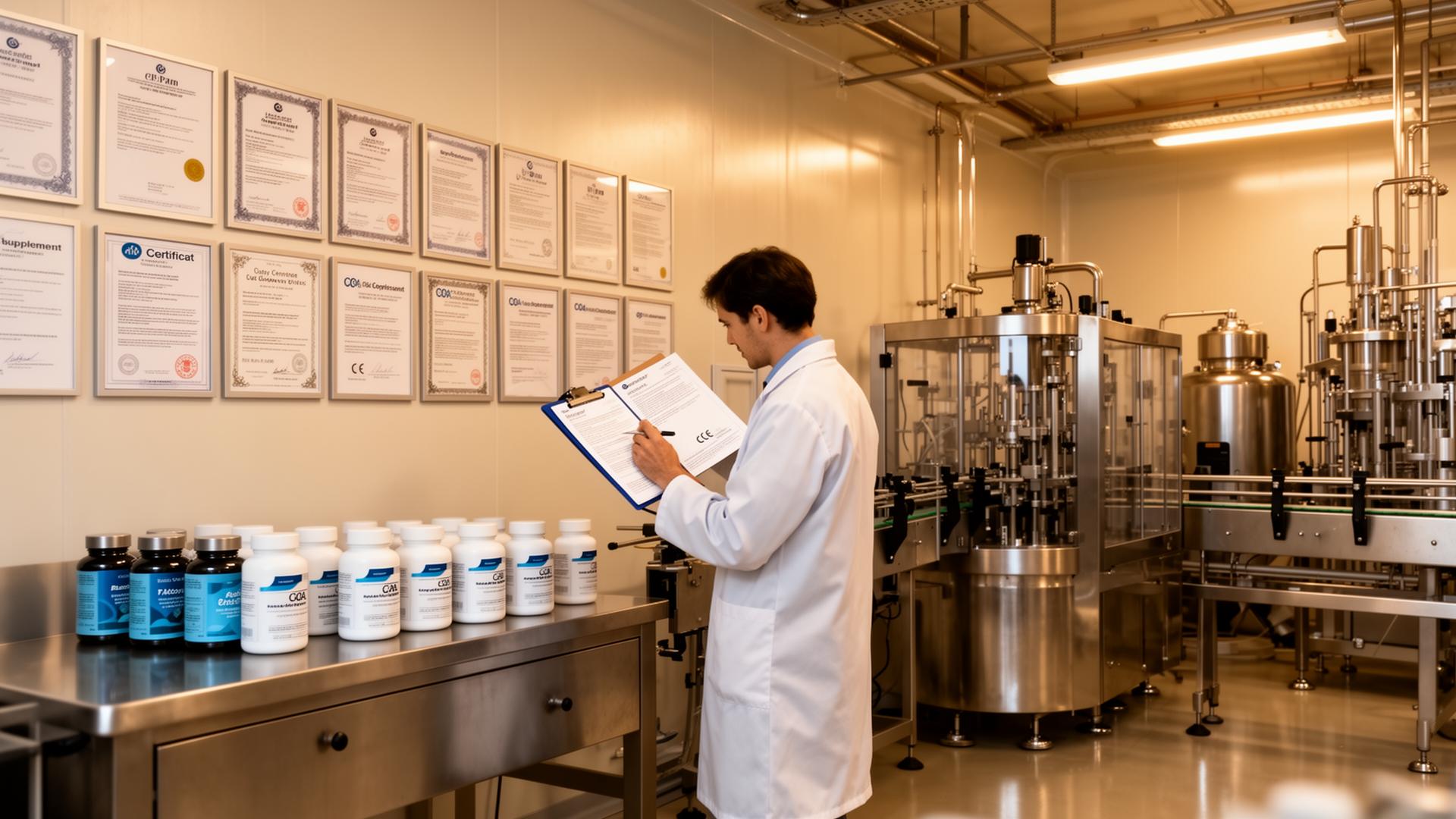
TL;DR — how Peakfinity Labs verifies GMP
- 1FDA doesn't 'certify' GMP—third-party audits do. Always ask: certified by whom, at which facility, and for which dosage forms.
- 2Request the GMP certificate, a redacted COA, and a sample batch record before you commit—if they can't produce these quickly, pause.
- 3Match the audit scope to your exact product: a capsule-audited facility may not cover gummies or softgels.
- 4GMP is the floor, not the ceiling—complement with ISO, cosmetic GMP (ISO 22716), or program-specific standards based on your channel.
- 5The biggest risk of skipping GMP verification isn't a bad batch—it's platform flags, retailer rejections, and slow recalls that cost more than the product itself.
Introduction
If you're selling supplements online, "GMP certified" can't be a vague promise on a sales deck. It has to be real, current, and tied to the exact facility that will make your product. Otherwise you're taking on avoidable risk: inconsistent potency, failed micro testing, label mismatches, and platform headaches when Amazon or a retail partner asks for documentation.
Here's the uncomfortable truth we see when brands switch manufacturers: many companies say "GMP" when what they mean is "we try to follow GMP." That's not the same thing as operating under a verified, audited quality system. And if you're planning a fast turnaround launch, low MOQ test run, or rapid scale after a viral moment, you need your quality paperwork to move as fast as your marketing does. (Related: Which Manufacturer Is Best for Testing Viral Product Ideas?)
This guide shows you exactly how to confirm GMP status (not just "GMP compliant"), what documents to request, how to spot red flags in audit certificates, and what other certifications matter for supplements and cosmetics. We'll also cover what happens if a batch fails third-party testing and how to protect your lead times and costs when switching manufacturers.
Prerequisites: what you should have before you start asking for GMP proof
You'll get better answers (and faster) if you come prepared. This also helps you compare manufacturers on an apples-to-apples basis.
- Your dosage form (capsules, tablets, softgels, gummies, powder, liquid). Peakfinity Labs supports multiple formats—see Supplement Manufacturing Overview and specific lines like Capsule Manufacturing, Tablet Manufacturing, Softgel Manufacturing, Gummy Manufacturing, and Powder Manufacturing.
- Your target markets and channels (Amazon, Shopify, TikTok Shop, clinics, influencers). Channel requirements affect labeling, claims, and documentation. Relevant resources: Amazon FBA Brands, Shopify Brands, TikTok Shop Sellers.
- Your "must-pass" quality attributes (identity testing, micro limits, heavy metals, allergens, banned substances, stability expectations).
- A packaging plan (D2C ready packaging, induction seal, lot/expiry coding, inserts, multi-SKU kitting). If you need fulfillment support, factor in 3PL: Supplement 3PL.
- A realistic launch timeline. A true fast turnaround (often 3–4 weeks from order to production for many projects) only works if the documentation and approvals don't stall.
First: understand what 'GMP certified' actually means for supplements
In the U.S., dietary supplement GMPs are defined in 21 CFR Part 111 (FDA's current Good Manufacturing Practice rules for supplements). FDA doesn't "certify" facilities the way some people assume; instead, FDA inspects and enforces. Many manufacturers use third-party audits to prove they operate under a GMP quality system.
So when a manufacturer says "GMP certified," you should immediately ask: Certified by whom? A credible answer includes an accredited audit program (or a well-known certification body), an audit scope that matches your product type, and current documentation that matches the facility address where your batch will be made.
Note
Authoritative reference: FDA's supplement GMP overview and rules for manufacturers are published by the FDA (21 CFR Part 111). You can start here: https://www.fda.gov/food/dietary-supplements
GMP vs FDA at a glance: what each one actually does
Founders confuse "FDA approved," "FDA registered," and "GMP certified" all the time — and so do some manufacturers. Use this comparison to keep them straight before you read a single certificate.
GMP certification vs FDA oversight for dietary supplements (U.S.)
| Term | Who Issues It | What It Proves | What It Does NOT Prove |
|---|---|---|---|
| FDA Approval | U.S. Food & Drug Administration | Used for drugs only — pre-market review of safety and efficacy | Supplements are never 'FDA approved.' Any brand claiming this is non-compliant. |
| FDA Facility Registration | U.S. Food & Drug Administration | Facility has filed required info under FSMA / Bioterrorism Act and is subject to inspection | Not an endorsement, not a quality stamp, not a GMP audit. |
| FDA 21 CFR Part 111 Compliance | Self-declared, enforced by FDA inspections | Facility follows the federal cGMP rule for dietary supplements | Self-declaration alone is not third-party verified — ask for an audit. |
| Third-Party GMP Certification (NSF, NPA, UL, etc.) | Accredited certification body | Independent annual audit confirming the facility operates under 21 CFR Part 111 | Scope matters — a capsule audit does not cover gummies or softgels. |
| ISO 22716 (Cosmetic GMP) | Accredited ISO registrar (e.g. SGS) | Documented cosmetic GMP for skincare, hair care, color cosmetics | Does not cover dietary supplements — different framework. |
| WHO-GMP | Recognized national regulatory authority | Pharmaceutical-grade GMP recognized internationally, including EU export | Audit cycle and scope vary by issuing authority — verify both. |
Bottom line: "FDA registered" tells you the address is on file. "GMP certified" tells you an independent auditor walked the floor, reviewed batch records, and signed off on a documented quality system. You want both, plus a scope that matches your dosage form. See our full credential register for how Peakfinity Labs documents every standard above.
Direct answers: GMP vs cGMP, FDA registration vs approval, ISO, and COAs
GMP vs cGMP — what is the difference?
GMP (Good Manufacturing Practice) is the general framework for producing a safe, consistent product. cGMP (current Good Manufacturing Practice) is the FDA's enforced version of that framework, with the word current meaning manufacturers must use up-to-date systems, equipment, and controls — not just whatever was acceptable years ago. For U.S. dietary supplements, cGMP requirements are codified in 21 CFR Part 111. In day-to-day procurement, "GMP certified" usually refers to a third-party audit confirming a facility operates in line with those cGMP rules.
FDA registration vs FDA approval — what your manufacturer can and cannot say
The FDA does not approve dietary supplements or their manufacturers before they go to market. A facility can be FDA-registered under the Bioterrorism Act / FSMA, which simply means it has filed required facility information with the FDA and is subject to inspection. Registration is not an endorsement, a certification, or a quality stamp. Any manufacturer (or brand) that claims its products are "FDA approved" is using non-compliant language. Use phrases like "manufactured in an FDA-registered facility" or "produced under FDA 21 CFR Part 111 GMP requirements" instead.
ISO 9001 vs ISO 22716 — which one applies to you?
ISO 9001:2015 is a general quality management system standard: documented processes, training records, corrective and preventive actions, and internal audits. ISO 22716 is the international cosmetic GMP standard covering hygiene, production, equipment, and storage for personal care products. If you sell supplements, ISO 9001 complements 21 CFR Part 111. If you sell skincare, hair care, or color cosmetics, ISO 22716 alignment is the proof point retailers and EU partners look for.
What is a COA, and what should it actually contain?
A Certificate of Analysis (COA) is a lot-specific document showing the test results for a finished good or raw material against a written specification. A defensible COA names the product, lot/batch number, manufacture and expiry dates, the laboratory (in-house or third party), the test methods used (e.g., HPLC, ICP-MS, USP <61>/<62> for microbial), the specification, the actual result, and a pass/fail disposition. A "COA" with only marketing copy and no methods or specs is not a COA — it is a flyer.
Can my manufacturer help with compliance and labeling?
A serious contract manufacturer supports compliant Supplement Facts / Drug Facts panels, allergen and "Contains" statements, structure-function claim boundaries, MoCRA registration for cosmetics, and lot-coded traceability. They will not, however, replace your regulatory counsel for novel claims, drug-adjacent positioning, or international filings. See our Certifications hub for the current credential register and our Our Process page for how labels are reviewed in the production workflow.
What quality standards do I need to sell supplements online?
At minimum: produce in a facility audited to 21 CFR Part 111 dietary supplement GMP, keep a current third-party GMP certificate on file, hold a finished-goods COA for every lot you ship, and align your label to the formula on the Master Manufacturing Record. For Amazon and major retailers, add traceable lot codes, stability data supporting your expiry, and a written recall procedure. For TikTok Shop, the bar is the same — platforms increasingly request the same documentation when a listing is challenged.
Evidence: credential register you should be able to request
Any contract manufacturer worth signing should be able to produce a credential register like the one below — with real certificate numbers, real issuing bodies, and current renewal dates tied to the legal facility name on your purchase order. The example below is the structure Peakfinity Labs publishes on its Certifications hub; ask any prospective partner for the same.
Example credential register format (supplement & cosmetic contract manufacturer)
| Credential | Issuing Body | Covered Facility / Scope | Issue Date | Renewal / Surveillance | What It Proves |
|---|---|---|---|---|---|
| NSF GMP Registration (21 CFR Part 111) | NSF International | Dietary supplement manufacturing — capsules, tablets, powders, softgels, gummies | Listed on certificate | Annual surveillance audit | Independently audited compliance with U.S. dietary supplement cGMP |
| FDA Facility Registration | U.S. Food & Drug Administration | Food & dietary supplement facility (registration, not approval) | On file | Renewed biennially | Facility is registered with FDA and subject to inspection |
| ISO 9001:2015 | Accredited ISO registrar | Quality management system across manufacturing operations | Listed on certificate | Annual surveillance, 3-year recertification | Documented QMS: process control, CAPA, internal audit, management review |
| ISO 22716 alignment (Cosmetic GMP) | Internal program + third-party audit | Skincare, hair care, color cosmetic manufacturing | Listed on certificate | Annual review | Hygiene, contamination control, and documented cosmetic GMP practices |
| WHO-GMP | Recognized regulatory authority | Pharmaceutical-grade manufacturing operations | Listed on certificate | Per issuing authority cycle | Compliance with World Health Organization GMP guidelines |
| Halal / Kosher (as applicable) | Recognized Halal / Kosher certifying agency | Specific SKUs and ingredient lines covered by certificate | Per certificate | Annual renewal | Ingredient sourcing and process meet religious dietary standards |
| Organic (as applicable) | USDA-accredited certifier | Specific SKUs formulated with certified-organic ingredients | Per certificate | Annual renewal | Ingredients and handling meet USDA National Organic Program rules |
Pro Tip
How to use this: when you request a manufacturer's credential register, ask for the actual PDFs (or verifiable certificate numbers), confirm the facility address on each certificate matches the address that will appear on your purchase order, and confirm the scope covers your dosage form. A confident partner answers within one business day.
Audit history & verification trail (what 'documented' really looks like)
A GMP certificate is a snapshot. The proof you can defend in a retailer review, an Amazon document request, or an FDA-style audit is the trail — initial certification, every surveillance audit, recertification, and any corrective actions closed in between. Ask any prospective manufacturer for a verification trail in the format below. (For the full vetting workflow — the document pack to request, a 30-minute call script, and a scoring rubric — see how to vet a cGMP manufacturer with documented audit history.)
Sample audit history format — request this from any GMP-claiming manufacturer
| Audit Cycle | Audit Type | Issuing Body | Scope Verified | Findings Status |
|---|---|---|---|---|
| Initial certification | Stage 1 + Stage 2 on-site | NSF International / SGS / equivalent | Full QMS, manufacturing, packaging, lab | Certificate issued — base year |
| Year 1 surveillance | On-site annual surveillance | Same certification body | QMS, CAPA closure, batch records sample | All findings closed within 30–60 days |
| Year 2 surveillance | On-site annual surveillance | Same certification body | QMS, document control, training, OOS handling | All findings closed within 30–60 days |
| Year 3 recertification | Full re-audit (Stage 1 + Stage 2) | Same certification body | Full QMS re-verification + scope review | Recertified — new 3-year cycle |
| Customer / brand audits | On-site or remote brand audits | Brand or retailer QA team | SKU-specific manufacturing, batch records | Documented in customer audit log |
| FDA inspection (if applicable) | Routine or for-cause | FDA investigator | 21 CFR Part 111 compliance, sample batch records | Form 483 observations (if any) closed and documented |
Pro Tip
What to download before you sign: the current GMP certificate (PDF), the most recent surveillance audit summary letter, and a redacted finished-goods COA from a batch made in the last 12 months. Peakfinity Labs provides this proof bundle under mutual NDA before project kickoff — request it via our Start Project form or directly from the Certifications hub.
How to verify GMP certification (the exact steps we recommend)
Use this as a checklist. If a manufacturer can't clear these steps quickly, that's a signal—especially if you care about speed, low MOQ, and smooth scaling.
Step 1: Ask for the GMP certificate and the most recent audit report summary
Request a PDF of the current GMP certificate plus either an audit report summary or a letter stating audit completion and outcome. You are not asking for their whole Quality Manual; you're asking for proof of a recent, legitimate audit.
What you want to see: issue date, expiry date (or surveillance schedule), facility legal name, facility address, and the scope (dietary supplements, cosmetics, specific dosage forms).
Fast test: the certificate should not look like a generic template with no scope, no address, and no traceable certification body.
Step 2: Confirm the certification body is real and the certificate is traceable
A credible certificate should be verifiable. Look for a certificate number and a certification body that can confirm validity. If the "certifier" has no public presence, no accreditation references, or no way to validate, treat it as marketing—not compliance.
If you're evaluating Peakfinity Labs, start with our Certifications page and then cross-check what matters to your exact product and facility.
Step 3: Match the scope to your product (this is where brands get burned)
GMP isn't one-size-fits-all. A facility might have a quality system for capsules and powders but not for gummies or softgels. Or they might be audited for "packaging" but outsource manufacturing.
Ask a direct question: "Will my SKU be manufactured and packaged at the address listed on the certificate, and is my dosage form included in the audit scope?"
Step 4: Ask for the Master Manufacturing Record (MMR) approach and batch record controls
You don't need proprietary formulas to confirm GMP behavior. You need to confirm they run controlled documentation.
- Do they have a controlled process for Master Manufacturing Records and Batch Production Records?
- Do they record lot traceability for each raw material and packaging component?
- Do they document in-process checks (weights, fill counts, tablet hardness, gummy moisture, etc.)?
At Peakfinity Labs, our quality approach is built for repeatability across low MOQ runs and rapid scale. You can review how we think about quality here: Certifications & Quality Standards.
Step 5: Verify their testing program (incoming, in-process, finished goods)
GMP certification matters, but testing is where quality becomes measurable. Ask for a sample COA package (with sensitive info removed) showing:
- Incoming raw material tests: identity testing at minimum; additional tests based on risk (micro, heavy metals, solvents).
- In-process checks: uniformity/weight checks; blend validation approach.
- Finished goods testing: identity, potency, micro, and contaminants appropriate to ingredients and dosage form.
Pro Tip
Contrarian take from the floor: brands often obsess over a "GMP certificate" and forget to ask which tests are actually performed for their formula. A real GMP partner can explain why a probiotic capsule needs a different testing and handling plan than a creatine gummy. (See also: Probiotic Supplement Manufacturing.)
Step 6: Confirm labeling and claim review is part of the workflow
Many costly problems come from labels, not manufacturing. Ask whether the manufacturer supports compliant Supplement Facts, allergen statements, and claim boundaries for your channel.
For Amazon-specific compliance, see Compliant Supplement Amazon and Amazon FBA Supplement Manufacturing. For process transparency, see Our Process.
Document checklist: what to request (and what each document proves)
GMP Documentation Checklist for Supplement Brands
| Document | What It Proves | Red Flag If… |
|---|---|---|
| GMP certificate (current) | Independent verification of a quality system at a specific facility | No address, no scope, no dates, no certificate number |
| Audit scope statement | Your dosage form and activities (manufacture vs packaging) are covered | Scope only says 'warehousing' or 'distribution' |
| COA template (finished goods) | They test what matters: identity, potency, micro, contaminants | COA lists marketing terms but no methods, specs, or lab info |
| Allergen & cross-contact controls | They prevent accidental allergen contamination | 'We clean well' with no written program |
| Recall & traceability procedure | They can trace lots quickly and act if there's an issue | No lot coding strategy or unclear record retention |
| Stability approach (as applicable) | They have a plan for shelf life claims and storage conditions | They guess expiry without rationale |
Documents to request before you sign the MSA
Before any MSA, SQA, or first PO, get this short proof bundle in writing. Every item below is something a credible GMP-certified contract manufacturer should be able to share within one to two business days under mutual NDA.
- Current GMP certificate (PDF): facility legal name, full address, audit scope including your dosage form, issue and expiry dates, certificate number, and named issuing body.
- Most recent surveillance audit summary: a one-page letter or report confirming the latest annual audit closed without open major findings.
- FDA facility registration confirmation: FEI number or registration confirmation tied to the same address on the GMP certificate.
- Redacted finished-goods COA: from a lot produced in the last 12 months in your dosage form, showing identity, potency, micro, and contaminant results with methods and specs.
- Master Manufacturing Record (MMR) overview: not the recipe — a description of how MMRs and Batch Production Records are controlled, approved, and retained.
- OOS / deviation procedure summary: a written description of how out-of-spec results are quarantined, investigated, and dispositioned.
- Recall and traceability procedure: lot-coding strategy, mock recall frequency, and record retention period.
- Allergen and cross-contact control program: a written program — not "we clean well."
- Insurance certificate: product liability and general liability with limits appropriate to your sales channels and order volume.
- Sub-contracted operations disclosure: any step (e.g. gummy depositing, softgel encapsulation, third-party testing) that is outsourced, with the sub-contractor's GMP status.
Note
How Peakfinity Labs handles this: we package items 1–10 above as a single NDA-gated proof bundle before kickoff so your QA, regulatory, and Amazon compliance teams can review everything in one pass. Request it from Certifications, Start Project, or by writing to team@peakfinitylabs.com.
What certifications should you look for in a supplement or cosmetic manufacturer?
GMP is the baseline, but it's not the full picture. The right "stack" depends on what you sell and where you sell it.
Certification Standards for Supplement and Cosmetic Manufacturers
| Certification / Standard | Best For | What It Tells You |
|---|---|---|
| Dietary Supplement GMP (21 CFR Part 111 aligned; third-party audited) | Supplements (capsules, tablets, powders, gummies, softgels) | Document control, sanitation, training, batch records, quality release |
| ISO (commonly ISO 9001; sometimes others) | Brands that want formal quality management system structure | Process consistency, corrective actions, continuous improvement discipline |
| Cosmetic GMP (ISO 22716 referenced often) | Skincare, hair care, makeup | Hygiene, contamination control, documented cosmetic manufacturing practices |
| NSF / USP style standards (program-dependent) | Brands with specific retailer, sport, or high-trust requirements | Often adds tighter auditing, testing, or program rules |
What does ISO mean in practice? ISO certification typically signals the manufacturer runs a formal quality management system with documented processes, training, corrective actions, and internal audits. It doesn't replace supplement GMP; it complements it—especially when you're scaling and need fewer surprises during rapid scale.
If you want a quick view of Peakfinity Labs' facility standards, start here: Facilities, Certifications, and About.
How to spot 'paper GMP' (common red flags)
- They won't share the facility address on the certificate. Real audits tie to real sites.
- The certificate scope is vague. "Nutraceuticals" with no dosage form or activity listed is not enough.
- They say they're "GMP compliant" but can't name the audit standard. Ask what standard and who audited.
- They outsource key steps without telling you. For example, they "make gummies" but actually broker to another plant.
- COAs look like marketing flyers. You want specs, methods, lab identity, and pass/fail results.
- Hidden costs show up after you commit. Common ones: rush fees, changeover fees, label revisions, additional testing, or storage.
Practical tip: test GMP claims with three fast questions
If you only have 10 minutes on a call, ask these. A serious manufacturer answers directly.
Pro Tip
- "Which facility address will manufacture and package my SKU?"
- "Send your current GMP certificate and confirm the audit scope includes my dosage form."
- "What tests are run on every lot for my formula, and can I see a redacted COA?"
Is there a risk using a manufacturer without proper certifications?
Yes, and it usually shows up as cost and time problems—not just quality problems.
- Platform risk: Amazon and payment processors can request documentation after a complaint or spike in returns.
- Retail risk: buyers often ask for audit status, COAs, and traceability details.
- Operational risk: uncertified operations tend to have weaker batch record discipline, which shows up as inconsistent fills, variable taste/texture, or avoidable rework.
- Legal risk: poor documentation makes recalls slower and more expensive.
If you're building for eCommerce velocity, you need compliance that doesn't slow you down. That's the reason we built Peakfinity Labs around fast turnaround, low MOQ test runs, and GMP & ISO certified systems—so launches don't turn into paperwork fires.
What happens if my supplement fails third-party lab testing?
Plan for this before it happens. A good manufacturer will tell you exactly how they handle OOS (out-of-spec) results and what your options are.
Typical outcomes (and what you should do)
- Confirm the method and sampling plan. A failure can come from a flawed method, wrong storage, or non-representative sampling.
- Open an investigation and document it. GMP systems require a documented deviation/OOS investigation.
- Quarantine product. Do not ship while results are unresolved.
- Decide disposition. Depending on cause, the batch may be reworked, relabeled (rare), or destroyed.
Important
Real-world detail: the fastest way to turn a manageable issue into a brand crisis is to keep selling while you "wait for confirmation." If you sell on Amazon, that can trigger a wave of refunds and listing suppression that takes longer to fix than the batch itself.
Supplements vs skincare: GMP and FDA requirements are not identical
Many brands sell both supplements and cosmetics, but the rules differ. Supplements fall under dietary supplement regulations (including 21 CFR Part 111 GMP). Cosmetics have different FDA oversight and often follow cosmetic GMP guidance (commonly aligned to ISO 22716).
If you're launching skincare, start with Skincare Manufacturing and the broader Cosmetic Manufacturing Overview. For specific product types, see Serum Manufacturing, Face Cream Manufacturing, Lotion Manufacturing, Shampoo Manufacturing, and Conditioner Manufacturing.
Amazon-required compliance documents: the exact paperwork for a 2026 supplement launch
As of 2026, Amazon treats dietary supplements as a documentation-first category. Before a listing goes live — or stays live after a Seller Performance request — you need a defined bundle of facility, lot, and label paperwork. The table below maps the documents Amazon (and most major retailers) ask for, what each one proves, and who is responsible for producing it. For the full marketplace context, see Which Certifications Are Needed to Sell on Amazon?
Compliance documents required to launch a supplement on Amazon (2026)
| Document | What It Proves | Who Issues It | Required For |
|---|---|---|---|
| Third-party cGMP certificate (21 CFR Part 111) | Facility operates under an independently audited dietary supplement GMP program (NSF/ANSI 455-2, USP, UL, NSF/ANSI 173 §8, etc.) | Accredited certification body — issued to the manufacturer | Every supplement ASIN — facility level |
| FDA facility registration (FEI number) | Manufacturing site is registered with FDA under FSMA / Bioterrorism Act and subject to inspection | U.S. FDA — issued to the manufacturer | All supplement and food facilities |
| Finished-product Certificate of Analysis (COA) | Lot-specific identity, potency, micro, heavy metals, and contaminant results against a written spec | ISO/IEC 17025 accredited lab (or compliant in-house lab inside the certified facility) | Every lot you ship — SKU level |
| Raw material identity & potency test reports | Each active and key excipient was tested on intake against a supplier spec | Manufacturer's QC lab or contracted ISO/IEC 17025 lab | Every production run |
| Heavy metals & microbiological test report | Lead, arsenic, cadmium, mercury, and microbial limits (USP <61>/<62>) within California Prop 65 and Amazon thresholds | ISO/IEC 17025 accredited lab | Botanicals, marine, mineral, and high-risk SKUs |
| Allergen control & cross-contact statement | Facility manages declared allergens and prevents undeclared cross-contact | Manufacturer — included in proof bundle | Any SKU with or near top-9 allergens |
| Stability data supporting expiry/best-by | Real-time or accelerated stability supports the date stamped on the bottle | Manufacturer or contract stability lab | Every SKU with an expiry claim |
| Compliant label artwork (Supplement Facts panel) | Label matches the formula on the Master Manufacturing Record and meets FDA labeling rules | Brand, with manufacturer label review | Every SKU before printing |
| TIC verification submission package | Documentation has been verified through an Amazon-approved Testing, Inspection, and Certification provider | Amazon-approved TIC (e.g., NSF, UL, SGS, Intertek) | Triggered by Amazon's 90-day compliance notice |
| Product liability insurance certificate | Brand carries adequate coverage, typically $1M–$2M per occurrence with Amazon listed | Brand's insurance carrier | All Amazon Professional sellers in supplements |
Note
How this maps to your launch: the first three rows (cGMP certificate, FDA registration, finished-product COA) are non-negotiable facility-side items your manufacturer must provide. Items 4–8 are produced for every batch and should be packaged with each PO. Items 9–10 sit with the brand. If a partner cannot hand over rows 1–8 inside one NDA-gated proof bundle, you are looking at a documentation gap, not a manufacturer.
What Peakfinity provides vs what Amazon and the FDA require
One of the most common questions we get from D2C founders is: "If I manufacture with you, how much of the Amazon and FDA compliance work is already done?" The table below maps each requirement to what is handled inside our facility versus what stays with the brand. The goal is to make compliance a launch accelerator instead of a 90-day fire drill.
Amazon & FDA requirements vs what Peakfinity Labs delivers
| Requirement | Source | What Peakfinity Provides | What the Brand Owns |
|---|---|---|---|
| Third-party cGMP certified facility (21 CFR Part 111) | Amazon supplement policy + FDA | NSF-audited GMP-certified facility, certificate provided in proof bundle | Confirms certificate scope covers their dosage form |
| FDA facility registration | FDA (FSMA / Bioterrorism Act) | Active FDA facility registration with FEI number tied to manufacturing address | Lists the registered facility as manufacturer of record |
| Finished-product COA (ISO/IEC 17025-traceable) | Amazon + FDA cGMP | Lot-specific COA with identity, potency, micro, heavy metals — methods and specs included | Retains COA in their SKU compliance file |
| Raw material identity & potency testing | 21 CFR Part 111 Subpart E | Incoming-material testing program on every shipment with documented disposition | Approves any spec changes through change control |
| Heavy metals, micro, and contaminant testing | FDA + California Prop 65 + Amazon | USP <61>/<62> micro plus ICP-MS heavy metals on applicable SKUs | Determines additional state-level disclosures (e.g., Prop 65 warning) |
| Stability data for expiry claims | FDA cGMP + Amazon listing claims | Accelerated and real-time stability protocols available; data shared per SKU | Selects target shelf life and packaging that supports it |
| Label compliance review (Supplement Facts, allergens, claim boundaries) | FDA labeling rules + Amazon claim policies | Label review against the Master Manufacturing Record and FDA labeling rules before print | Owns marketing claims, structure/function statements, and PDP copy |
| TIC verification submission | Amazon 2026 supplement policy | All facility-side documentation packaged in Amazon-ready format for the TIC | Submits through the Amazon-approved TIC and responds to Seller Performance |
| Product liability insurance | Amazon Professional seller requirement | Manufacturer carries product liability coverage on production operations | Brand carries its own product liability policy with Amazon as additional insured |
| Recall procedure & lot traceability | FDA cGMP + retailer requirements | Documented recall SOP, lot coding strategy, and annual mock recall | Maintains its own customer-side recall communication plan |
In practice, that means 8 of the 10 most-requested Amazon and FDA documents are produced inside our facility as part of a normal production run — not as a paid add-on. The brand owns its label claims, its insurance, and the TIC submission itself. For the full credential register, see Certifications; to see how this integrates with the production timeline, see Our Process.
Stock formulas vs custom formulas: which launch path is realistic for Amazon sellers?
"How do I create a compliant supplement product for Amazon without a huge upfront investment?" usually comes down to one decision: launch on a proven stock formula at a low MOQ, or invest in a custom formulation that becomes a defensible asset. Both paths can be Amazon-compliant — they trade off speed, cost, differentiation, and how much R&D risk you carry. The table below makes the trade-offs explicit so you can pick the path that matches your capital and timeline.
Stock private-label vs custom formulation for an Amazon supplement launch
| Factor | Stock / Private-Label Formula | Custom Formulation |
|---|---|---|
| Typical MOQ | From 1,500–2,000 units per SKU | 2,000+ units per SKU |
| Upfront investment | Lowest — formula and label templates already validated | Higher — covers R&D, prototyping, and stability work |
| Time to first PO | Roughly 4–6 weeks from approved label artwork | 8–12 weeks including R&D, prototyping, and pilot batch |
| Amazon compliance documents | Same bundle as custom — cGMP certificate, COA, FDA registration, stability already in place | Same bundle, plus SKU-specific stability and validation built during R&D |
| Differentiation | Limited — you compete on brand, packaging, content, and price | High — proprietary blend, dosing, or delivery format you own |
| Best for | Validating a niche, testing creative on TikTok/Amazon, building reviews fast | Brands that have validated demand and want a defensible long-term SKU |
| Risk profile | Low product risk, higher commodity / margin risk | Higher upfront cost, lower long-term commodity risk |
A practical sequencing tip we share with new Amazon brands: launch on a stock formula at the lowest viable MOQ to validate listing, creative, and conversion, then roll the proven SKU into a custom formulation once you have repeat orders and review velocity. The Amazon compliance bundle (rows 1–8 in the previous table) is the same on both paths, so switching from stock to custom does not restart your compliance work — it extends it. For a deeper comparison, see Private Label vs Custom Manufacturing, and for ready-to-launch SKUs browse our stock product catalog.
How to make sure your private label product is safe to sell on Amazon and Shopify
"Safe to sell" is really three things: compliant product, compliant listing, and consistent quality that keeps returns low.
- Build a defensible quality file. Keep GMP certificate, COAs, specs, allergen statements, and traceability info organized per SKU.
- Align your label to your formula. Never launch with "close enough" Supplement Facts. One mismatch can cause complaints and platform flags.
- Control claims. Avoid disease claims; keep structure/function claims supportable and consistent across label, PDP, and ads.
- Match dosage form to channel reality. Gummies and flavored powders can win on TikTok, but they also raise sensory consistency expectations. That means tighter specs and change control.
If Amazon is a key channel, read Amazon FBA Supplement Manufacturing. If Shopify is your home base, see Shopify Brands. If you're deciding between "ready-to-sell" options and deeper customization, see Private Label vs Custom Manufacturing.
Switching manufacturers without blowing up lead times (and how to avoid hidden costs)
Switching can be smooth, but only if you manage it like a controlled transition.
Our practical transition plan (works even during rapid scale)
- Run a documentation sprint first. Before you move anything, collect specs, COAs, label files, and ingredient statements from your current manufacturer.
- Mirror the formula, then improve it. If you're changing suppliers and excipients at the same time, you'll struggle to isolate issues. Start with a match, then optimize.
- Approve a pilot at low MOQ. Low minimum order quantities let you validate appearance, taste, fill weights, and COA results without overbuying inventory.
- Lock change control. Require written approval for any raw material, flavor, capsule shell, or packaging change.
- Build a continuity buffer. Keep 4–8 weeks of coverage during the first transition cycle, especially for gummies and flavored powders.
For brands planning a fast launch, prototyping saves time. See Prototyping Services and our team approach via R&D.
Troubleshooting: quick fixes for common GMP verification problems
- Problem: "They sent a certificate but it's expired." — Fix: Ask for the most recent surveillance audit proof and the updated certificate. If they can't provide it quickly, pause the project.
- Problem: "The certificate name doesn't match the company I'm talking to." — Fix: Ask who the legal manufacturer of record is and whether you're dealing with a broker or a manufacturing partner. Your agreement should name the facility that produces the goods.
- Problem: "COA doesn't include potency tests for actives." — Fix: Require a written testing spec per SKU that includes identity and potency for actives where applicable, plus micro and contaminants based on risk.
- Problem: "They can't explain what happens if a batch fails." — Fix: Ask for their deviation/OOS workflow and a sample (redacted) investigation report format.
Frequently Asked Questions
How can I tell if my supplement manufacturer is really GMP certified?
GMP matters because it's the easiest way to separate a documented quality system from marketing claims. You can confirm a manufacturer's GMP status by requesting a current GMP certificate that lists the facility name and address, the audit scope (including your dosage form), the issuing certification body, and a traceable certificate number. As a practical next step, ask for a redacted finished-goods COA and confirm the product will be made at the same address shown on the certificate.
What certifications should I look for in a supplement contract manufacturer?
Certifications matter because they predict how consistent your product will be across low MOQ test runs and rapid scale. At minimum, look for a third-party audited dietary supplement GMP program aligned to FDA 21 CFR Part 111, and consider ISO certification if you want additional structure around corrective actions and process control. If you sell specific formats like gummies or softgels, confirm the audit scope explicitly includes those dosage forms at the facility that will manufacture your SKU.
Is my private label supplement safe to sell on Amazon and Shopify if my manufacturer is GMP certified?
GMP certification helps, but marketplace safety also depends on labeling, claims, and lot-level documentation. A GMP-certified manufacturer can support a safer launch by providing traceable lot codes, finished-goods COAs, and controlled batch records that match your Supplement Facts and ingredient statements. Before you list, keep a compliance file per SKU (certificate, COAs, specs, label approvals) so you can respond quickly if Amazon, Shopify apps, or customers request proof.
What happens if my supplement fails third-party lab testing?
This question matters because a failed result can trigger refunds, listing issues, and expensive rework if you don't act fast. If a supplement fails third-party testing, the correct GMP response is to quarantine the lot, confirm the test method and sampling plan, and run a documented OOS investigation before any product ships. A practical next step is to require a written disposition plan from your manufacturer (retest, rework, destroy) and keep all investigation records tied to the lot code.
How do I make sure my skincare product meets FDA requirements?
Skincare compliance matters because cosmetics follow different rules than dietary supplements, especially around labeling and claims. You can keep a skincare product aligned with FDA expectations by working with a manufacturer that follows documented cosmetic GMP practices (often aligned to ISO 22716), uses controlled batch records, and reviews labels to avoid drug-style claims. As a next step, confirm your ingredient list, warnings, and product claims match how the product is actually formulated and intended to be used.
What is the difference between GMP and cGMP?
GMP (Good Manufacturing Practice) is the general framework for producing a safe, consistent product. cGMP (current Good Manufacturing Practice) is the FDA-enforced version, with 'current' meaning manufacturers must use up-to-date systems, equipment, and controls rather than what was acceptable a decade ago. For U.S. dietary supplements, cGMP requirements are codified in 21 CFR Part 111, and when a manufacturer says 'GMP certified' they almost always mean a third-party audit confirming the facility operates in line with those cGMP rules.
What is the difference between FDA registration and FDA approval for a supplement manufacturer?
FDA registration means a facility has filed its address and basic product categories with the FDA under the Bioterrorism Act — it is a directory listing, not a quality endorsement. FDA approval does not exist for dietary supplements; the FDA does not pre-approve supplement products or facilities. Any manufacturer that markets itself as 'FDA approved' is misrepresenting the regulation, so what you actually want to verify is FDA facility registration plus an independent third-party cGMP audit against 21 CFR Part 111.
How do I verify a supplement manufacturer's audit history before I sign?
Ask for a documented audit trail covering the last 3 years: initial certification audit, annual surveillance audits, and the most recent recertification — each with the auditor name, audit date, scope, and outcome (pass, observations, or corrective actions). A serious manufacturer can also share any FDA Form 483 observations or warning letters from the same period and explain how each item was closed. If they hesitate to share an audit summary or only offer a generic certificate PDF, treat it as a red flag and request the full register before sending a deposit.
Conclusion: the fastest path to confidence is documented proof
If you remember one thing, make it this: GMP is verifiable. A real manufacturing partner can show you current certificates, clear audit scope, sensible testing specs, and controlled documentation tied to the exact facility making your product.
If you want a GMP & ISO certified partner built for fast turnaround, low MOQ runs, custom formulation, and D2C ready packaging, start here: Start Project or reach out via Contact. If you want to vet us first, review Certifications & Quality Standards and Facilities.
For terms and data handling, see Terms and Privacy Policy.

Tushar
Licensed Pharmacist and COO @ Peakfinity Labs
Written by the Peakfinity Labs R&D Team — 46+ years of supplement formulation expertise. Our team of formulation chemists, manufacturing specialists, and regulatory experts has helped thousands of eCommerce brands bring their products to market successfully since 1980.
Related Articles
How to Find an ISO 17025-Accredited Supplement Testing Lab, and What Founders Should Ask For
How to verify a lab's ISO/IEC 17025 scope actually covers your test, the questions to ask before shipping samples, and a testing plan built for ecommerce timelines.
Supplement Manufacturing Lead Times and Reorders: What Founders Should Expect Before and After Launch
The five workstreams hiding inside "lead time," why reorders move faster than first runs, and the ramp plan that survives a demand spike.
How to Vet a cGMP Supplement Manufacturer With Documented Audit History
The document pack, audit-history call script, and scoring rubric that separate real cGMP quality systems from certificate PDFs.