How to Create a Compliant Supplement Product for Amazon
Amazon can scale a supplement brand fast, but it can also shut down listings fast when compliance slips. This step-by-step guide covers formula, labeling, COA documentation, and FBA-ready packaging — all with lower upfront inventory risk.
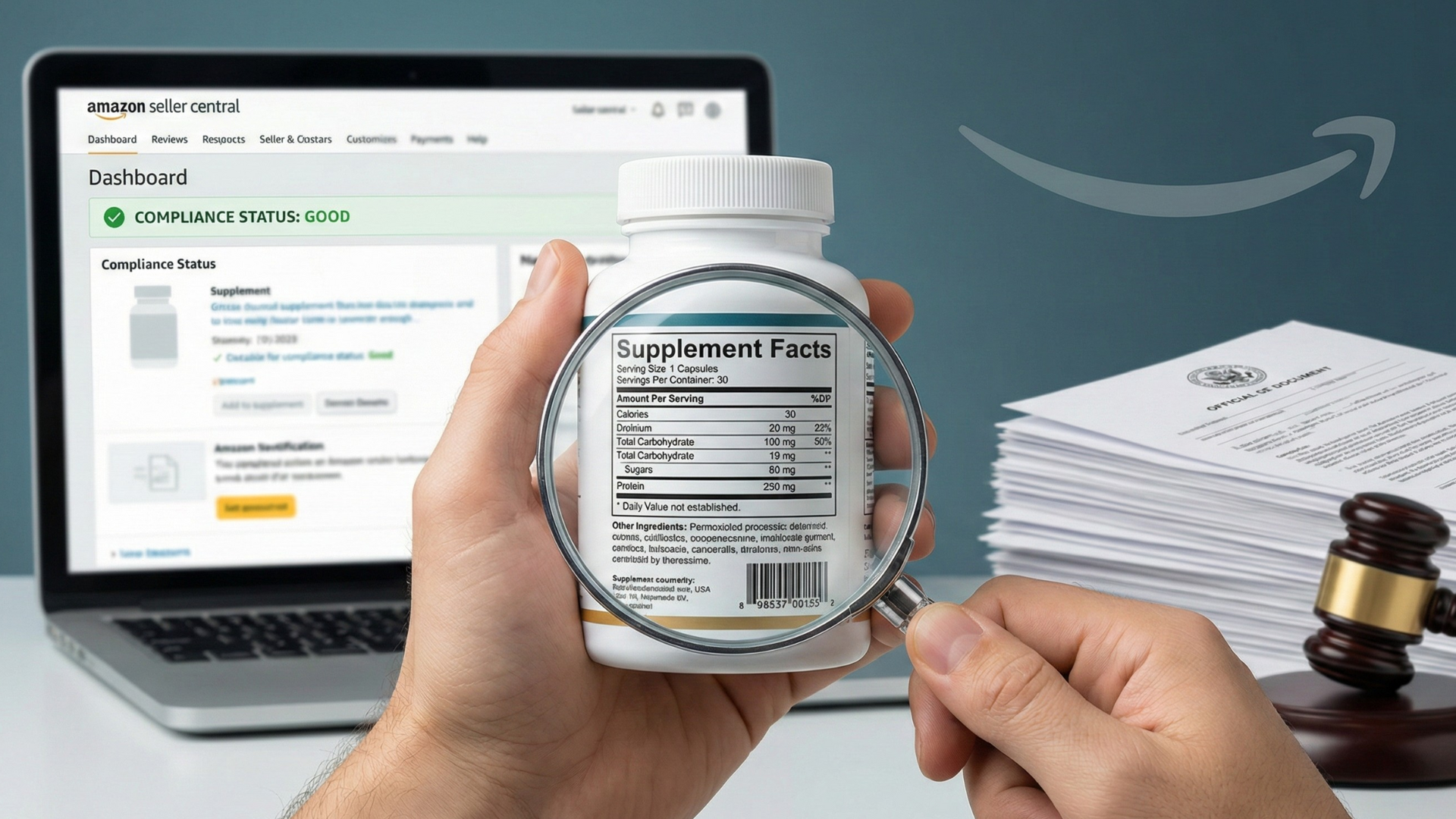
- 1Define your structure/function claims before formulating — your claims decide your ingredient set and listing copy
- 2Meet two compliance layers: U.S. dietary supplement regulations and Amazon's stricter marketplace policies
- 3Start with a low MOQ small-batch run to test positioning before scaling inventory
- 4Keep COAs, batch records, and traceability documentation organized per ASIN and lot code from day one
- 5Choose ecommerce-ready packaging that survives FBA handling to prevent refunds and bad reviews
Introduction
Amazon can scale a supplement brand fast, but it can also shut down listings fast when compliance slips. Most founders don't fail because the product idea is bad. They fail because they guess on claims, skip documentation, or order too much inventory before the offer proves itself.
The good news: you can build an Amazon-ready supplement the right way without betting your budget on a massive first run. You need a compliant formula, compliant labels, a manufacturer that can document everything, and packaging that survives FBA handling.
This guide walks you through a practical, step-by-step process to launch with lower risk: start with small-batch testing, keep your claims tight, and set up your quality and paperwork from day one. You'll also learn the common reasons listings get suppressed and how to avoid them before you ship a single unit.
Peakfinity Advantage
If you want to move fast with less upfront inventory risk, a low MOQ, turnkey partner with GMP-certified and ISO-certified systems can make the difference between a smooth launch and weeks of delays. Learn about our Amazon FBA brand services →
Amazon Supplement Compliance Checklist (Top Matrix)
Use this matrix to assemble every document Amazon, the FDA, or a payment processor may request before, during, or after launch. Print it, share it with your manufacturer, and store the completed file per ASIN.
Amazon supplement compliance checklist — documents, owners, timing, purpose
| Document | Who Provides It | When You Need It | Purpose |
|---|---|---|---|
| GMP Certificate (current, third-party audited) | Manufacturer | Before signing the MSA / first PO | Proves the facility operates under an audited 21 CFR Part 111 quality system |
| FDA Facility Registration (FEI number) | Manufacturer | Before first FBA shipment | Confirms the production facility is on file with the FDA |
| Master Manufacturing Record (MMR) | Manufacturer (controlled internally) | Before first production run | Locks the recipe, in-process checks, and packaging spec for repeatability |
| Batch / Lot Production Record | Manufacturer | Per production lot | Full traceability of every raw material, weight, and operator for that batch |
| Certificate of Analysis (COA) per lot | Manufacturer (in-house or 3rd-party lab) | Before each FBA shipment ships | Identity, potency, micro, heavy metals tied to a specific lot/expiry |
| Allergen & cross-contact control statement | Manufacturer | Before label printing | Supports allergen call-outs and 'Contains' / 'May Contain' decisions |
| Finished label artwork (compliant Supplement Facts) | Brand (designed against MMR) | Before label printing | Must mirror the actual formula and meet 21 CFR Part 101 labeling rules |
| Banned-words / claim review document | Brand (with manufacturer / regulatory input) | Before listing goes live | Pre-approves title, bullets, A+, and image text against disease-claim rules |
| Tamper-evidence specification | Manufacturer | Before production | Confirms shrink band, induction seal, or other expected supplement seal |
| FNSKU / UPC plan | Brand (via Seller Central) | Before FBA shipment plan creation | Required for FBA receiving and proper inventory tracking |
| Product liability insurance certificate | Brand | Before first sale | Required by Amazon for many supplement categories (commonly $1M / $1M minimum) |
| Recall & traceability procedure | Manufacturer | Before first PO (kept on file) | Lot-coding and mock-recall capability for fast response to complaints |
| Retention samples | Manufacturer | Per production lot (held by manufacturer) | Lets you investigate complaints or test failures without guessing |
| Stability data (as applicable) | Manufacturer (or 3rd-party lab) | Before assigning shelf-life on label | Justifies the expiration date printed on every bottle |
Pro Tip
Pro tip: Peakfinity Labs ships rows 1–7 and 9–14 above as a single NDA-gated compliance pack per lot, so you only own the brand-side items (label artwork, banned-words doc, FNSKU plan, insurance). Request the pack via Start Project.
What Peakfinity provides vs. what Amazon & FDA require
Founders often ask, "Will my manufacturer handle this for me?" The honest answer: a serious contract manufacturer covers most of the production-side compliance, but the brand still owns claims, listing copy, insurance, and Seller Central setup. This table makes the split obvious.
Responsibility split: Peakfinity Labs vs. brand vs. Amazon / FDA
| Requirement Area | FDA / Amazon Expects | Peakfinity Labs Provides | Brand Still Owns |
|---|---|---|---|
| Facility quality system | 21 CFR Part 111 compliance, third-party GMP audit, FDA registration | GMP-certified, ISO-certified, WHO-GMP facility — see our credential register | Choosing a partner whose audit scope covers your dosage form |
| Formula & MMR | Documented Master Manufacturing Record per SKU | Custom or private-label MMR creation, version control, change management | Final formula approval and any reformulation requests |
| Testing & COAs | Identity, potency, micro, contaminants appropriate to ingredient & dosage form | Per-lot COA with methods, specs, and pass/fail disposition | Forwarding the COA into your Amazon compliance file by ASIN/lot |
| Label compliance | 21 CFR Part 101 Supplement Facts, allergens, net contents, manufacturer info | Label review against the MMR and panel-format check | Final claim language, brand design, marketing copy on the label |
| Claim discipline | Structure/function only — no disease claims (FDA + Amazon) | Flagging risky language we see on label / artwork drafts | Title, bullets, A+ content, images, social ads, influencer scripts |
| Packaging & tamper evidence | Industry-standard tamper-evident seal on supplements | Tamper bands, induction seals, FBA-durable bottles, master cartons | FNSKU labels and Seller Central shipment plan |
| Traceability & recall | Lot coding, batch records, recall procedure | Lot/exp coding, retention samples, written recall procedure | Customer complaint intake and Seller Central case management |
| Product liability insurance | Amazon requires for most supplement listings (commonly $1M/$1M) | Not provided — this is a brand obligation | Brand-name policy listing Amazon as additional insured |
| Listing & A+ content | Amazon enforces claim and image policies on the PDP | Reference banned-words list and compliant-claim examples | Writing, uploading, and maintaining the PDP / A+ modules |
| Ongoing change control | Notify of formula, supplier, or label changes that affect identity | Documented change-control workflow with brand sign-off required | Approving (or rejecting) changes before they affect a lot |
See our full Certifications & Quality Standards hub and the deeper GMP verification guide for the underlying audit trail.
Prerequisites (What You Need Before You Start)
Before you work on formulas or branding, set up the basics Amazon and regulators expect. This prevents rework and keeps your timeline predictable.
- A clear product concept (format, target customer, key ingredient story, expected price point).
- A compliance-first claim strategy (structure/function claims only, no disease claims).
- A manufacturer with documented quality systems (GMP-certified, and ideally ISO-certified processes).
- Label and listing ownership (you control the brand assets, copy, and documentation).
- Budget for testing and first production (plan for COAs, stability where needed, packaging samples).
- Amazon-ready packaging (durable, scannable, correct FNSKU/UPC plan, tamper evidence).
Compliance Basics: FDA Rules vs. Amazon Rules
To succeed on Amazon, you must meet two layers of requirements: U.S. dietary supplement regulations and Amazon's marketplace policies. Amazon may enforce stricter standards than the minimum legal baseline, especially around claims and restricted ingredients.
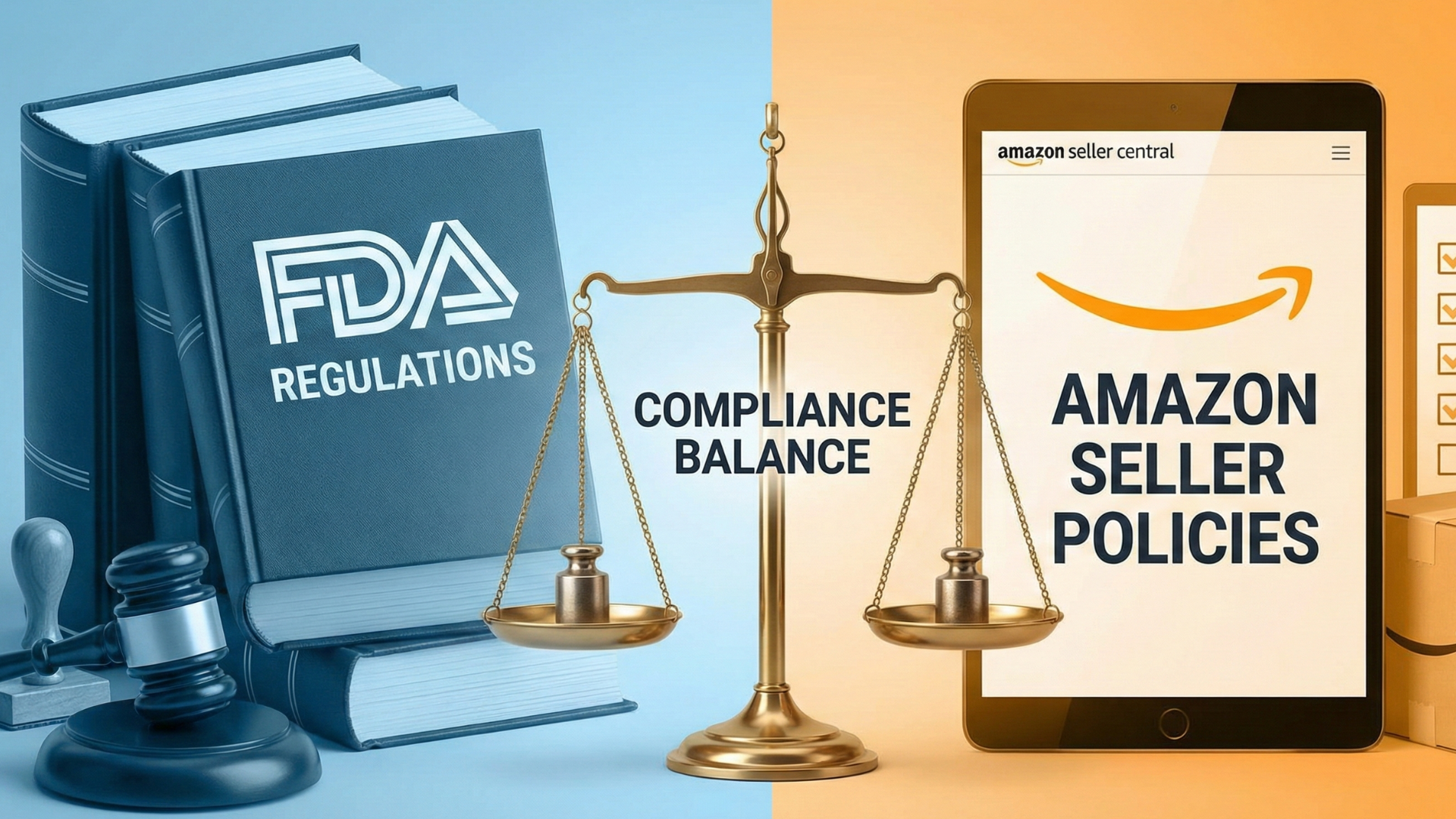
FDA vs. Amazon Compliance Requirements
| Area | What Regulators Expect (U.S.) | What Amazon Commonly Enforces | What You Should Prepare |
|---|---|---|---|
| Claims | Structure/function claims allowed with proper wording; no disease claims | Listing suppression if copy implies diagnosis, treatment, cure, prevention | Claim list review for label + bullets + A+ + images |
| Labeling | Supplement Facts, ingredient list, allergen disclosure, net contents, manufacturer info | Flags for missing info, misleading imagery, or inconsistent directions | Final label proof + compliance checklist + version control |
| Quality documentation | GMP records, identity testing, batch records, complaint handling | Requests for documentation during audits or complaints | COA per lot, traceability, expiration/lot coding plan |
| Restricted ingredients | Depends on ingredient status and safety; some ingredients are not allowed in supplements | Extra strict on stimulants, drug-like ingredients, and "gray area" compounds | Ingredient screen before formulation and before listing |
Step-by-Step: Create a Compliant Supplement Product for Amazon
Use this process to move fast while protecting your account, your cash flow, and your brand reputation.
1) Pick a Category That Is Easier to Keep Compliant
Start with products that support general wellness and have clear, defensible structure/function claims. Avoid "borderline" positioning that attracts compliance scrutiny.
- Lower-risk examples: basic vitamins/minerals, electrolytes, fiber, protein, creatine (with compliant claims).
- Higher-risk examples: sexual enhancement, extreme weight loss, strong stimulants, anything implying disease outcomes.
Pro Tip
If your marketing angle depends on medical-style outcomes, rewrite the concept now. It's faster than rewriting after your first suppression.
2) Define Your Claims Before You Formulate
Your claims decide your ingredient set, dosage, label wording, and listing copy. If you formulate first and write claims later, you often end up with a formula that forces risky language.
- Write 3–5 allowed structure/function claims (example: "supports energy metabolism," "supports immune function").
- List banned claim topics you will avoid (example: "treats arthritis," "lowers blood pressure," "cures anxiety").
- Align claims across all surfaces: label, Amazon title, bullets, description, A+ content, images, inserts.
Important
Amazon policy enforcement often scans images and A+ modules. A compliant label alone won't save a non-compliant infographic.
Compliant structure-function claim examples (use vs. avoid)
Structure-function claims describe how an ingredient supports the normal structure or function of the body. Disease claims describe diagnosis, treatment, cure, mitigation, or prevention of a disease — those are illegal on supplement labels in the U.S. and will get an Amazon listing suppressed. Use this side-by-side reference whenever you draft titles, bullets, A+ copy, or label panels.
Compliant vs. non-compliant supplement claim language by category
| Category | ✅ Compliant (use) | ❌ Non-Compliant (avoid) | Why |
|---|---|---|---|
| Sleep | "Supports healthy sleep cycles," "Helps you wind down before bed" | "Cures insomnia," "Treats sleep disorders" | Insomnia is a recognized disease — treatment language is a drug claim |
| Immune | "Supports immune function," "Helps maintain a healthy immune response" | "Prevents colds and flu," "Boosts immunity to fight COVID" | Prevention of a named disease is a drug claim |
| Joint | "Supports joint comfort and flexibility," "Helps maintain cartilage health" | "Treats arthritis," "Cures joint pain" | Arthritis is a disease; "treats / cures" are drug claims |
| Cardiovascular | "Supports healthy cholesterol levels already within the normal range," "Supports heart health" | "Lowers high blood pressure," "Prevents heart attacks" | Hypertension and heart attack are diseases — treatment / prevention is a drug claim |
| Weight | "Supports a healthy weight when paired with diet and exercise," "Helps you feel full longer" | "Burns fat," "Causes 30 lbs of weight loss in 30 days" | Specific outcome claims trigger Amazon's restricted-claim filters and FTC scrutiny |
| Cognitive | "Supports focus and mental clarity," "Supports memory function" | "Treats Alzheimer's," "Reverses cognitive decline" | Named disease + reversal language = drug claim |
| Energy | "Supports energy metabolism," "Helps fight occasional fatigue" | "Cures chronic fatigue syndrome," "Treats anemia" | Both are recognized diseases — treatment language is prohibited |
| Digestive | "Supports digestive health," "Helps maintain regularity" | "Treats IBS," "Cures acid reflux" | IBS and GERD are diseases — treatment claims are prohibited |
| Mood / Stress | "Helps you relax," "Supports a calm mood," "Helps manage occasional stress" | "Treats anxiety," "Cures depression" | Anxiety and depression are diagnosed conditions — drug claims |
| Hormonal | "Supports hormonal balance during menopause," "Supports a healthy menstrual cycle" | "Treats menopause," "Replaces hormone therapy" | Menopause is a life stage, but "treats" and "replaces hormone therapy" cross into drug territory |
Important
Watch the images and icons too. A compliant headline beside a stethoscope, heart-rate line, or "before / after" photo will still trigger Amazon suppression. Apply the avoid-list to every PDP image, A+ module, infographic, and inserted card — not just the text.
3) Choose a Manufacturing Model That Limits Inventory Risk
To avoid a huge upfront investment, you need small-batch production and a clear path to scale when the listing proves demand.
Manufacturing Model Comparison
| Model | Upfront Inventory Risk | Speed | Best For |
|---|---|---|---|
| Low MOQ custom formula | Low–medium | Fast if turnkey | Brand differentiation without over-ordering |
| Private label (stock formula) | Low | Fastest | Testing a niche or offer angle quickly |
| Large MOQ custom (traditional) | High | Slower | Established brands with proven velocity |
Peakfinity Labs supports low MOQ and small-batch runs so you can test positioning and creatives without tying up cash in months of inventory. When the offer hits, production can scale. Learn about private label vs. custom manufacturing →
4) Build a Compliant Formula (Ingredient Screen First)
Start with an ingredient screen to reduce the chance of reformulation later. This step matters because Amazon and payment processors can flag certain ingredients even if competitors sell them.
- Confirm ingredient status and intended use (supplement ingredient vs. drug-like ingredient risk).
- Check allergens and sensitivities (soy, dairy, gluten, shellfish).
- Choose forms that are stable and testable (for example, avoid hygroscopic blends without the right packaging).
- Document targets: active dosage per serving, servings per container, and excipient approach.
5) Set Quality Documentation Expectations
Amazon issues and customer complaints become much easier to resolve when you can produce documentation quickly.
- COA per batch for finished goods and, where relevant, key raw materials.
- Lot coding and expiration dating (clear placement, readable print, consistent format).
- GMP batch records and traceability from raw materials to finished units.
- Retention samples so you can investigate issues without guessing.
Work with a GMP-certified manufacturer and ask for a simple documentation pack you can store with your Amazon compliance files. See our certifications & quality standards →
6) Create an Amazon-Safe Label (and Keep It Consistent with the Listing)
Your label is both a regulatory document and an Amazon asset. It must be accurate, readable, and aligned with your listing copy.
- Required label elements: Supplement Facts, other ingredients, allergen statements, directions, warnings, net contents, manufacturer/packer/distributor info.
- Claim discipline: keep claims short and support-focused; avoid medical outcomes.
- Barcode plan: decide UPC vs. GTIN exemption; plan for Amazon FNSKU labels if using FBA.
- Tamper evidence: shrink band or seal (common expectation for supplements).
Important
"Before/after" images, symptom imagery, or medical iconography can trigger suppression even if the words look compliant.
7) Choose Ecommerce-Ready Packaging That Survives FBA
FBA is rough on packaging. Dented lids, broken seals, and smeared lot codes lead to refunds and bad reviews. Packaging choice is a compliance and profitability decision.
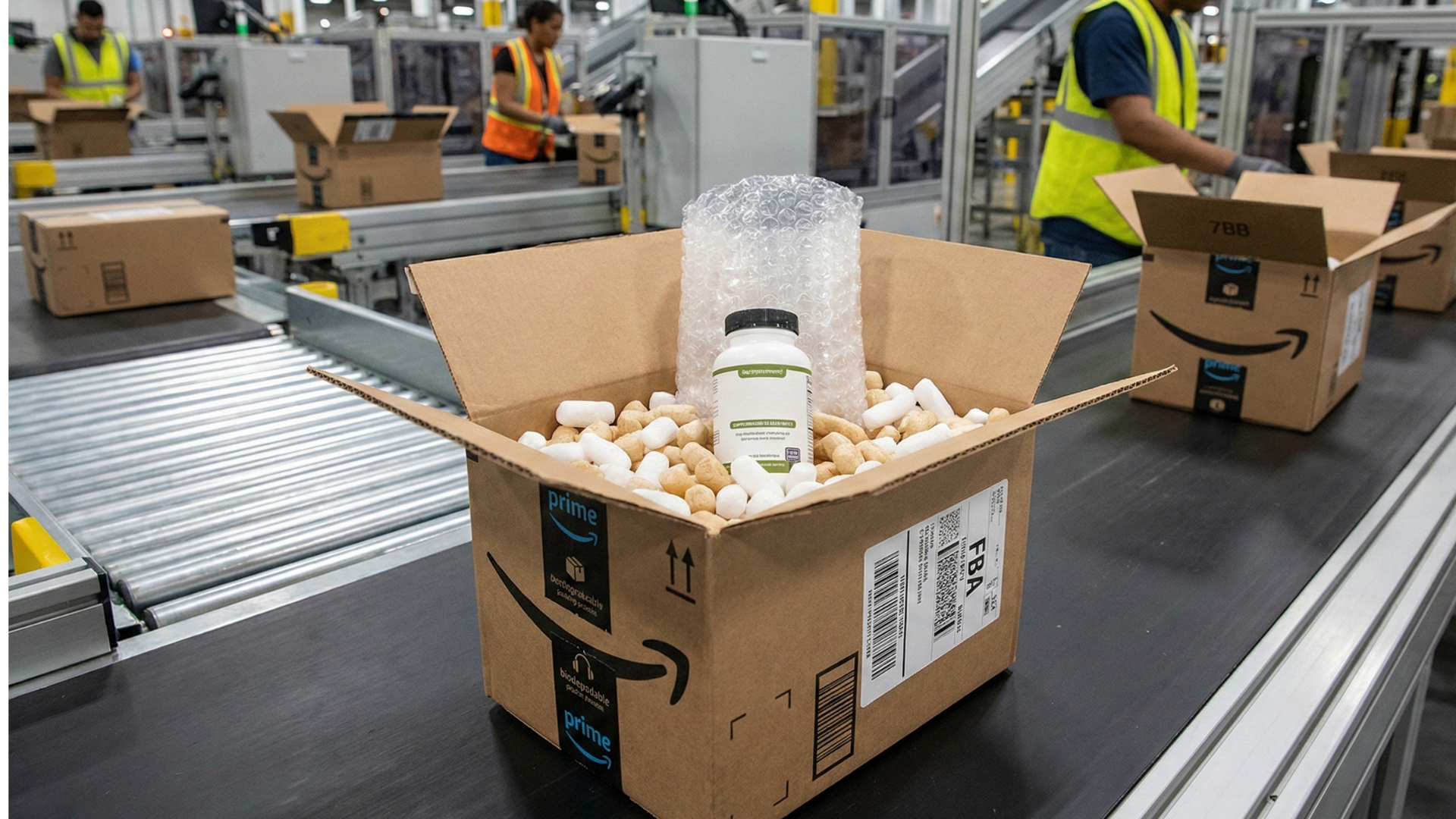
Packaging Format Comparison for FBA
| Format | Pros | Common Risks | Recommended Safeguards |
|---|---|---|---|
| Bottles (capsules/tablets) | Familiar, easy dosing, strong perceived value | Cracked lids, loose seals, label scuffing | Tamper band, scuff-resistant label stock, strong master cartons |
| Pouches (powders) | Lower shipping weight, modern look | Seal failures, powder leaks, zip damage | Quality heat seals, drop testing, moisture barrier film |
| Stick packs/sachets | Great for trial and bundles, easy compliance per serving | Higher unit complexity | Turnkey co-packing and clear lot coding per box |
Peakfinity Labs focuses on ecommerce-ready packaging so your product arrives in sellable condition and stays compliant through fulfillment. Learn about our 3PL & fulfillment services →
8) Plan a Low-Risk First Run (Small Batch + Clear Reorder Trigger)
To avoid over-ordering, you need a demand test plan, not a guess.
- Start with a low MOQ that covers your launch window (often 30–60 days of projected sales).
- Set a reorder trigger based on your lead time and sell-through (example: reorder when 40% of units remain).
- Keep your SKU count tight: one hero SKU first, then flavors/sizes after reviews stabilize.
Pro Tip
If you plan to run ads, ensure you can reorder before you scale spend. Ad success without inventory is a fast way to lose ranking.
9) Align Production Timeline with Amazon Launch Tasks
Founders often lose weeks because they wait for finished goods before building listing assets. Run tasks in parallel.
Production Timeline for Amazon Launch
| Phase | What You Do | Deliverables |
|---|---|---|
| Week 1 | Finalize formula direction and claims; start label draft | Claim list, draft Supplement Facts, packaging dieline |
| Week 2 | Approve label and packaging; start listing copy and images | Print-ready label, compliant bullets, image brief |
| Week 3–4 | Production + QC; prep FBA shipment plan | Finished goods, COA, lot/exp list, carton labels |
With a fast partner, you can often go from formulation to finished goods in 3–4 weeks, assuming quick approvals and in-stock components.
10) Create a Listing That Stays Compliant as You Scale
Build an "Amazon-safe" listing from day one. That means you write for clarity, not hype.
- Title: include brand, product type, key attribute, count/size. Avoid medical language.
- Bullets: focus on benefits that match structure/function claims and directions.
- Images: show Supplement Facts clearly; avoid banned claims in icons and callouts.
- A+ content: keep it consistent with the label and avoid condition-specific wording.
Important
Customer Q&A and reviews can create compliance problems. Monitor them and respond carefully without repeating disease claims.
Tips and Warnings (Read This Before You Spend Money)
- Don't copy competitor claims. Many listings remain up until they don't. Build yours to survive audits.
- Control your version history. Keep dated files for formula, label, and listing copy. This helps if Amazon asks what changed.
- Lock down your supply chain early. A fast timeline depends on component availability (bottles, scoops, films, flavors).
- Get confidentiality in writing. Use an NDA and clear terms on formula ownership and non-disclosure during transitions.
Troubleshooting: Common Amazon Compliance Problems (and Fixes)
Problem 1: Your listing gets suppressed for a "medical claim"
What happened: Amazon detected disease-related language in text or images (or a competitor reported you).
Fix: Remove condition terms from title, bullets, A+, backend keywords, and images. Keep support-focused wording only.
Prevention: Create a banned-words list (disease names, "treat," "cure," "diagnose," "prescription-strength") and run it before every update.
Problem 2: Amazon requests documentation (COA, GMP, ingredient proof)
What happened: A complaint, audit, or category check triggered a request.
Fix: Provide the COA for the specific lot, product label, and manufacturer information. Respond quickly and keep files organized.
Prevention: Ask your manufacturer for a standard compliance pack per batch and store it by ASIN and lot code.
Problem 3: Bad reviews mention broken seals or damaged units
What happened: Packaging didn't hold up to FBA handling or shipping conditions.
Fix: Upgrade tamper evidence, adjust packaging materials, and improve carton packing specs. Consider drop testing and scuff-resistant labels.
Prevention: Choose ecommerce-ready packaging and confirm lot/exp ink won't smear under friction.
Problem 4: Timeline slips and you miss your launch window
What happened: Approvals dragged, components went out of stock, or label revisions reset the clock.
Fix: Tighten your approval process (24–48 hour SLA), pre-approve alternates for components, and lock claims before design.
Prevention: Use a turnkey manufacturer that manages formulation, packaging, labeling, and compliance support in one workflow.
Frequently Asked Questions
How do I create a compliant supplement product for Amazon without a huge upfront investment?
Start with a low MOQ, small-batch run using a GMP-certified manufacturer, and build compliance into the formula, label, and listing before you order inventory. Choose an Amazon-safe claim set, confirm restricted-ingredient risk early, and order only enough units for a 30–60 day launch test. Set a reorder trigger based on lead time so you can scale once sales data proves demand.
What makes a supplement "compliant" on Amazon?
A compliant Amazon supplement avoids disease claims, uses accurate labeling (Supplement Facts and required statements), and has documentation to back up quality and traceability. Amazon also checks images and A+ content for risky language. Keep claims consistent across every surface, maintain COAs by lot, and use clear lot/expiration coding to support complaints or audits.
How fast can I launch a supplement on Amazon if I'm starting from scratch?
If you approve quickly and components are available, you can often go from formulation to finished goods in about 3–4 weeks with a fast, turnkey manufacturer. Build your listing, photos, and FBA shipment plan while production runs. The biggest delays usually come from label rewrites, ingredient changes, and packaging backorders.
What documents should I keep ready in case Amazon asks?
Keep the finished product COA by lot, your final label file, manufacturer details, and basic traceability records in an organized folder per ASIN. A GMP-certified, ISO-certified partner can provide consistent batch records, retention samples, and documentation packs that match your lot codes and expiration dates.
How do I protect my formula and brand when switching or starting with a new manufacturer?
Use an NDA, confirm formula ownership terms, and require controlled access to documents and version history. Keep your master formula, label claims list, and approved artwork in your own secure storage. Work with a manufacturer that has clear compliance workflows and professional change control so updates don't drift into risky claims or unapproved ingredient swaps.
Conclusion and Next Steps
You can launch a compliant supplement on Amazon without tying up a huge budget. The key is to lock claims early, choose an Amazon-safe formula, and work with a manufacturer that can deliver documentation, quality, and speed.
- Write your 3–5 structure/function claims and a banned-words list.
- Decide your format (capsule, powder, gummy) and packaging needs for FBA.
- Request a low MOQ plan and a compliance-first label review before printing.
- Build your listing assets in parallel with production to hit your launch date.
If you want a fast, turnkey path with low MOQ production, GMP-certified quality systems, and ecommerce-ready packaging, Peakfinity Labs can help you move from idea to finished goods in 3–4 weeks for many projects.
Related Articles

Fast-Turnaround Supplement Co-Packing for Amazon FBA and TikTok Launches
What actually controls co-packing lead time, the direct-to-FBA checklist, and the two-wave inventory plan for TikTok spikes.
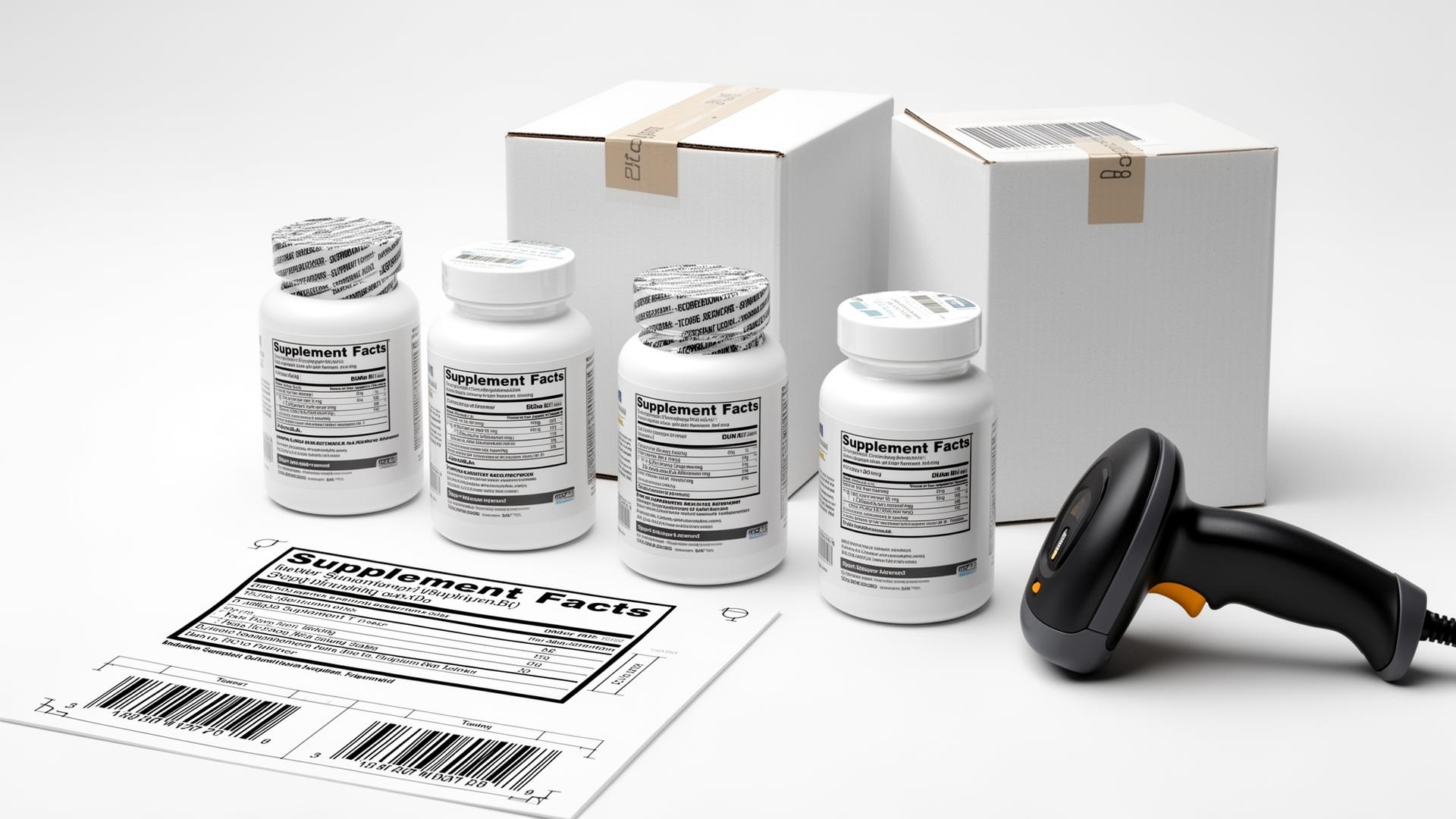
Amazon-Ready Supplement Packaging: Labels, Barcodes, Seals, and FBA Prep Explained
The pass-or-fail packaging system for FBA: compliant labels, FNSKU vs UPC strategy, seals that survive heat, and prep decisions made before the run.

Supplement Quality Documents for Amazon and Retail: COAs, Testing Records, and What to Keep on File
The lot-level release packet Amazon reviewers and retail buyers actually check, and how to keep it usable at scale.

Tushar
Licensed Pharmacist and COO @ Peakfinity Labs
Written by the Peakfinity Labs R&D Team — 46+ years of supplement formulation expertise. Our team of formulation chemists, manufacturing specialists, and regulatory experts has helped thousands of eCommerce brands bring their products to market successfully since 1980.