White Label Supplement Manufacturing: What It Is & How It Works
Compare 7 white label supplements and learn how to start a supplement brand fast — low MOQ options, GMP-certified US labs, and D2C-ready packaging.
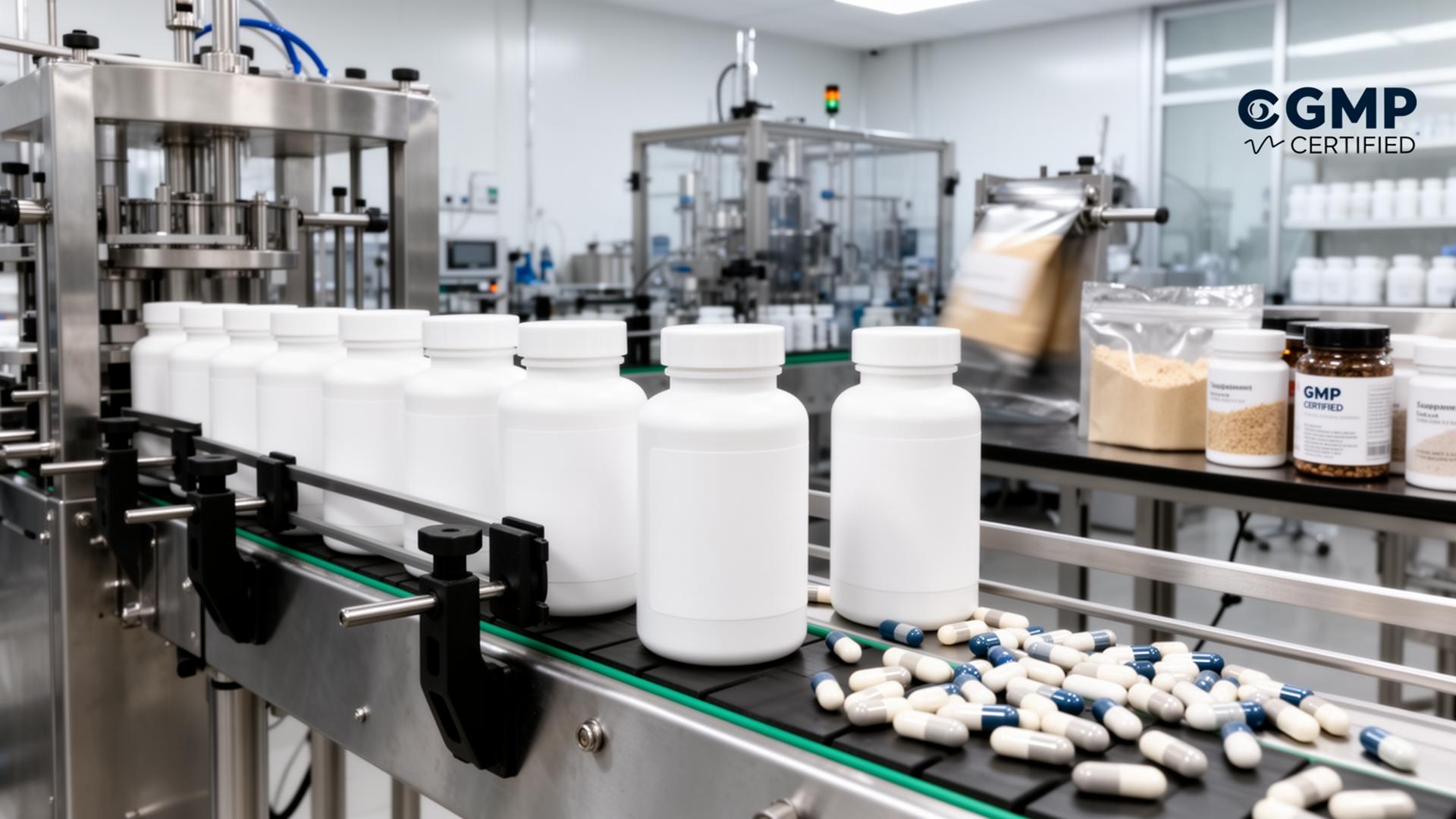
- 1White label lets you launch fast with a proven, production-ready formula under your own brand
- 2Start with one hero SKU and one upsell—validate CAC and reorder rate before scaling inventory
- 3Low MOQ plus fast turnaround beats 'no MOQ' claims that often hide compliance and traceability gaps
- 4Three comparison tables break down white label vs private label vs custom, cost buckets, and pros/cons
- 5Transition to custom formulation only after you prove demand, retention, and can forecast volume
Introduction
White label supplement manufacturing is the fastest way to launch a supplement brand without spending months (and a lot of cash) on R&D. You start with a pre-made, proven formula that a GMP & ISO certified manufacturer already produces. Then you brand it as your own and sell it through your D2C store, Amazon, retail, or wholesale.
That speed matters because the supplement market rewards timing. A trend can spike on TikTok, a creator can drive demand overnight, or a competitor can raise prices and leave a gap. White label lets you move while the window is open.
The catch is that "white label" gets used loosely. Some suppliers mean drop shipping from overseas. Others mean a US-based, compliant manufacturer that can do D2C ready packaging and consistent lot-to-lot quality. This guide breaks down how white label supplement manufacturing actually works, what it costs, where brands get burned, and how to transition from white label to custom formulation without disrupting lead times.
What is white label supplement manufacturing?
White label supplement manufacturing means you sell a supplement made from an existing, standardized formula that the manufacturer already produces, but it ships under your brand name, label, and packaging.
You are not "inventing" the formula. You are choosing from a menu of ready-to-produce options (for example: a collagen capsule, a greens powder, or a sleep gummy) and applying your branding.
- Fast turnaround: you avoid long formulation and stability steps because the base formula is already production-ready.
- Lower risk: you can test demand with a low MOQ before ordering deeper inventory.
- Operational simplicity: you focus on positioning, creative, and distribution while your manufacturing partner runs compliant production.
How white label supplement manufacturing works (step-by-step)
Most brands think the process is "pick a product, slap on a label." In reality, good white label manufacturing is a controlled process that protects quality and keeps you compliant.
1) Choose a base product that fits your channel
Pick a formula and format that matches your audience and your fulfillment reality.
- Capsules: simplest to ship, stable, usually the fastest path to market.
- Powders: strong margins and branding space, but higher flavor and clumping risk.
- Gummies: high conversion in D2C, but more complex manufacturing and often higher MOQs.
- Liquids: great for certain niches, but heavier shipping and more stability constraints.
Peakfinity Labs perspective
2) Confirm the specs you'll sell (and what you can claim)
A white label product still needs a clean commercial spec sheet. You should confirm:
- Supplement Facts panel (actives, serving size, servings per container)
- Allergens and dietary positioning (e.g., vegan, gluten-free) only if verified
- Ingredient sourcing constraints (e.g., "no artificial colors") if you plan to market that
- Label claim boundaries (structure/function claims vs. disease claims)
In the US, supplement labeling falls under FDA and DSHEA rules, and claims have strict lines. Use official FDA guidance when you write your label and ads: FDA dietary supplement information.
3) Choose packaging that's actually D2C ready
Packaging is not cosmetic. It drives breakage rate, returns, and your first impression on unboxing videos.
- Bottles: best for capsules/tablets; add induction seals for tamper evidence.
- Pouches: strong for powders; pick barrier films to reduce moisture issues.
- Sachets/stick packs: premium feel for daily use, but more moving parts and higher unit costs.
Ask your manufacturer what they consider "D2C ready packaging." For us, that usually means tamper evidence, scuff-resistant labels, lot/expiry coding that won't rub off, and pack-out that survives parcel shipping.
4) Approve label artwork and compliance checks
Your manufacturer should support label review for basics like panel layout, net contents, required statements, and scannable barcode placement. This is where hidden costs pop up if you skip it and have to reprint thousands of labels later.
If you plan to sell on Amazon, also confirm that your label and listings won't trigger restricted claim enforcement. "Helps support sleep" is not the same as "treats insomnia."
5) Place the order (MOQ, lead time, and deposit terms)
This is where white label shines. A strong program offers low MOQ for test runs and a fast turnaround so you can launch quickly.
At Peakfinity Labs, many brands come to us because they want a 3–4 week turnaround from order to production and the ability to scale without switching processes midstream.
6) Production, QC, and lot coding
In a GMP & ISO certified facility, production should include documented batch records, in-process checks, and finished product QC. Your finished units should be lot-coded and date-coded so you can trace product through the supply chain.
If a manufacturer can't clearly explain their lot traceability, that's a red flag.
7) Fulfillment handoff: ship to your 3PL, Amazon, or warehouse
Decide upfront where inventory goes. A good manufacturer can coordinate delivery windows and pallet configuration to reduce 3PL receiving headaches and fees.
White label vs private label vs custom formulation (clear differences)
These terms get mixed up, so here's the practical breakdown that matters for your launch plan.
| Model | What you're buying | Best for | Main tradeoff |
|---|---|---|---|
| White label | Existing formula + your branding | Fast launch, low-risk testing, trend response | Less differentiation at the formula level |
| Private label | Often a semi-custom formula (tweaks) + your branding | Brands that want some uniqueness without full R&D | Still limited if you need a truly novel spec |
| Custom formulation | A formula built to your spec from scratch | Long-term brand moat, unique dose/ingredients | More time, more cost, more complexity |
Verdict: If you're pre-product-market fit, start white label. If you already have repeat buyers and clear differentiation, move to custom formulation. Most fast-growing D2C brands do both in sequence. (If you want a deeper breakdown, see private label vs custom manufacturing.)
Can you use white label to test the market before custom manufacturing?
Yes, and it's one of the smartest ways to reduce risk. The key is to test the offer, not just the ingredient list.
- Test your price point and subscription conversion
- Test creative angles and hooks (what actually drives CPA down)
- Test retention: do customers reorder at 30–45 days?
Contrarian take from our launch data
How do you start a supplement brand using white label products? (Where to start)
If you want a clean, fast path, follow this sequence. It avoids common mistakes like buying too much inventory or picking a format that slows you down.
Step 1: Pick one hero SKU and one upsell
One hero product keeps your ad messaging focused. Add one upsell SKU that fits the same buyer intent.
- Hero: Sleep, stress, gut, energy, hydration, beauty-from-within
- Upsell: magnesium add-on, collagen add-on, probiotic add-on (depending on your hero)
Step 2: Decide your MOQ based on your traffic plan
Match inventory to your realistic sales forecast for 30–45 days. If you can't confidently move 500–1,000 units in that window, a lower MOQ reduces your risk.
Step 3: Build packaging that sells in a thumbnail
Your front label should communicate three things in under two seconds: who it's for, the primary benefit (compliant), and the format.
- Use high-contrast type and limit the front panel to the essentials
- Don't bury serving count and dosage details
- Make sure the label looks good under phone camera compression
Step 4: Set up your compliance basics early
Have a process for label review, claim review, and customer support language. If you plan to scale paid ads, your compliance system must scale with it.
Step 5: Launch with a reorder plan
White label works best when you treat it like a supply chain, not a one-time order. Ask your manufacturer how reorders work, what lead times look like in peak season, and how they handle rapid scale.
What manufacturer offers white label supplements with no minimum order?
Most compliant supplement manufacturing does not offer true "no minimum" production because facilities run validated batch sizes, QC testing, and packaging line setups. When you see "no MOQ," it often means one of these:
- Reselling inventory: you're buying someone else's overstock.
- Drop shipping: product ships from a third party you don't control.
- Non-standard compliance: unclear GMP controls or missing traceability.
Practical recommendation: instead of chasing "no MOQ," look for low MOQ plus predictable reorders and documented QC. That gives you a real path to scale without switching manufacturers right when you start winning. (Related: how to launch a supplement without buying 10,000 units.)
Can you dropship supplements with your own branding and labels?
Sometimes, but you need to separate logistics from manufacturing responsibility. Even if a supplier ships direct to customers, you still own brand risk: complaints, returns, and compliance issues show up under your name.
If you want the speed of drop shipping, ask tough questions:
- Where is the product made (country, facility certifications)?
- Do you get lot numbers and expiry dates for each shipment?
- How do they handle recalls or adverse event reports?
- Can you keep packaging consistent as volume grows?
For most serious D2C brands, shipping bulk inventory to a 3PL gives better control over customer experience, inserts, and subscription bundles.
How much does it cost to start a white label supplement brand?
Costs vary by format, packaging, and MOQ. Your real budget has three buckets: product, packaging/labels, and launch operations (creative + site + traffic).
| Cost bucket | What's included | Typical range (starter) | What drives the number |
|---|---|---|---|
| Manufacturing run | Formula, blending, encapsulation/tableting, filling | $3,000–$15,000 | MOQ, dose size, ingredient costs, format |
| Packaging & labels | Bottles/pouches, lids, seals, printed labels | $800–$5,000 | Custom printing, finishes, tamper evidence |
| Testing & QC | Finished product testing, documentation | $250–$2,000 | Panel scope, lot count, third-party testing |
| Brand & launch | Design, Shopify/Amazon setup, creative, initial ads | $1,500–$20,000+ | Content quality, traffic goals, agency vs in-house |
Reality check
What are the best white label supplement products to sell online?
The "best" products are the ones that match buyer intent, have repeat purchase behavior, and fit your channel economics. In D2C, that usually means products people take daily and feel quickly (without making risky claims).
- Sleep support (high demand, strong subscription behavior)
- Stress/mood support (broad audience, story-driven marketing)
- Hydration/electrolytes (high frequency, creator-friendly)
- Beauty-from-within like collagen (strong demographic targeting)
- Gut support (high LTV potential, but messaging must stay compliant)
What we see work right now: brands that package a simple daily habit with a clear routine (AM/PM) tend to scale faster than brands that sell "random single bottles." Your offer architecture matters as much as the formula. If you want examples of proven "beauty-from-within" SKUs, see our multi collagen peptides powder options.
How to find a reliable white label supplement manufacturer in the USA
Reliability is not a vibe. It's documented systems plus predictable execution.
- Verify GMP & ISO certified operations: ask what standards they follow and what audits they complete.
- Ask about lead time in writing: not best-case, but typical and worst-case.
- Check supply continuity: do they have backup suppliers for key ingredients and packaging?
- Understand hidden costs: plate fees, label revisions, setup charges, storage, rush fees.
- Review QC documentation: lot coding, COAs, traceability, and complaint handling.
Speed with control is the goal: a fast turnaround means nothing if your next reorder slips, your labels change shade, or your capsule fill weights drift. Consistency is what protects your reviews and refund rate. For more on what "D2C ready" really means in the real world, read supplement packaging and label design.
Pros and cons of white label vs custom formulated supplements
White label and custom formulation are both valid. The best choice depends on your stage.
| Category | White label | Custom formulation |
|---|---|---|
| Speed to launch | Fast (often weeks) | Slower (often months) |
| Upfront cost | Lower, especially with low MOQ | Higher (R&D + testing + longer run planning) |
| Differentiation | Mostly branding, offer, channel execution | Formula-level moat possible |
| Risk | Lower technical risk | Higher technical and timeline risk |
| Best time to use | Validation and early scaling | After you prove demand and retention |
Recommendation: start white label to prove the funnel and retention, then move to custom formulation once you can forecast volume and you know exactly what improvement will increase conversion or LTV.
How to transition from white label to custom manufacturing (without disrupting lead times)
Brands get anxious here for good reason. A transition can cause stockouts, inconsistent product, or surprise costs if it's not planned.
Plan a dual-inventory runway
Keep your white label SKU live while you develop the custom version. Aim for an 8–12 week runway of inventory coverage so you don't rush decisions.
Lock your "non-negotiables" before R&D
Decide what must stay consistent for customer trust.
- Format (capsule vs gummy)
- Serving size and servings per container
- Key sensory cues (smell, taste, texture) if relevant
Upgrade one variable at a time
If you change dose, format, flavor, and packaging all at once, you can't diagnose what helped or hurt conversion and reviews. Keep the offer stable and improve the formula strategically.
Communicate the change in a controlled way
If the supplement facts panel changes, update your site, PDP images, and customer support macros before the first custom lot ships. Consistency prevents chargebacks and "bait and switch" reviews.
Negotiate testing and documentation upfront
Ask your manufacturing partner what testing comes standard and what adds cost. Get clarity on COAs, micro testing, heavy metals panels where relevant, and how they handle any out-of-spec result.
Frequently Asked Questions
What is white label supplement manufacturing and how does it work?
This matters because it determines how fast you can launch and how much product development risk you take on. White label supplement manufacturing is when a GMP-compliant manufacturer produces an existing, ready-to-sell supplement formula and packages it under your brand's label and design. The typical flow is choose a base SKU, approve compliant label artwork, order at a low MOQ, then receive finished, lot-coded units you can send to a 3PL or Amazon.
What's the difference between white label and private label supplements?
The difference matters because it affects how unique your product can be and how long it takes to go live. White label supplements use a standard formula that multiple brands can sell with different branding, while private label often allows light customization like adjusting a dose, adding a flavor, or changing excipients. If you need true formula-level differentiation, you usually move from white label/private label into full custom formulation.
How do I start a supplement brand using white label products?
Starting the right way matters because most early losses come from over-ordering inventory or choosing a complex format too soon. The simplest path is to pick one hero SKU, build compliant D2C ready packaging and a clear offer, then order a low MOQ run to validate CAC, conversion, and reorder rate before scaling. Once you can forecast demand, you can add complementary SKUs or shift to custom formulation without risking stockouts.
Can I dropship supplements with my own branding and labels?
This matters because "dropship" can hide quality and traceability risks that show up as refunds and compliance issues under your brand name. You can dropship supplements with your branding if the supplier can apply your labels, provide lot numbers and expiry dates per shipment, and show documented QC and complaint handling. A practical next step is to request a recent COA and a traceability example (lot-to-raw-material) before you commit.
How much does it cost to start a white label supplement brand?
Cost clarity matters because many new brands budget for product but forget packaging, testing, and launch spend. A typical starter white label launch often falls between roughly $5,000 and $25,000 depending on MOQ, format, packaging choices, and how aggressively you plan to drive traffic. The most controllable cost variable is inventory risk, so a low MOQ and a predictable 3–4 week turnaround helps you start smaller and reorder based on real sales.
Can you use white label to test the market before custom manufacturing?
Yes. White label is a smart way to test the offer—price, subscription conversion, creative angles, and retention—without heavy R&D. Focus on validating positioning and distribution in the first 60–90 days, then consider custom formulation once metrics are proven.
What manufacturer offers white label supplements with no minimum order?
Most compliant manufacturers do not offer true "no minimum" because facilities run validated batch sizes and QC. "No MOQ" claims often mean resold overstock, dropshipping, or unclear compliance. Instead, seek low MOQ plus predictable reorders and documented QC.
What are the best white label supplement products to sell online?
The best products match buyer intent, encourage repeat purchases, and fit channel economics. Common high-performing D2C SKUs include sleep support, stress/mood support, hydration/electrolytes, beauty-from-within (collagen), and gut support, provided messaging stays compliant.
Conclusion: Launch fast, stay compliant, and keep your cash flexible
White label supplement manufacturing is a pragmatic way to launch quickly, stay compliant, and test demand without betting big on inventory. You get speed, lower MOQs, and a clearer path to rapid scale when the product hits.
Your next steps are simple:
- Pick one hero SKU that fits your channel and fulfillment plan
- Confirm Supplement Facts, compliant claims, and D2C ready packaging details
- Order a low MOQ test run and plan your reorder before you launch ads
- Once retention is proven, map a controlled transition to custom formulation
If you want a manufacturing partner built for fast turnaround, low MOQ launches, and GMP & ISO certified production that can scale with eCommerce demand, Peakfinity Labs supplement manufacturing is set up for that workflow.

Tushar
Licensed Pharmacist and COO @ Peakfinity Labs
Written by the Peakfinity Labs R&D Team — 46+ years of supplement formulation expertise. Our team of formulation chemists, manufacturing specialists, and regulatory experts has helped thousands of eCommerce brands bring their products to market successfully since 1980.
Related Articles
Private Label Supplement Markup: Typical Margins for DTC, Amazon, and Wholesale
Typical markup ranges for DTC, Amazon, and wholesale, plus the landed-cost model that decides whether your margin is real.

How to Compare Quotes From Supplement Manufacturers Without Missing Hidden Costs
A six-bucket framework and paste-ready RFQ table that surfaces hidden costs before you sign with a manufacturer.
When Is a Supplement Brand Ready to Move From Private Label to Custom?
Nine readiness signals, the custom-light middle path, and a seven-step switch plan that avoids stockouts and claim issues.