Supplement Manufacturing Costs: Complete 2026 Breakdown
Transparent cost analysis for every stage of supplement manufacturing — raw materials, production, packaging, testing, and the hidden fees most brands don't budget for.
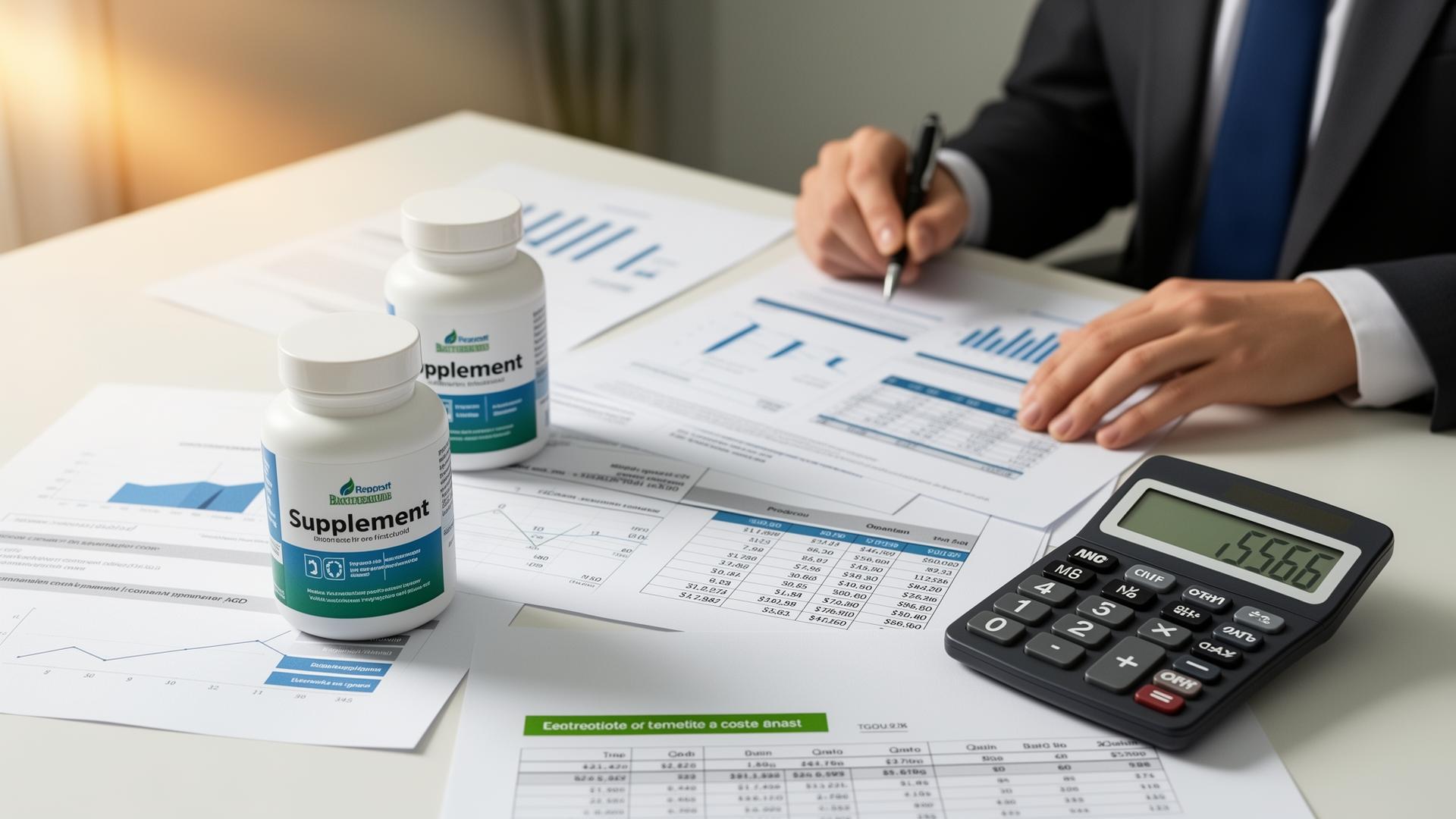
- 1Total cost to manufacture a supplement ranges from $3 to $15+ per unit depending on format, ingredients, and MOQ
- 2Raw materials typically represent 30–50% of total COGS; packaging is 15–25%; manufacturing labor is 20–30%
- 3Hidden costs like plate fees, label revisions, storage, and rush charges can add 10–20% to your budget
- 4Format significantly impacts cost: capsules are cheapest to produce; gummies and softgels cost more per unit
- 5The single biggest cost lever is MOQ — doubling your order quantity typically reduces per-unit cost by 15–25%
Introduction
"How much does it cost to manufacture a supplement?" is the first question every new brand founder asks — whether they're launching on Amazon FBA, Shopify, or TikTok Shop. "It depends" is technically true but practically useless when you're trying to build a business plan.
This guide gives you concrete numbers. We break down every cost component in supplement manufacturing — from raw materials and labor to packaging, testing, and hidden fees. You'll get cost ranges by format (capsules, tablets, softgels, gummies, powders), understand what drives costs up or down, and learn how to price for healthy margins.
All numbers reflect 2026 US manufacturing costs from GMP-certified facilities. For overseas comparisons, see our India vs China manufacturing guide.
Total cost overview: what you're actually paying for
Your total cost of goods sold (COGS) for a supplement has five main components. Understanding the proportion of each helps you identify where you have the most leverage to reduce costs.
| Cost component | % of total COGS | Typical range per unit | What it covers |
|---|---|---|---|
| Raw materials | 30–50% | $0.80–$6.00+ | Active ingredients, excipients, flow agents, flavors |
| Manufacturing labor | 20–30% | $0.50–$3.00 | Blending, encapsulation/tableting, line setup, cleaning |
| Packaging | 15–25% | $0.40–$2.50 | Bottles, caps, labels, seals, cartons, shrink bands |
| Testing & QC | 5–10% | $0.10–$0.80 | Identity, potency, micro, metals, COA generation |
| Overhead & margin | 10–15% | $0.30–$1.50 | Facility costs, equipment, compliance, manufacturer margin |
Key insight: at low MOQs (2,000 units), fixed costs like line setup and testing get spread across fewer units, increasing per-unit cost. As volume grows, per-unit cost drops significantly because these fixed costs become a smaller proportion of total COGS.
Raw material costs: what drives ingredient pricing
Raw materials are usually the largest single cost component. Here's what drives ingredient pricing up or down:
| Factor | Lower cost | Higher cost | Example |
|---|---|---|---|
| Ingredient type | Basic vitamins, minerals | Branded ingredients, premium extracts | Vitamin C ($5/kg) vs CoQ10 ($150/kg) |
| Sourcing | Conventional, commodity | Organic, non-GMO verified, USP grade | Conventional turmeric vs organic KSM-66 ashwagandha |
| Dose per serving | Low dose (50–200mg) | High dose (500mg–2g+) | 50mg vitamin C vs 2g collagen peptides |
| Number of actives | 1–3 ingredient formula | 8–15 ingredient complex | Single-herb capsule vs comprehensive multi |
| Branded/patented | Generic ingredients | Branded (Sabinsa, Kyowa, etc.) | Generic B12 vs MecobalActive B12 |
Cost optimization tip
Manufacturing and labor costs
Manufacturing costs include everything that happens on the production floor: blending, encapsulation or tableting, filling, and in-process quality checks. These costs are driven by:
- Line setup and changeover: every production run requires cleaning, sanitizing, and calibrating equipment. This fixed cost is typically $500–$2,000 per run and gets spread across all units in the batch.
- Format complexity: capsule filling is faster and simpler than softgel encapsulation or gummy molding, resulting in lower per-unit labor costs.
- Batch size: larger batches run more efficiently because setup costs are amortized over more units and the production line hits steady-state throughput faster.
- Special handling: ingredients that require controlled temperature, humidity, or inert atmosphere processing add to manufacturing costs (common with probiotics and certain botanicals).
US vs overseas manufacturing labor: US labor costs are higher, but US manufacturing offers faster turnaround (4–6 weeks vs 10–16 weeks), easier communication, simpler logistics, and stronger regulatory compliance. For most D2C and Amazon brands, the speed and compliance advantages of US manufacturing outweigh the labor cost difference. For more on this comparison, see India vs China supplement manufacturing.
Packaging costs: bottles, labels, and finishing
Packaging is where many new brands underestimate costs. Your packaging includes the primary container (bottle, pouch, or box), closure (cap, lid), tamper evidence (induction seal, shrink band), label, and any secondary packaging (carton, mailer box).
| Component | Cost range per unit | Key variables |
|---|---|---|
| HDPE bottle (120–300cc) | $0.15–$0.50 | Size, color, custom mold vs stock |
| Cap/closure | $0.05–$0.20 | Child-resistant, flip-top, standard screw |
| Induction seal | $0.02–$0.05 | Standard safety feature |
| Printed label | $0.10–$0.60 | Size, colors, finish (matte, gloss, spot UV) |
| Shrink band | $0.03–$0.08 | Additional tamper evidence |
| Pouch (for powders) | $0.25–$0.80 | Barrier film, zipper, size, custom print |
| Carton/box | $0.20–$0.75 | Custom print, size, insert |
Practical tip: for your first run, use stock bottles with custom printed labels rather than custom-molded bottles. Custom molds cost $3,000–$10,000+ and only make sense at scale (10,000+ units per run). Stock bottles with premium labels can look just as professional. For more packaging strategies, read supplement packaging and label design.
Testing and quality control costs
Testing is non-negotiable for GMP compliance and brand protection. Here's what testing typically costs:
| Test type | Cost per lot | Required or optional | What it covers |
|---|---|---|---|
| Identity testing | $50–$200 | Required (GMP) | Confirms each ingredient is what it claims to be |
| Potency/assay | $100–$500 | Required for label claims | Verifies active ingredient amounts match label |
| Microbial screening | $75–$250 | Required (GMP) | Total plate count, yeast, mold, pathogens |
| Heavy metals panel | $100–$400 | Required for many ingredients | Lead, arsenic, cadmium, mercury |
| Allergen testing | $75–$200 | Required if allergen-free claims | Gluten, soy, dairy, etc. |
| Stability testing | $500–$3,000 | Recommended for custom formulas | Accelerated and real-time shelf life data |
Total testing cost per lot typically runs $300–$1,500. At a 2,000-unit MOQ, that adds $0.12–$0.60 per unit. Testing costs per unit decrease significantly at higher volumes. Your manufacturer should be transparent about which tests are included in the manufacturing quote and which are additional.
Cost comparison by supplement format
Format is one of the biggest cost drivers. Here's a side-by-side comparison at a 2,000-unit MOQ:
| Format | Per-unit COGS range | Setup complexity | Speed to market | Margin potential |
|---|---|---|---|---|
| Capsules (2-piece) | $2.50–$5.00 | Low | Fastest (3–4 weeks) | Strong (4–6x markup typical) |
| Tablets | $2.00–$4.50 | Medium | Fast (4–5 weeks) | Strong (lowest COGS) |
| Softgels | $4.00–$8.00 | Medium-High | Medium (5–7 weeks) | Good (premium pricing supports cost) |
| Gummies | $5.00–$12.00 | High | Slower (6–8 weeks) | Moderate (higher COGS, but high conversion) |
| Powders (tub) | $4.00–$9.00 | Medium | Medium (4–6 weeks) | Good (high perceived value) |
| Stick packs | $5.00–$10.00 | Medium-High | Medium (5–7 weeks) | Good (premium single-serve pricing) |
| Liquids | $5.00–$12.00 | High | Slower (6–8 weeks) | Moderate (heavier shipping costs) |
Our recommendation: if cost efficiency is a priority (and it should be for new brands), start with capsules or tablets. They have the lowest per-unit costs, fastest turnaround, and simplest QC. Graduate to more complex formats once you've proven demand. See our formats guide for a detailed comparison.
How to reduce supplement manufacturing costs
Here are the most effective levers for reducing your per-unit cost without sacrificing quality:
1) Increase MOQ strategically
This is the single biggest cost lever. Going from 2,500 to 5,000 units typically saves 15–25% per unit. Only increase MOQ after you've validated demand — otherwise you're just buying more inventory you might not sell.
2) Simplify your formula
Fewer ingredients means less sourcing complexity, faster blending, and lower raw material costs. A focused 3–5 ingredient formula often outperforms a 15-ingredient complex both in manufacturing cost and consumer perception.
3) Choose cost-efficient formats
Capsules and tablets are significantly cheaper to produce than gummies, softgels, or liquids. If your formula works in capsule form, start there and save complex formats for line extensions.
4) Use stock packaging components
Stock bottles, caps, and standard pouch sizes cost significantly less than custom-molded containers. Invest in premium labels — that's where consumers notice quality — while using stock containers.
5) Plan reorders to avoid rush charges
Rush charges (15–30% premium) are entirely avoidable with good inventory planning. Monitor your sell-through rate and place reorders with enough lead time (typically 4–6 weeks) to avoid emergency production requests.
6) Negotiate ingredient sourcing
Your manufacturer may be able to suggest equivalent-quality alternatives to expensive branded ingredients. Ask about generic versions of patented ingredients and whether bulk buying across their client base gives you better pricing.
How to price your supplement for healthy margins
Pricing isn't just "cost plus markup." Your pricing strategy should account for channel economics, competitive positioning, and customer acquisition costs.
| Channel | Typical markup on COGS | Why | Example (at $5 COGS) |
|---|---|---|---|
| D2C (Shopify) | 4–6x | Covers ad spend, fulfillment, returns, LTV building | $25–$35 retail |
| Amazon FBA | 3–5x | Covers referral fees, FBA fees, PPC, competition | $20–$30 retail |
| Wholesale/retail | 2–3x | Retailer takes 40–50% margin | $12–$18 wholesale |
| Subscription D2C | 3–5x (but higher LTV) | Lower initial price offset by recurring revenue | $20–$28/month |
Key principle: your price needs to support profitable customer acquisition. If your COGS is $5, your retail is $30, and your CAC is $20, you have $5 left for fulfillment, returns, and profit. That's tight. Either reduce CAC through better creative and organic content, increase AOV through bundles and upsells, or improve LTV through subscriptions.
Subscription economics
Frequently Asked Questions
How much does it cost to manufacture supplements?
The total cost to manufacture a supplement typically ranges from $3 to $15+ per unit at the bottle level, depending on format, ingredients, MOQ, and packaging. A basic capsule product at 2,000 units might cost $3–$5 per bottle, while a complex softgel or gummy at similar quantities might run $6–$12 per bottle. Your all-in cost includes raw materials, manufacturing, packaging, testing, and any setup or tooling fees.
What is the minimum investment to start a supplement brand?
Most supplement brands can launch their first SKU for $5,000–$25,000 all-in, covering manufacturing, packaging, testing, and basic brand setup. The investment varies significantly based on format (capsules are cheapest), ingredient complexity (basic vitamins vs premium extracts), and MOQ. Starting with a low MOQ of 2,000 units keeps your initial investment manageable.
Why do supplement manufacturing costs vary so much between manufacturers?
Cost variation comes from facility overhead (a GMP-certified facility in the US costs more to run than one overseas), ingredient sourcing quality, testing rigor, packaging capabilities, and whether the quote includes hidden fees. A manufacturer quoting significantly below market may be cutting corners on testing, using lower-grade ingredients, or not including setup/tooling fees in the initial quote.
How does MOQ affect supplement manufacturing cost per unit?
MOQ has the single largest impact on per-unit cost. Manufacturing lines have fixed setup costs (cleaning, calibration, changeover) that are spread across more units at higher MOQs. Typically, doubling your order from 2,500 to 5,000 units reduces per-unit cost by 15–25%. Going from 5,000 to 10,000 may yield another 10–15% reduction.
What are the hidden costs in supplement manufacturing?
Common hidden costs include: plate fees for custom label printing ($200–$500), label revision charges ($50–$150 per round), storage fees if you don't pick up inventory promptly ($50–$200/month), rush charges for expedited production (15–30% premium), minimum testing panel requirements, and shipping/freight to your 3PL or FBA warehouse.
Is it cheaper to manufacture supplements overseas?
Raw material sourcing from overseas can reduce ingredient costs by 20–40%, but total landed cost often narrows the gap when you factor in shipping, customs, longer lead times, quality verification, and compliance risk. Many brands source ingredients globally but manufacture in the US for compliance confidence and faster turnaround. See our India vs China manufacturing comparison for more detail.
How do I price my supplement to maintain healthy margins?
A common target is 4–6x markup on COGS for D2C brands and 2–3x for wholesale/Amazon. If your all-in COGS is $5 per unit, retail pricing of $25–$35 is typical for D2C. Factor in advertising costs (often $5–$15 per acquisition), fulfillment, and returns when calculating true profitability. Subscription models improve unit economics significantly.
Conclusion: Know your numbers, control your margins
Understanding supplement manufacturing costs isn't optional — it's the foundation of a profitable brand. The brands that succeed aren't necessarily the ones with the cheapest manufacturing; they're the ones who understand their cost structure well enough to price confidently, scale strategically, and avoid the hidden fees that erode margins.
Start with the cost framework in this guide, get detailed quotes from GMP-certified manufacturers, and build your financial model before you place your first order. With clear cost visibility, you can make smarter decisions about MOQ, format, packaging, and pricing — and build a brand that's profitable from the first run.
If you want a transparent cost breakdown for your specific product, Peakfinity Labs provides detailed quotes with no hidden fees, covering all cost components discussed in this guide.

Tushar
Licensed Pharmacist and COO @ Peakfinity Labs
Written by the Peakfinity Labs R&D Team — 46+ years of supplement formulation expertise. Our team of formulation chemists, manufacturing specialists, and regulatory experts has helped thousands of eCommerce brands bring their products to market successfully since 1980.
Related Articles
Private Label Supplement Markup: Typical Margins for DTC, Amazon, and Wholesale
Typical markup ranges for DTC, Amazon, and wholesale, plus the landed-cost model that decides whether your margin is real.
How to Compare Quotes From Supplement Manufacturers Without Missing Hidden Costs
A six-bucket framework and paste-ready RFQ table that surfaces hidden costs before you sign with a manufacturer.
When Is a Supplement Brand Ready to Move From Private Label to Custom?
Nine readiness signals, the custom-light middle path, and a seven-step switch plan that avoids stockouts and claim issues.