What Makes a Good Contract Manufacturer for Small Ecommerce Brands
A good contract manufacturer doesn't just make the product. They help you hit launch dates, keep quality consistent, and stay compliant as you scale. Here's what to look for.

- 1A good contract manufacturer offers low MOQ (2,000 units), fast turnaround, and turnkey execution from formulation to shipping
- 2GMP-certified and ISO-certified quality systems with lot traceability and COAs protect your brand and marketplace listings
- 3Ecommerce-ready packaging, labeling, and batch documentation are non-negotiable for Amazon, Shopify, and TikTok sellers
- 4Start with a small-batch pilot run to validate quality and demand before scaling production spend
- 5Evaluate manufacturers on communication discipline, timeline control, and change management—not just unit cost
Introduction
Small ecommerce brands win by moving faster than bigger players. You can spot a trend, build a landing page, and start taking pre-orders in days. But manufacturing can slow everything down if you pick the wrong partner.
A good contract manufacturer doesn't just "make the product." They help you hit launch dates, keep quality consistent, and stay compliant as you scale. They also understand what ecommerce demands: short timelines, fast reorders, clean packaging, and clear batch tracking for customer support.
If you're launching supplements or skincare, the stakes are higher. You need GMP-certified and ISO-certified processes, tight specs, and strong documentation. You also need a partner who can work with low MOQ and small-batch runs so you can test offers without overbuying inventory.
This guide breaks down what makes a good contract manufacturer for small ecommerce brands, from the basics (MOQs and lead times) to advanced signals (quality systems, compliance support, and scale planning). You'll also get a practical "where to start" checklist you can use this week.
Why Contract Manufacturing Matters More for Ecommerce
Ecommerce brands don't grow in a straight line. One creator post can spike demand overnight, then drop. Your manufacturer needs to handle that reality without breaking your cash flow or your customer experience.
Here's what ecommerce changes about manufacturing decisions:
- You need speed. Missing a launch window can kill paid ad momentum and affiliate plans.
- You need flexible inventory. Low MOQ and small-batch production reduce risk while you test creative and pricing.
- You need consistent unboxing. Packaging, labeling, and lot coding must be ecommerce-ready from day one.
- You need reorder reliability. Your second and third POs matter more than the first because that's where margin expands.
- You need documentation. Chargebacks, retail outreach, and marketplace reviews often require proof of quality and compliance.
The Core Traits of a Good Contract Manufacturer
If you're early-stage, start here. These traits protect your budget and timeline before you worry about advanced optimizations.
1. Low MOQ That Matches Your Testing Plan
Low MOQ matters because it lets you validate demand with less cash tied up in inventory. It also lets you A/B test formulas, flavors, formats, and packaging without committing to a huge run.
Ask for MOQ by format and packaging type. A low MOQ on powder in bags may not match MOQ on capsules in bottles with induction seals and full-color labels. At Peakfinity Labs, our MOQs start at 2,000 units depending on product format.
Pro Tip
Good sign: The manufacturer offers low MOQ options and explains how MOQ changes by component choices.
Risk sign: They only quote one MOQ number and avoid details about packaging or raw material constraints.
2. Fast, Realistic Turnaround Times
Speed is only helpful if it's real. A good partner gives you a clear plan with checkpoints: formula lock, label proof, component ordering, production slot, QC release, and ship date.
Peakfinity Labs focuses on fast, turnkey execution with a stated 3–4 week turnaround from formulation to finished goods for qualified projects. That speed matters when you're coordinating creators, email flows, and ad launches.
Pro Tip
Good sign: They provide a written timeline and call out what can slow it down (component lead times, revisions, testing).
Risk sign: They promise speed but don't define what "ready to ship" means.
3. Clear Pricing and Quote Structure
Small brands don't fail because unit cost is $0.30 higher. They fail because of surprise costs: label changes, extra fees, storage, long pick-and-pack delays, or last-minute ingredient substitutions.
A good manufacturer breaks down costs in a way you can model in your unit economics:
- Formula and raw materials
- Packaging components (bottles, pumps, caps, scoops, cartons)
- Labeling and coding
- Testing and QC
- Freight terms and lead time assumptions
US vs Overseas Manufacturers: Side-by-Side Comparison
One of the first decisions small ecommerce brands face is whether to manufacture domestically or overseas. The right answer depends on launch speed, MOQ flexibility, certification needs, and whether you want a stock private-label SKU or a custom formulation. Use the table below as a quick reference before you take a sales call.
US vs Overseas Contract Manufacturers for Supplements and Skincare
| Factor | US Manufacturer (e.g., Peakfinity Labs) | Overseas Manufacturer |
|---|---|---|
| MOQ Flexibility | Low MOQ pilots from 2,000 units per SKU; small-batch test runs supported | Typically 5,000–10,000+ units per SKU; small runs rarely economical after freight |
| Turnaround Time | 3–4 weeks from approved formula and artwork to finished goods for qualified projects | 8–16 weeks including sea freight, customs clearance, and inland trucking |
| GMP & ISO Certifications | FDA-registered facility, GMP-certified and ISO-certified, audit history available on request | Quality varies; certifications must be verified independently and may not match US recordkeeping |
| Custom Formulation | In-house R&D, ingredient sourcing, stability testing, and label compliance support included | Often limited to existing catalog formulas; custom work adds months and tooling fees |
| Compliance & Labels | US-compliant Supplement Facts / Drug Facts / cosmetic INCI panels reviewed before print | Label review usually on you; rework after import is expensive and slow |
| Reorder Speed | Reorder windows in 3–6 weeks once specs are locked | Reorders require new ocean freight cycles, harder to react to viral demand |
| Total Landed Cost (small runs) | Lower once you include freight, duties, defect risk, and inventory carrying cost | Lower unit cost only at high volume with mature specs |
For a deeper breakdown of the tradeoffs by product category, see our guide on choosing a manufacturer for viral product testing and India vs China supplement manufacturing.
Pro Tip
Rule of thumb: Before product-market fit, optimize for speed, low MOQ, and clean US documentation. After you've proven repeat orders, revisit overseas only for SKUs where unit cost dominates and specs are fully locked.
Quality and Compliance: The Make-or-Break Layer
For supplements and cosmetics, quality systems protect your customers and your brand. They also protect you if a marketplace flags your listing or a customer asks for documentation.
GMP-Certified and ISO-Certified Operations
GMP-certified facilities set standards for sanitation, traceability, documented processes, and training. ISO-certified systems add structure around consistent process control and continuous improvement.
Don't treat certifications as a logo. Ask what they mean in practice and how the manufacturer enforces them in daily work.
Batch Records, Lot Traceability, and COAs
Good manufacturers can trace every finished unit back to ingredient lots and packaging lots. That matters for investigations, returns, and quality questions.
- Lot coding on each unit or master case
- Batch production records for each run
- Certificates of Analysis (COAs) for key raw materials and/or finished goods
- Retention samples stored per policy
Label Compliance Support
Label errors are expensive. If your supplement facts panel is wrong or your cosmetic INCI list is incomplete, you can end up relabeling inventory or pulling listings. A good contract manufacturer provides compliance support as part of a turnkey workflow—they flag issues early, before print, and they keep records of approved label proofs.
Turnkey Execution: Formulation, Packaging, Labeling, and Launch Readiness
Small ecommerce teams don't have time to manage five vendors and stitch everything together. A good manufacturer runs an end-to-end process so you can focus on demand generation.
Custom Formulation That Respects Your Constraints
You need a formula that fits your claim strategy, your budget, and your supply chain. That means the manufacturer should ask practical questions up front:
- Target customer and use case (energy, sleep, barrier repair, acne support, etc.)
- Format and sensory goals (capsule size, flavor, texture, finish)
- Allergen preferences and restricted ingredients
- Stability needs (heat, shipping, shelf life)
- Target landed cost and margin goals
Peakfinity Advantage
Good sign: They give you options and explain tradeoffs instead of pushing one "standard" formula.
Packaging That Is Ecommerce-Ready
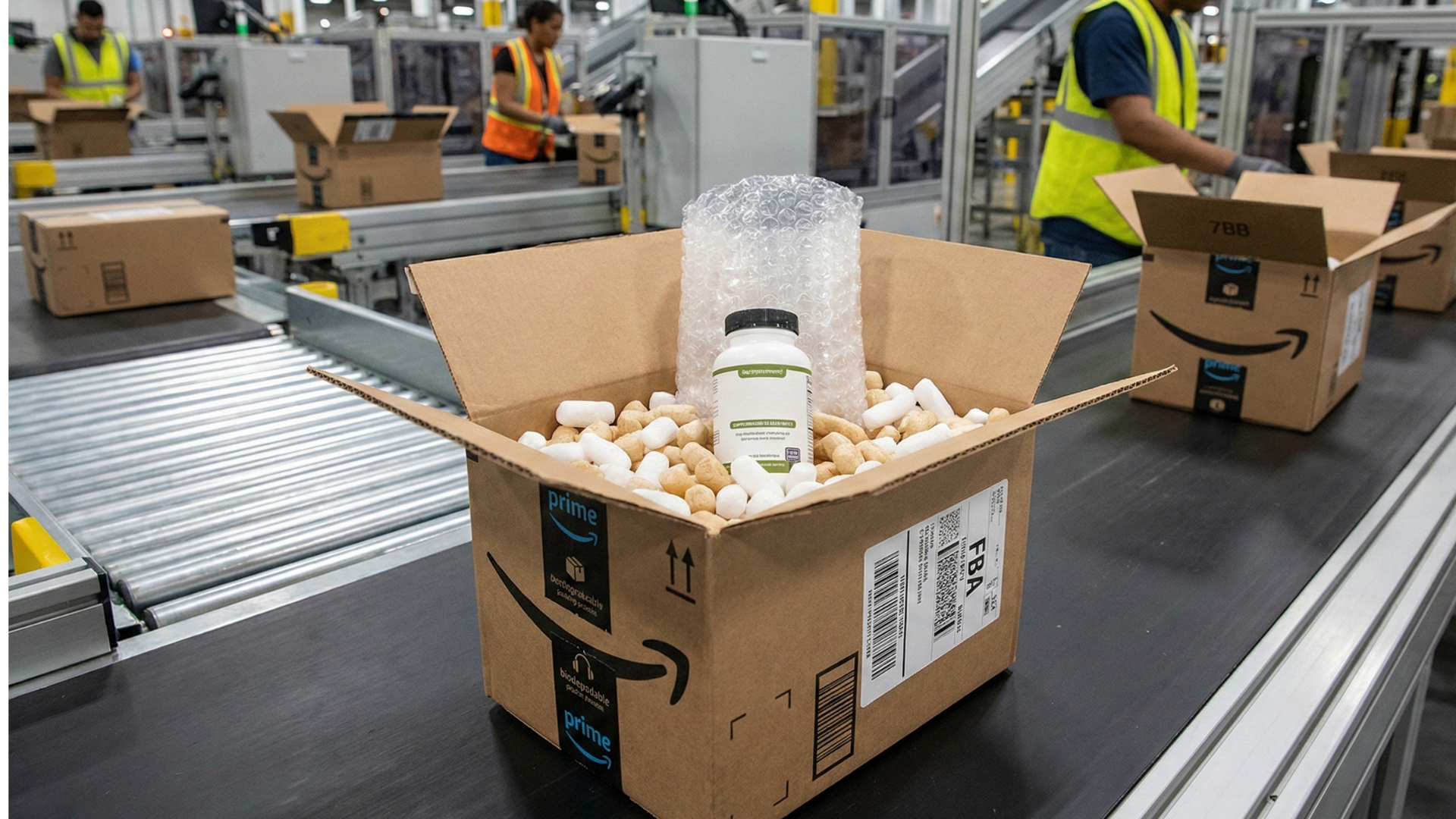
Ecommerce-ready packaging is more than a good look. It needs to survive shipping, reduce damage rates, and support customer support workflows.
- Durability: closures that don't leak, pumps that lock, seals that hold
- Consistency: color matching and label alignment across batches
- Scan and track: lot codes, case labels, and barcodes where needed
- Unboxing: clear directions and a premium feel without fragile parts
If you plan to run on Amazon or other marketplaces, confirm packaging requirements early (tamper evidence, labeling placement, barcode standards).
Reliability Signals: How to Spot a Partner You Can Trust
Most manufacturer problems show up in communication and process discipline. You can often spot them before you place a PO if you know what to look for.
Manufacturer Reliability Signals vs. Red Flags
| Area | Strong Manufacturer Signals | Red Flags |
|---|---|---|
| Communication | Clear owner per project, fast responses, written recaps after calls | Vague answers, long delays, changing points of contact |
| Timeline Control | Defined milestones, proofing workflow, realistic component lead times | "We'll figure it out," no schedule, no visibility |
| Quality Systems | GMP/ISO documentation, batch records, lot traceability, QC release step | No process detail, inconsistent answers, no clear QC gate |
| Change Management | Formal approval for substitutions and label changes | Ingredient swaps without documented approval |
| Confidentiality | NDA offered, limited access to formulas, controlled document sharing | Reluctant to sign NDA, loose handling of files |
What to Prove Before You Sign With a Contract Manufacturer
Most regrets in contract manufacturing trace back to skipping verification. Before you sign an MSA or wire a deposit, work through this checklist with your prospective partner and get answers in writing. If they can't produce documentation for any of these items, that's your signal to keep looking.
- Active certifications on file. Request copies of current cGMP certificates, FDA registration, and ISO certifications—with issue and expiration dates.
- Audit history. Ask for a summary of the last 3 third-party audits (NSF, UL, or equivalent) and any 483 observations or corrective actions.
- MOQ in writing by SKU and format. Confirm low MOQ pilots (2,000 units) and how MOQ changes with packaging or label complexity.
- Milestone-based timeline. Formula lock, label proof, component PO, production slot, QC release, and ship date—dated, not estimated.
- Sample batch record and COA. A redacted real example proves their documentation is real, not a template.
- Stability and shelf-life data. How they assign expiry dates and what testing supports those claims.
- Label compliance review. Confirm who reviews Supplement Facts, Drug Facts, or cosmetic INCI panels before print and who carries the liability.
- Change control process. Written procedure for ingredient substitutions, supplier swaps, and artwork edits—with sign-off requirements.
- Insurance and liability. Product liability coverage (typically $2M+) and a current COI naming your brand as additional insured.
- IP and confidentiality terms. Mutual NDA signed before specs are shared, plus clear ownership of custom formulas and artwork.
- Reorder and capacity plan. Realistic lead time for a 2–3x reorder within 60 days and how production slots are reserved.
- References from similar-sized brands. Two ecommerce brands at your stage who'll take a 15-minute call.
Peakfinity Advantage
Want a printable version of this checklist alongside our certification documentation? Start your project and we'll send our full verification packet with your quote.
Protecting Your Formula and Brand: IP and Confidentiality Basics
Many founders worry about sharing formulas, suppliers, and positioning. That's normal, especially when switching manufacturers or starting from scratch.
Good manufacturers treat confidentiality as part of being compliant and professional. They should offer an NDA, control who can access files, and keep formula versions organized.
- NDA process: Signed before sharing full specs
- Document control: Versioned formulas, locked label proofs, controlled approvals
- Ownership clarity: Clear terms for custom formulas and artwork
If you are transitioning from another supplier, ask how they handle formula recreation, raw material matching, and spec alignment without exposing your business to unnecessary risk.
Scaling with Ecommerce Demand: What 'Scalable' Really Means
A manufacturer can be great at small-batch runs but struggle when you go viral. The best partners build a plan that grows with you.
Look for a manufacturer who can support:
- Small-batch testing now with low MOQ (2,000 units)
- Repeatable reorders with stable raw material sourcing
- Capacity planning for promotions, bundles, and seasonal spikes
- Packaging upgrades without redoing everything (same bottle, improved label stock, carton add-on)
Ask what happens if you need 2–3x volume within 60 days. A good answer includes lead time ranges, what inputs they need from you, and how they reserve production time.
Where to Start: A Practical Shortlist Process
If you want to move fast and reduce risk, run a simple process. It keeps you in control and makes comparisons easy.
- Define your MVP. Format, count/size, packaging type, target cost, target launch date.
- Write a one-page spec. Include claims you want to avoid, allergen notes, and markets you plan to sell into.
- Ask for a turnkey quote. Formulation, packaging, labeling, coding, QC, and freight assumptions.
- Review their timeline map. You want milestone dates, not a single estimate.
- Validate quality systems. Ask about GMP-certified processes, ISO-certified systems, traceability, and COAs.
- Start with a low MOQ pilot. Prove repeatability before you scale spend.
Peakfinity Advantage
Ready to run this process? Start your project with Peakfinity Labs and get a turnkey quote with milestone timeline within 2 business days.
Advanced Evaluation: Questions That Reveal Operational Maturity
Once you've narrowed to 2–3 finalists, ask questions that surface how they work under pressure.
- What is your QC release process? Who signs off, and what happens if results are out of spec?
- How do you handle component delays? Do you stock common items or offer alternate components that stay on-brand?
- What is your approach to stability and shelf life? How do you set expiry dates, and what testing supports them?
- How do you manage change requests? What is the cut-off date for label edits without moving the ship date?
- Can you support ecommerce-specific packaging? Tamper seals, scannable labels, case pack labeling, and marketplace needs.
Common Mistakes Small Ecommerce Brands Make
These issues show up repeatedly. Most are preventable with a tighter process.
- Optimizing for unit cost too early. Start with a small-batch, compliant product that ships on time. Improve cost on reorder.
- Ignoring packaging lead times. Custom components can take longer than production. Choose ecommerce-ready stock packaging first when speed matters.
- Overcomplicating the first run. Too many SKUs, flavors, or variants slows everything down.
- Weak label proofing. Treat label approval like code release. One owner, one checklist, zero guesswork.
- No plan for reorder cadence. If you wait until you're almost out, you force rush shipping and mistakes.
Frequently Asked Questions
What makes a good contract manufacturer for small ecommerce brands?
A good contract manufacturer offers low MOQ small-batch runs (2,000 units), fast and reliable timelines, GMP-certified and ISO-certified quality systems, and turnkey services from formulation through compliant labeling and ecommerce-ready packaging. Look for written timelines with milestones, lot traceability and batch records, clear quote breakdowns, and a defined process for label approvals and change requests.
What should small brands ask a manufacturer before placing the first PO?
Ask about MOQ by format and packaging, lead times with milestones, QC release steps, traceability (lot codes and batch records), and what compliance support they provide for labels. Also confirm who owns the project day to day, what triggers delays (like component sourcing), and how substitutions or changes get approved in writing.
How do low MOQs help ecommerce brands grow?
Low MOQ reduces upfront inventory risk and lets brands run small-batch tests for formula, packaging, and positioning before committing to large production runs. This approach supports faster iteration, smoother cash flow, and better unit economics over time because you scale based on real conversion and retention data.
How can a brand verify manufacturing quality and compliance?
Verify that the facility is GMP-certified and ISO-certified, and confirm they maintain batch records, lot traceability, and COAs where appropriate. Ask how they handle deviations, holds, and rework. A strong manufacturer can explain their QC release gate and provide controlled documentation without confusion.
What causes manufacturing timelines to slip for supplements and skincare?
Timeline slips usually come from packaging component lead times, multiple rounds of label revisions, formula changes late in the process, or missing approvals. You can reduce risk by choosing stock ecommerce-ready components for the first run, locking the formula early, assigning one label approver, and working with a manufacturer that provides a clear milestone-based schedule.

Tushar
Licensed Pharmacist and COO @ Peakfinity Labs
Written by the Peakfinity Labs R&D Team — 46+ years of supplement formulation expertise. Our team of formulation chemists, manufacturing specialists, and regulatory experts has helped thousands of eCommerce brands bring their products to market successfully since 1980.
Related Articles
Private Label Supplement Markup: Typical Margins for DTC, Amazon, and Wholesale
Typical markup ranges for DTC, Amazon, and wholesale, plus the landed-cost model that decides whether your margin is real.

How to Compare Quotes From Supplement Manufacturers Without Missing Hidden Costs
A six-bucket framework and paste-ready RFQ table that surfaces hidden costs before you sign with a manufacturer.
When Is a Supplement Brand Ready to Move From Private Label to Custom?
Nine readiness signals, the custom-light middle path, and a seven-step switch plan that avoids stockouts and claim issues.