India vs China Supplement Manufacturing: Lower Cost, Faster Scale
If you're deciding between India and China for supplement manufacturing, you're usually chasing the same outcome: a product that lands on time, tests clean, looks premium, and still leaves margin for paid ads and creator commissions.
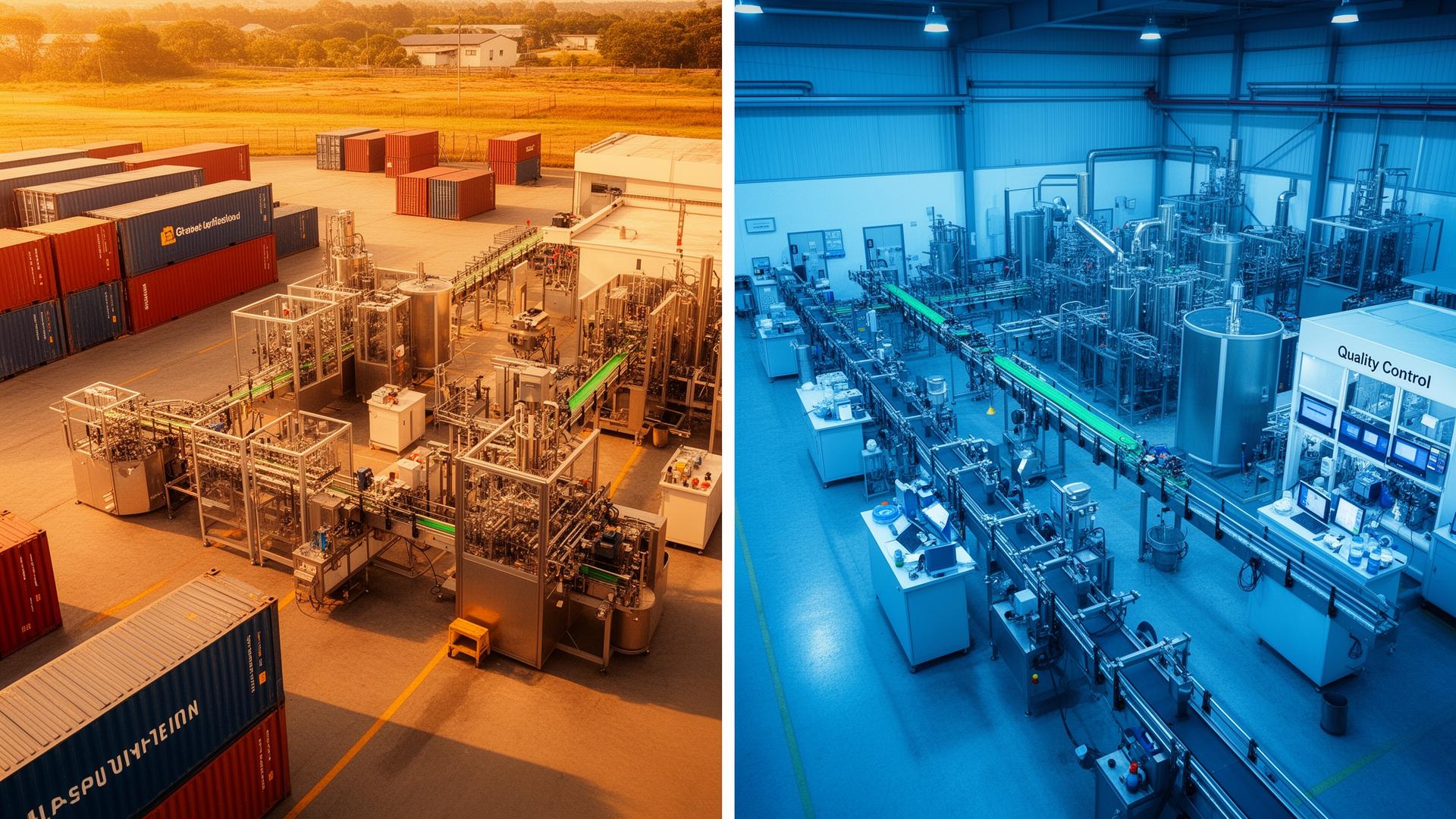
- 1India often wins for low MOQ test runs, fast iteration, and controlled execution with strong documentation
- 2China often wins for large-volume pricing on stable, commodity-heavy SKUs
- 3Total landed cost—not per-unit price—determines which country is actually cheaper for your brand
- 4Quality is determined by the specific facility's GMP systems and change control, not the country name
- 5The safest manufacturer switch uses a controlled overlap with 4–8 weeks of buffer inventory
Why This Comparison Matters for D2C Brands
The tradeoffs aren't obvious until you've lived through a delayed COA, an ingredient swap you didn't approve, or a "small" packaging change that turns into a new lead time. India and China can both produce excellent supplements, but they tend to win for different reasons depending on your dosage form, your compliance needs, and how fast you plan to scale.
This guide compares India vs China with a D2C operator's lens: low MOQ test runs, fast turnaround, consistent quality, and supply continuity during transitions. We'll also cover the hidden cost drivers that don't show up in the per-unit quote—like testing, shipping mode, label compliance, and revision cycles.
Want the three-way view including domestic production? Read USA vs China vs India supplement manufacturing, or go deeper on botanicals in why India leads herbal and pharmaceutical manufacturing.
Peakfinity Advantage
Peakfinity Labs offers GMP & ISO certified manufacturing with custom formulation and D2C ready packaging. Explore our capabilities on the Supplement Manufacturing Overview page.
Quick Comparison: India vs China for D2C Brands
| Decision Factor | India (Typical Strengths) | China (Typical Strengths) | Recommendation |
|---|---|---|---|
| Speed to first PO | Fast with in-house R&D and packaging control | Fast for stock formulas; slower for iterative changes | If launching in 30–45 days, optimize for fewer revision loops |
| Lead time reliability | Strong when QA/QC and docs run in a single system | Can be strong, but variability increases with multi-vendor chains | Choose the side that commits to a written production slot + QC timeline |
| MOQ flexibility | Often better for low MOQ pilot runs for D2C testing | Optimized for larger runs; low MOQ may raise per-unit cost | If testing 1–3 angles, choose low MOQ and scale after CAC stabilizes |
| Raw material ecosystem | Strong in botanicals, ayurvedic herbs, pharma-grade inputs | Huge breadth; strong in commodity vitamins, amino acids, excipients | Match country to your hero ingredient and required test panel |
| Packaging & presentation | Great when manufacturer is set up for D2C ready packaging | Very broad packaging ecosystem; coordination can add time | Pick whoever can control label, print, and pack under one schedule |
| Regulatory documentation | Often strong for export documentation and batch traceability | Can be strong; depends heavily on factory and third-party labs | Ask for sample COAs, specs, stability approach, and change-control process |
| Total landed cost | Competitive; savings show up when you reduce rework and delays | Can be lower at scale on certain SKUs; freight volatility changes the math | Model cost with worst-case timelines (air freight + retests), not best-case |
The Real Decision: Cost vs Speed vs Control
Most comparisons stop at "China is cheaper" or "India is better for compliance." That's incomplete for modern D2C. What actually drives profit is how fast you can reach a stable, repeatable batch that doesn't trigger returns, chargebacks, or ad fatigue.
A lower per-unit quote can lose to a slightly higher quote if you burn two weeks on label revisions, wait on third-party testing, or pay for air freight to hit a launch window. Compare systems: documentation, testing discipline, change control, and packaging execution. That's where "hidden costs" live.
India for Supplement Manufacturing: Where It Wins
India often wins when you value controlled execution over lowest-possible unit cost. Many high-growth brands prefer India for pilot runs because it's easier to run low MOQ tests, iterate the formula, and still keep the process compliant.
India Advantages
- Low MOQ test runs: If you're validating hooks (sleep, gut, beauty-from-within, performance), smaller batches reduce inventory risk while you dial in creatives and retention.
- Strong herb and botanical supply chains: India is a practical fit when your hero ingredients are plant-based and you need consistent specs.
- Documentation mindset: With the right manufacturer, batch records, traceability, and export documents are structured for audits and retailer questions.
- Custom formulation support: Fast iteration matters. You can't wait 6–10 weeks to learn a flavor system fails or a tablet chips in transit.
India Tradeoffs
- Ingredient price variance: For some commodity inputs (certain vitamins, amino acids), China's pricing can be hard to beat at large volumes.
- Capacity planning matters: If your partner doesn't reserve production slots, your "4-week lead time" becomes a moving target during peak seasons.
- Not all factories are equal: You need a clear view of certifications, QA systems, and in-process controls.
Don't start with a marketing deck. Start with a sample batch packet: finished product specification, in-process QC checks, and a real COA from a recent lot. Review how we approach this on our Quality and Certifications pages.
China for Supplement Manufacturing: Where It Wins
China often wins on scale economics and breadth. If your brand already has a stable SKU, predictable demand, and you're ordering in larger volumes, China can deliver strong unit economics—especially on commodity-heavy formulas.
China Advantages
- Scale pricing: Large runs of standard formats can come in at very competitive per-unit pricing.
- Wide supplier ecosystem: Packaging components, excipients, and niche ingredients are available, often with multiple supplier options.
- High throughput on mature SKUs: If the formula and packaging are locked, big factories can move fast.
China Tradeoffs
- More coordination risk: When ingredients, testing, packaging, and fulfillment touch multiple vendors, timelines slip and accountability gets blurry.
- Revision cycles can cost weeks: D2C brands change labels, claims, and packaging often. Each change can trigger new proofs, print windows, and compliance checks.
- Quality consistency depends on the specific plant: You need clear incoming QC, in-process checks, and change control—not just a certificate on a website.
The biggest "surprise cost" we see from brands switching from China is not the product cost. It's the total cost of schedule disruption: stockouts, expedited freight, and lost ranking momentum after an out-of-stock event.
Dosage Form Reality Check: India vs China by Product Type
Country-level comparisons break down fast when you get specific. A gummy is a different business than a capsule. A softgel is a different business than a powder.
| Dosage Form | What Tends to Matter Most | India Fit | China Fit |
|---|---|---|---|
| Capsules | Blend uniformity, flow, fill weight, microbial limits, clean COAs | Strong for custom formulas + low MOQ test runs | Strong for scale runs of stable SKUs |
| Tablets | Hardness, friability, disintegration time, coating durability | Strong when R&D can adjust binders/coatings quickly | Strong for large volume if specs are already locked |
| Softgels | Oil quality, oxidation control, seam integrity, stability | Good with the right facility; verify stability approach | Often competitive at scale; ensure oxidation and stability controls |
| Gummies | Texture, pectin/gelatin behavior, heat sensitivity, sugar systems, shelf life | Great if your partner owns the flavor + stability process | Great scale potential; watch iteration cycles and moisture control |
| Powders | Mixing, flavor masking, clumping control, scoopability, solubility | Strong when paired with Flavor System Manufacturing | Strong for commodity sports nutrition inputs at volume |
If you're building vitamins or proteins, the supply chain can dominate the decision. See our Vitamin Manufacturing and Protein Manufacturing capabilities. If your hero story is botanical-heavy, our Herbal Manufacturing page is a better match.
Compliance and Quality Systems: What to Ask (Regardless of Country)
"GMP" on a brochure is not a plan. You need evidence that the manufacturer runs a tight loop from incoming raw materials to finished goods release.
- Facility certifications and scope: Start here, then verify what the certificate covers. See our Facilities and Certifications pages.
- A sample COA from a recent batch (not a template).
- Microbial, heavy metal, and identity testing plan for your specific ingredients and dosage form.
- Stability approach (real-time or accelerated) based on your product's risk profile.
- Deviation and CAPA workflow when something goes wrong.
We also push brands to ask one question most manufacturers hate: "Show me your last three change-control records." If they can't, expect surprises later. For more on verifying GMP credentials, read our guide on how to verify GMP certification.
Lead Times: What 'Faster Scale' Actually Means in Practice
For D2C, scaling isn't only about producing more units. It's about producing more units without breaking your launch cadence. At Peakfinity Labs, our baseline planning assumption for many projects is 3–4 weeks turnaround from order to production once the formula, packaging, and artwork are approved.
If you're comparing India vs China, ask every partner for a written lead-time map with dates for:
- Raw material intake + QC release
- Manufacturing slot
- In-process QC
- Finished goods testing + COA release
- Packaging production + pack-out
Learn more about our process on R&D and Our Process.
Switching Manufacturers Without Supply Disruption
The safest switch is a controlled overlap. Brands get burned when they stop reordering from the old manufacturer before the new one proves repeatability.
- Run a low MOQ pilot first and hold it to full spec testing.
- Match critical-to-quality specs (assay ranges, micro limits, disintegration, viscosity for liquids, moisture for gummies) so your customers don't feel a change.
- Lock your packaging bill of materials before you scale. "Close enough" components create rework.
- Keep 4–8 weeks of buffer stock during the transition if your sales velocity is high.
If you want a partner that's used to transitions, scaling, and creator-driven demand spikes, see our experience working with Doctors, Influencers & Experts. For more on handling viral demand, read how manufacturers handle sudden demand spikes.
Verdict: Which Is Better for Lower Cost and Faster Scale?
Choose India if you want the best balance of low-risk testing and controlled execution. It's often the better path for brands that need low MOQ, fast iteration, and a manufacturer that can stay compliant while you refine the product and packaging.
Choose China if you have a stable, proven SKU and you're ready to order at higher volumes where unit economics dominate. China can be a strong choice when you don't expect frequent label or formula changes and you have the operational bandwidth to manage more coordination.
Peakfinity Advantage
Our pragmatic rule: if you're still learning (new offer, new channel, new claim angle), optimize for speed and control. If you're already winning and you need margin at scale, optimize for unit economics—without weakening your QC and documentation.
Frequently Asked Questions
How does India compare to China for supplement manufacturing?
India often compares favorably for low MOQ test runs and controlled execution with strong documentation, while China often compares favorably for large-volume pricing once a formula is stable. A practical next step is to request a recent COA, a written lead-time map, and a change-control policy from any factory you're considering—then compare the systems, not just the quote.
Is China always cheaper than India for supplements?
'Cheaper' depends on total landed cost, not the per-unit manufacturing price. China can be cheaper at scale on certain commodity-heavy SKUs, but delays, retesting, coordination overhead, and expedited freight can erase the savings. To decide, price both best-case ocean freight and worst-case air freight scenarios, and include lab testing, packaging revisions, and timeline risk.
Which country is faster for launching a new supplement brand?
Launch speed depends more on revision cycles and packaging control than on geography alone. India is often faster for first launches when you need low MOQ, quick formula adjustments, and tighter QA-to-packaging coordination, while China can be fast when you're using a stock formula and standard packaging. Lock your label copy early and choose a manufacturer that can commit to a written production slot and QC release date.
Is quality better in India or China for supplement manufacturing?
Quality is determined by the specific facility's GMP systems, testing discipline, and change control, not the country name. Both India and China have excellent factories and weak factories, so judge by batch records, in-process QC, and real COAs from recent production lots. Ask for incoming raw material specs and what happens when an ingredient fails identity or heavy metal testing.
What's the safest way to switch from a China manufacturer to an India manufacturer (or vice versa)?
The safest approach is a controlled overlap: run a low MOQ pilot with full testing, match critical-to-quality specs, and maintain 4–8 weeks of buffer inventory until the new supplier proves repeatability across at least two lots. You'll also want a documented packaging bill of materials and a change-control agreement so no substitutions happen without written approval.

Tushar
Licensed Pharmacist and COO @ Peakfinity Labs
Written by the Peakfinity Labs R&D Team — 46+ years of supplement formulation expertise. Our team of formulation chemists, manufacturing specialists, and regulatory experts has helped thousands of eCommerce brands bring their products to market successfully since 1980.
Related Articles
How to Find an ISO 17025-Accredited Supplement Testing Lab, and What Founders Should Ask For
How to verify a lab's ISO/IEC 17025 scope actually covers your test, the questions to ask before shipping samples, and a testing plan built for ecommerce timelines.
Supplement Manufacturing Lead Times and Reorders: What Founders Should Expect Before and After Launch
The five workstreams hiding inside "lead time," why reorders move faster than first runs, and the ramp plan that survives a demand spike.
How to Vet a cGMP Supplement Manufacturer With Documented Audit History
The document pack, audit-history call script, and scoring rubric that separate real cGMP quality systems from certificate PDFs.