How to Vet a cGMP Supplement Manufacturer With Documented Audit History
The document pack, 30-minute call script, and scoring rubric that separate manufacturers with real audit trails from ones with just a certificate PDF.
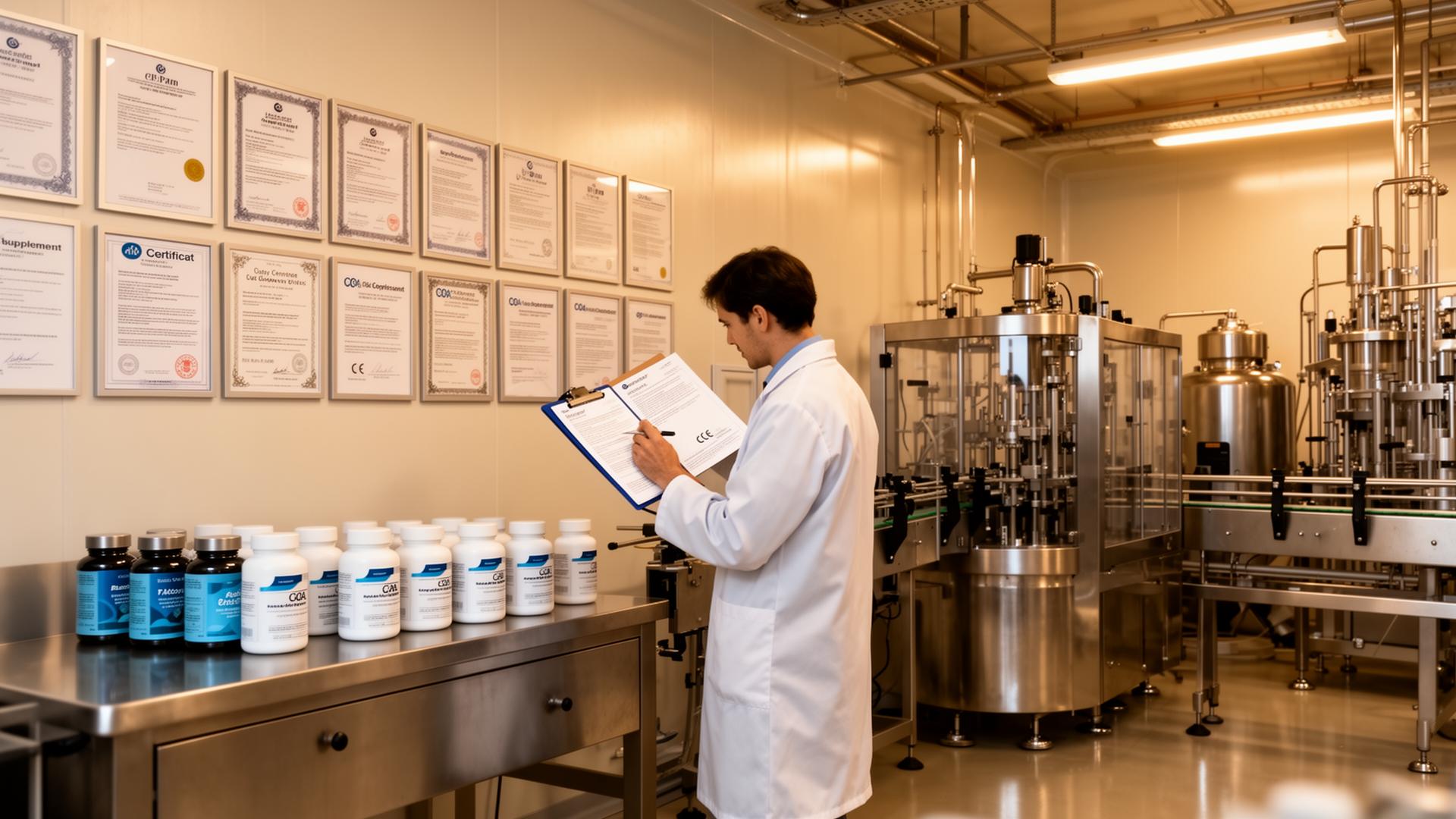
- 1A certificate PDF is not audit history. Real audit history shows what was reviewed, what was found, what was fixed, and how repeats are prevented — audit reports, graded findings, CAPA records, change control, and trending.
- 2Run a two-step filter: request a short document pack (certificate scopes, audit summary, example COAs, quality agreement template) then a 30-minute audit-history call. A serious manufacturer produces the pack under NDA within 24–72 hours.
- 3Don't reject a manufacturer for having findings — reject them for hiding the CAPA trail. Audits find things in real plants; strong systems close them, verify them, and stop repeats.
- 4"FDA registered" is facility registration, not a quality stamp. US supplement cGMP is 21 CFR Part 111, and there is no official FDA-issued cGMP certificate — third-party certification only counts when its scope covers your product type.
- 5Ask for the batch release SLA. If QA release takes 10 business days, a 3–4 week production timeline is not real.
Introduction
If you have ever switched manufacturers or tried to launch a new supplement fast, you have seen the same problem. Everyone says they are cGMP. Few can prove it with a clean paper trail that matches what happens on the floor.
A documented audit history is not a nice-to-have. It is how you reduce the two risks that sink launches: quality surprises (failed micro, wrong potency, label errors) and timeline slippage (missing raw materials, rework, hold releases). It also protects your brand if a retailer, marketplace, or regulator asks how you control suppliers.
This guide shows how to verify cGMP status using documents you can request, questions you can ask, and red flags you can spot before you sign an MSA. It is written for ecommerce-first brands that need low MOQ, small-batch testing, and the ability to scale without redoing packaging or compliance work. You will also see a practical, contrarian take: the "best" manufacturer is often the one that shows you their audit findings and CAPAs, not the one with the flashiest certificate.
What "documented audit history" actually means
When brands ask for audit history, they often get a certificate PDF and a promise. That is not audit history. A useful audit record shows what was reviewed, what was found, what was fixed, and how the manufacturer prevents repeat issues.
- Audit reports: full reports or a controlled-summary from third-party audits, customer audits, or regulatory inspections.
- Findings and severity: observations graded by risk (for example, minor vs major), with clear references to the requirement.
- CAPA records: corrective and preventive actions tied to each finding, with owners, dates, and effectiveness checks.
- Change control: records that show how they manage formula, supplier, and process changes without breaking compliance.
- Complaint and deviation trending: proof they review issues over time, not one-off fixes.
In the US, supplement cGMP is governed by FDA 21 CFR Part 111. A manufacturer can be "FDA registered" and still run a weak quality system. Audit history is the evidence that their quality system works under scrutiny. (If you want a clearer baseline on what GMP certification covers in practice, see our GMP certified supplement manufacturer guide.)
Where to start (a fast vetting path that avoids weeks of back-and-forth)
If you want a yes or no in a few days, run a two-step filter before you schedule calls with three factories.
Step 1: request a short document pack
Ask for these items up front. A serious manufacturer can provide them quickly under NDA.
- Current cGMP certificate(s) and scope statement (what product types and processes it covers).
- ISO certificate if applicable, plus scope (often ISO 9001, sometimes ISO 22000).
- Most recent third-party audit summary (date, auditor name, standard used, count of major/minor findings).
- Example Certificate of Analysis (COA) for a finished product and for a raw material.
- Quality agreement template (or at least a list of what they will and will not sign).
- Release process overview (who releases product, what must be reviewed, typical hold reasons).
If they stall on all of it, that is usually the answer. If they can share a pack within 24-72 hours, you are likely dealing with a team that runs on process.
Step 2: run a 30-minute audit-history call
Keep it focused. You are not auditing the full plant yet. You are confirming that audit history is real and usable.
- Ask for the last audit date and who performed it.
- Ask how many major findings they had in the last 24 months.
- Ask for one example CAPA and how they verified it worked.
- Ask how often they trend deviations and complaints.
Listen for specifics: dates, counts, and what changed on the line. Vague talk about "high standards" is not evidence.
Documents you should request, and what to look for in each
Many brands stop at certificates. Certificates matter, but they are the cover page. The decision is in the supporting records.
| Document | What good looks like | Red flags |
|---|---|---|
| cGMP audit report (full or controlled-summary) | Recent (within 12-18 months), shows scope, auditor, findings with clear references, and close-out status | "We cannot share anything" even under NDA, or only a certificate with no scope |
| CAPA log (sample) | Each CAPA ties to a root cause, has due dates, owners, and an effectiveness check | CAPAs close fast with no proof, or root cause is always "operator error" |
| Deviation/OOS (out-of-spec) procedure | Defines investigation steps, impact assessment, and disposition paths (rework, reject, release) | No clear OOS process, or OOS is treated as a paperwork issue |
| Supplier qualification procedure | Clear standards for approved suppliers, testing requirements, re-qualification cadence | They "buy from brokers" without robust testing or traceability |
| Finished goods COA (example) | Lists identity, potency, micro, heavy metals where relevant, method references, and pass/fail limits | COA is missing methods, missing limits, or looks templated with no batch-specific data |
| Batch record (redacted sample) | Shows line clearance, in-process checks, yields, lot traceability, QA review and release | No QA release signature, poor traceability, unclear reconciliation |
Contrarian but practical: do not reject a manufacturer just because they had findings. Reject them if they cannot show the CAPA trail and the fix. In real plants, audits find things. Strong systems close them, verify them, and stop repeats.
How to verify claims: cGMP, ISO, and "FDA registered"
Marketing language gets sloppy in this space, so you need to separate what is regulated from what is optional.
- cGMP compliance for supplements is a legal requirement in the US under 21 CFR Part 111. There is no official "FDA cGMP certificate" that the FDA issues to supplement manufacturers.
- Third-party cGMP certification is a private audit against a standard (often NSF, UL, or similar schemes). It can be useful if the scope matches your product type.
- ISO certification usually refers to quality management (ISO 9001) or food safety systems (ISO 22000). It matters most if the certificate scope covers the processes you will use.
- FDA registered usually means facility registration (for food facilities) and is not a quality stamp.
Ask for the certificate scope page, not just the badge. If you are making capsules, the scope should include encapsulation and packaging. If you are making gummies, the scope should include gummy manufacturing. If you are doing stick packs, it should include sachet or stick pack filling. You can see the certifications Peakfinity Labs operates under on our certifications trust hub.
Audit history questions that reveal real operational maturity
These questions work because they are hard to bluff. They force a manufacturer to talk about how work happens day to day.
- "How many audits have you had in the last 12 months, and what types?" You want a mix: third-party, customer, and internal audits.
- "What were the top 3 recurring observation themes in the last 24 months?" Strong teams know their trends.
- "Show me one CAPA that failed its effectiveness check." This is a trust test. Honest answers show a real system.
- "What is your batch release SLA?" If QA release takes 10 business days, your 3-4 week timeline is not real.
- "What triggers a change control, and who must approve it?" You want controlled changes to suppliers, specs, labels, and processes.
- "Do you quarantine all incoming raw materials until released?" The right answer is yes, with clear labeling and segregation.
If you hear "we have never had a finding," push harder. Either they do not get audited, or they are not being transparent.
How documented audit history protects your launch timeline
Most timeline slips do not happen at mixing or encapsulation. They happen in QA review, testing, and rework.
Audit history helps you predict whether the manufacturer controls those bottlenecks. Look for evidence of:
- Clear incoming testing rules so raw materials do not sit in quarantine with no release date.
- Defined hold and release criteria so batches do not get stuck in "QA review" with no owner.
- Label control so you do not reprint 10,000 labels due to a net quantity or supplement facts error.
- Document control so the batch record matches the approved master formula every time.
At Peakfinity Labs, we see ecommerce brands win when they treat manufacturing as a timed workflow, not a black box. If your launch date is tied to influencer drops or ad campaigns, your manufacturer must show a release process that can keep pace. That is one reason we prioritize small-batch, low MOQ runs and packaging that is ecommerce-ready from day one. It reduces rework when a product starts scaling fast. (More on this workflow: Ecommerce supplement manufacturing and Typical low MOQ in supplement manufacturing: what to expect.)
Confidentiality and IP: what to request so your formula does not walk
Brands worry about IP exposure, especially during formulation transitions. You can reduce risk with process and paperwork, not trust alone.
- Sign an NDA that covers formulas, suppliers, specs, and forecast data.
- Ask who owns the formula and whether the manufacturer can produce it for other brands.
- Request role-based access in their systems for formula and batch records.
- Confirm they can work with a blind-coded formula name internally if needed.
Also ask where your electronic records live, who can export them, and how long they retain batch and test records. If they cannot answer simply, that is a risk.
Low MOQ and audit history: why small-batch testing can be safer, not riskier
Some brands assume low MOQ means lower quality. That is not automatically true. Small-batch production can reduce risk if the quality system is tight.
Here is the practical reason. When you start with 300-2,000 units instead of 20,000, you limit exposure if a label needs changes, a flavor needs adjustment, or the market response is weak. If the manufacturer runs validated, repeatable processes, a small batch uses the same controls as a large batch.
Audit history matters here because it shows whether they can run frequent changeovers, line clearances, and short campaigns without mix-ups. Many plants struggle with short runs because document control and line clearance get sloppy under pressure. The audit trail should show how they prevent that.
Scoring rubric: a simple way to compare manufacturers without getting lost in details
If you are choosing between two cGMP manufacturers, use a scoring grid. It forces a decision based on evidence.
| Category | Score 1 | Score 3 | Score 5 |
|---|---|---|---|
| Audit transparency | Shares only certificates | Shares audit summary and dates | Shares summary plus CAPA examples and close-out proof |
| CAPA maturity | Root causes vague, no effectiveness checks | CAPAs documented, some verification | Strong root cause, documented verification, trend reviews |
| Release speed | No clear SLA | Release in 7-10 business days | Release targets tied to testing plan, clear hold reasons |
| Supplier controls | Relies on COAs only | Some incoming testing | Identity testing plus risk-based verification and re-qualification |
| Packaging compliance | Client is responsible for most controls | Shared responsibility with checklists | Documented label control, line clearance, reconciliation |
Recommendation: pick the manufacturer that scores highest on audit transparency and release speed, even if their unit price is slightly higher. Quality holds and relabeling cost more than a small price difference, and they burn calendar time you cannot buy back.
What to ask for in a facility visit (or virtual audit)
If you can visit, focus on what you can verify with your eyes in 60-90 minutes. If not, ask for a live video walkthrough.
- Quarantine vs released materials: clear segregation, status labels, controlled access.
- Line clearance: ask to see the checklist and how they document it.
- Scales and measuring tools: calibration stickers and current status.
- Environmental controls: cleanliness, pest control logs, temperature/humidity where required.
- Batch record review area: QA presence and a clear release workflow.
Ask to see one redacted batch record from start to finish. If they cannot produce one during a visit, assume their documentation is not audit-ready.
Conclusion and next steps
A cGMP claim is easy to say and hard to prove. Documented audit history is how you confirm the system behind the claim, including how the manufacturer handles findings, closes CAPAs, and releases product on time.
Next steps: request the document pack (certificate scope, audit summary, COAs, batch record sample, quality agreement), run a 30-minute audit-history call and ask for one real CAPA example, then score finalists using the rubric and validate with a small-batch, low MOQ pilot.
If you need a turnkey partner that can support low MOQ testing, a 3-4 week path from formulation to finished goods when inputs are ready, and ecommerce-ready packaging with compliance support, Peakfinity Labs is built for that workflow. If you are ready to scope a project, start a project with us.
Frequently Asked Questions
What is the best way to confirm a cGMP supplement manufacturer has real audit history?
Audit history matters because certificates alone do not show how a factory handles real findings. The most reliable way is to request a recent third-party audit report or controlled-summary plus at least one matching CAPA example with close-out and an effectiveness check. If the manufacturer can share dates, finding counts, and a documented fix under NDA, you have evidence that their quality system works under scrutiny.
Is "FDA registered" the same as being a cGMP-certified supplement manufacturer?
This matters because many suppliers market "FDA registered" as a quality badge when it is not. "FDA registered" generally refers to facility registration and does not confirm compliance with 21 CFR Part 111 dietary supplement cGMP requirements. Ask for third-party audit documentation and batch-release records, since those show how product is controlled and released.
What documents should a cGMP supplement manufacturer provide before I place a PO?
This matters because you need proof of quality controls before you commit inventory and ad spend. A credible manufacturer can provide certificate scopes, a recent audit summary, example raw material and finished goods COAs, a redacted batch record sample, and a quality agreement template under NDA. If any of these are missing or delayed without a clear reason, treat it as a risk to timeline and compliance.
How many audit findings are "too many" when choosing a cGMP supplement manufacturer?
This matters because audits often find issues even in well-run plants, so the raw count can mislead you. The more useful rule is to avoid manufacturers that cannot show CAPAs with root cause, due dates, and effectiveness checks for any major findings in the last 24 months. If they can document how they fixed findings and prevented repeats, the audit record can be a strength rather than a weakness.
How do I choose the best cGMP supplement manufacturer if I need low MOQ and fast turnaround?
This matters because low MOQ and speed fail when QA release and label control are not built into the process. The best choice is a GMP-certified, ISO-certified manufacturer that can show documented audit history, defined batch release SLAs, and strong label version control for frequent small-batch changeovers. Before you sign, run a small pilot batch and require the full documentation set you will get at scale, including COAs and batch records.

Tushar
Licensed Pharmacist and COO @ Peakfinity Labs
Written by the Peakfinity Labs R&D Team — 46+ years of supplement formulation expertise. Our team of formulation chemists, manufacturing specialists, and regulatory experts has helped thousands of eCommerce brands bring their products to market successfully since 1980.
Related Articles
How to Find an ISO 17025-Accredited Supplement Testing Lab, and What Founders Should Ask For
How to verify a lab's ISO/IEC 17025 scope actually covers your test, the questions to ask before shipping samples, and a testing plan built for ecommerce timelines.
Supplement Manufacturing Lead Times and Reorders: What Founders Should Expect Before and After Launch
The five workstreams hiding inside "lead time," why reorders move faster than first runs, and the ramp plan that survives a demand spike.

What Questions Should I Ask a Supplement Manufacturer on the First Call?
27 first-call questions with what a good answer sounds like: MOQ drivers, timeline gates, testing scope, and IP ownership.