What Custom Supplement R&D Really Costs — and Why It Doesn't Have To
The traditional path to a custom formulation runs $40,000–$60,000 before you sell anything. Here is exactly where that money goes, which parts are genuinely necessary, and which parts are waste a modern manufacturer removes.
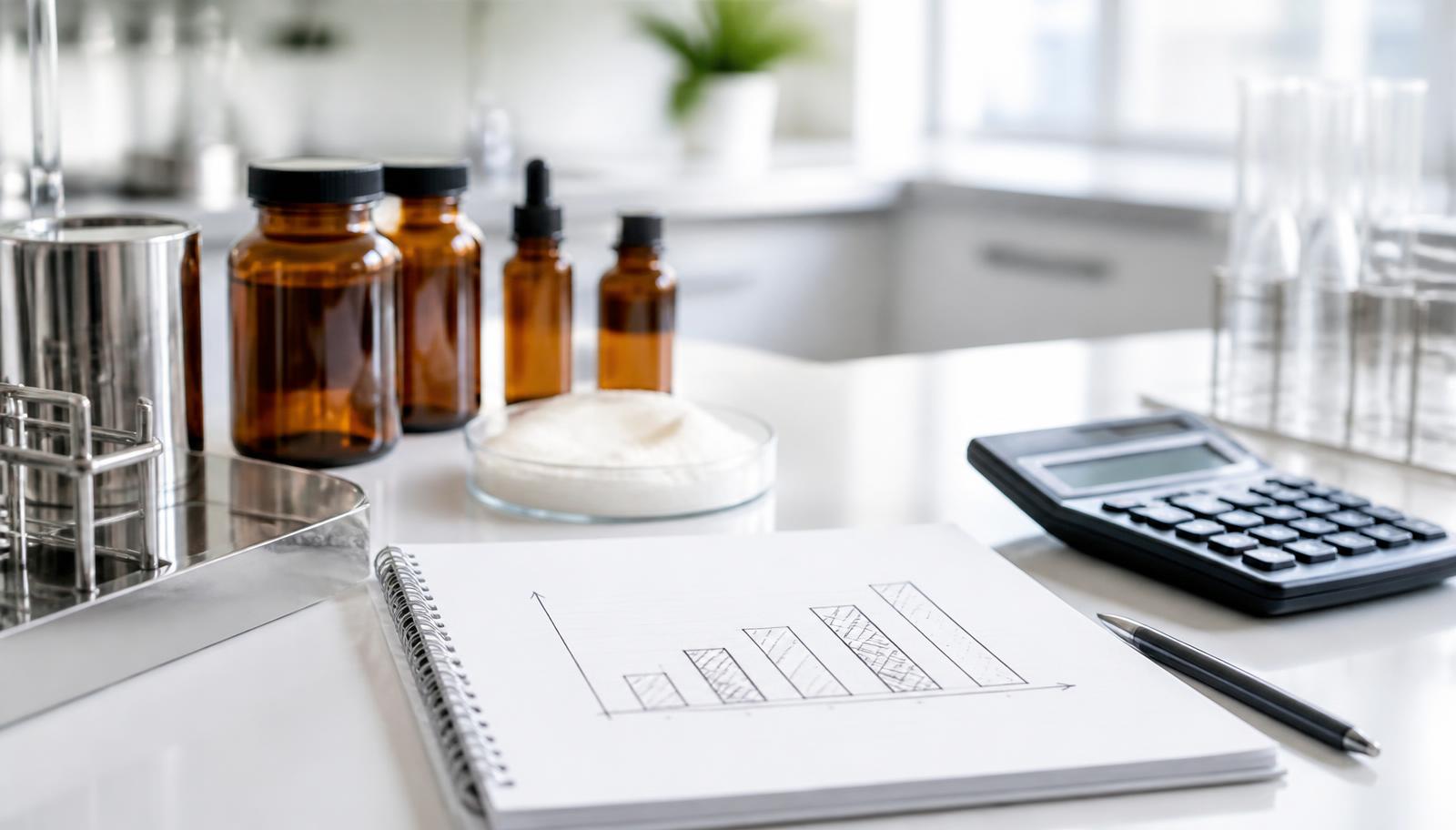
- 1A fully custom supplement formulation developed the traditional way typically runs $40,000–$60,000 before a single retail unit is produced — and that figure excludes inventory, packaging tooling and marketing.
- 2The money is not going into ingredients. It is going into time: consultant hours, sequential bench iterations, repeat stability studies and the rework caused by discovering a cost or format problem late.
- 3The single most expensive line item in traditional R&D is the failed iteration — a formula that tastes wrong, cakes in the bottle or prices out at 3x target after weeks of bench work.
- 4AI-assisted formulation collapses that cost by pre-screening interactions, stability risks, format feasibility and live vendor pricing before anyone books bench time — so scientists validate promising candidates instead of eliminating bad ones.
- 5At Peakfinity Labs a custom formulation reaches a tested, spec-sheeted prototype for a fraction of a traditional R&D program, and the prototyping cost is credited toward your first production order at a flat 2,000-unit MOQ.
Short answer
Developing a genuinely custom supplement the traditional way — an independent formulation consultant, a separate contract lab, sequential bench iterations, standalone stability studies — costs most brands $40,000 to $60,000 before a single salable unit exists. That figure buys a specification. It does not buy inventory, packaging tooling, artwork, a production run or a customer.
That number is real, and for a long time it was simply the price of entry. It is also, in 2026, largely avoidable. Most of that budget is not paying for science — it is paying for sequence: work done one step at a time, by parties who don't share data, discovering expensive problems late. A next-gen CDMO that runs AI-assisted formulation inside the same organization that owns the plant removes most of that waste, which is why brands can now launch custom formulations for a fraction of the historical cost. For the wider category comparison, see our guide to the best next-gen supplement CDMOs.
Where $40K–$60K actually goes
Almost nobody quotes R&D as a single number, which is why the total surprises founders. Here is the typical line-item structure of a mid-complexity custom formulation — say a flavored functional powder or a multi-ingredient capsule with clinical dosing — developed through the conventional consultant-plus-lab route.
| Line item | Typical range | What it covers |
|---|---|---|
| Formulation consulting | $8,000–$18,000 | 40–90 hours at $150–$300/hr: brief, ingredient selection, dose architecture, excipient system, revisions |
| Bench iterations (3–6 rounds) | $6,000–$15,000 | Small-batch trials, lab time, materials, technician hours — each round is a separate charge |
| Analytical method development | $3,000–$8,000 | Establishing and validating the assay that proves your active is present at label claim |
| Stability testing | $5,000–$12,000 | Accelerated (3–6 months) plus initiated real-time; restarts whenever the formula materially changes |
| Flavor and sensory development | $4,000–$10,000 | Masking systems, sweetener balance, panels — applies to powders, gummies, liquids and chewables |
| Regulatory and claim review | $2,500–$6,000 | DSHEA and NDI screening, allergen review, structure/function claim substantiation, label copy review |
| Scale-up and pilot trials | $4,000–$10,000 | Proving the bench formula still behaves at production volume on real equipment |
| Documentation and tech transfer | $2,000–$5,000 | Specifications, batch record drafting, handing the formula to whoever will manufacture it |
| Total | $34,500–$84,000 | Mid-point lands squarely in the $40K–$60K band most brands report |
Note
Note what is missing. That table does not include raw material inventory, packaging tooling, artwork, the first production run, third-party certifications or a dollar of marketing. R&D is the cost of being ready to spend money.
Why traditional R&D costs this much
It is worth being fair to the model: none of these costs are fraudulent. They are the natural output of how the work has always been organized.
- Formulation is a search problem solved by hand. There are thousands of viable ingredients, each with multiple supplier grades, particle sizes and price points, interacting across dose, stability, taste, format and cost. A human formulator can hold maybe a dozen candidates in mind. The rest of the space goes unexplored, and the answer you buy is the best of a very small sample.
- Iteration is sequential and slow. Formulate, blend, test, wait, taste, revise. Each loop is weeks. Parallelizing costs proportionally more, so most programs run them one at a time.
- Nobody shares data. The consultant does not have the plant's equipment constraints. The plant does not have the consultant's rationale. The ingredient supplier does not know your cost target. Every gap between parties is paid for in rework.
- Cost is discovered last. In the traditional sequence, landed cost per unit is calculated after the formula is finalized. Discovering the formula is unsellable at that COGS means going back to the beginning with a constraint you should have started with.
- Stability restarts on change. Any material formula revision invalidates in-progress stability data. One late change can add three months and five figures.
What a next-gen manufacturer changes
Peakfinity Labs is an AI-first manufacturer, and the cost implication is specific: we attack the failed iteration. Our proprietary AI formulation systems reason across thousands of ingredients and supplier grades simultaneously, before anyone books bench time.
- Interaction and stability pre-screening. Known incompatibilities, hygroscopic pairings, oxidation risks, pH conflicts and heat-sensitive actives are flagged before a trial is scheduled — so caking, browning and potency loss are designed out instead of discovered.
- Live cost modeling from the first candidate. Every formulation option is priced against real vendor cost data while it is still editable. You never finish a formula and then learn it cannot hit your retail price.
- Dosage-form feasibility scoring. The same actives behave completely differently in a capsule, a gummy and a stick pack. Feasibility is scored per format up front, so you learn in week one whether your concept fits the format your customers actually want.
- Regulatory pre-checks before quoting. Dietary-ingredient eligibility, NDI considerations, allergen declarations and marketplace-restricted lists are screened early, not after artwork is printed.
- 40+ scientists validating, not eliminating. Our formulation, analytical, microbiology, flavor and regulatory teams spend their hours confirming promising candidates instead of burning weeks ruling out bad ones. That is the entire cost difference in one sentence.
- Development and production in the same building. 375,000+ sq ft of company-owned capacity means no tech transfer gap, no second round of scale-up trials, no formula that behaves differently on somebody else's equipment.
Brands can also explore formulation concepts themselves through our AI product formulator, then hand the output straight to our scientists for validation and scale-up — closing the gap between an idea and a manufacturable specification, which is exactly where most first-time brands stall.
Traditional R&D vs the next-gen path
| Stage | Traditional consultant + lab | Peakfinity Labs (AI-first, integrated) |
|---|---|---|
| Concept to first candidate formulas | 2–6 weeks of consulting hours | Days — AI searches the ingredient space, scientists shortlist |
| Cost visibility | Calculated after the formula is locked | Live vendor pricing on every candidate, before bench work |
| Bench iterations needed | 3–6 rounds, mostly eliminating failures | Typically 1–2, validating pre-screened candidates |
| Stability restarts | Common — each late change resets the clock | Rare — incompatibilities screened before trials |
| Flavor and masking | Separate specialist engagement | In-house flavor bench, included in development |
| Regulatory screening | Separate consultant, often late | Pre-quote screening on every ingredient |
| Scale-up | Tech transfer to a third-party plant | Same facility, no transfer, no re-trials |
| Time to production-ready | 4–9 months | Weeks to prototype, 4–6 weeks to first run |
| Development cost | $40,000–$60,000 typical | A fraction of that — and credited toward your first production order |
| MOQ after development | Often 10,000+ units for custom | Flat 2,000 units, custom included |
Key Advantage
The compounding effect. A lower development cost and a 2,000-unit MOQ change the math together. A $50,000 R&D bill forces you to order deep inventory just to amortize it. Remove most of the R&D cost and drop the MOQ to 2,000, and a brand can launch a genuinely custom formula, read real market data, and reformulate — for less than the old cost of getting to the starting line once.
What you don't give up
There is a legitimate version of this concern: cheap formulation is often bad formulation. It usually is — when the savings come from skipping work. Be precise about which kind of saving you are being sold.
| Savings that cost you later | Savings that are simply waste removed |
|---|---|
| A stock base relabeled as a custom formula | Eliminating bench iterations that were always going to fail |
| Skipping stability testing | Not restarting stability because of avoidable late changes |
| Underdosed actives hidden in a proprietary blend | Buying ingredients through an established, high-volume supply chain |
| No analytical verification of label claim | Running development and production in one organization |
| No regulatory review before launch | Screening ingredients before quoting instead of after artwork |
| Unqualified or undocumented ingredient sources | Software doing the search work humans were doing manually |
Everything in the left column still happens at Peakfinity Labs: full stability programs, analytical verification, per-lot Certificates of Analysis, regulatory screening and documented sourcing under cGMP (21 CFR 111), ISO 9001:2015 and WHO-GMP. See our quality standards and certifications for specifics. What disappears is the dead-end iteration, the tech transfer gap and the consulting hours spent rediscovering things a well-built system already knows.
A realistic launch budget
Here is what a first custom SKU actually looks like when development is integrated rather than outsourced. Ranges vary by format, ingredient cost and packaging choices — treat this as structure, not a quote.
| Item | Traditional path | Integrated next-gen path |
|---|---|---|
| Formula development | $40,000–$60,000 | Prototyping cost, credited toward production |
| Minimum first order | Often 10,000+ units | 2,000 units |
| Packaging and artwork | $3,000–$10,000 | $3,000–$10,000 (unchanged) |
| Certifications and testing | $2,000–$8,000 | Included in per-lot COA + program testing |
| Time before first revenue | 6–12 months | Weeks to prototype, 4–6 weeks to first run |
| Capital at risk before market feedback | Very high | Low enough to test, learn and iterate |
The strategic point is not that cheaper is better. It is that lower capital at risk before market feedback is structurally better, because your first formula is a hypothesis. Brands that can afford to be wrong once tend to win. For the wider launch sequence see our guide to launching a supplement company.
Questions to ask before you pay an R&D fee
- Is the fee credited toward production? A non-credited R&D fee paid to a party that cannot manufacture your product is the worst structure in this industry. Ours is credited toward your first full production order.
- Do I own the formula outright? Get formula ownership, IP assignment and confidentiality in writing before money moves. An R&D fee should buy an asset, not a dependency.
- Does the same organization manufacture it? If not, budget for a tech transfer round you have not been quoted.
- When do I see landed cost per unit? If the answer is "after the formula is finalized," you are buying a formula that may be unsellable at your price point.
- How many bench iterations are included, and what does a seventh cost? This is where fixed quotes quietly become hourly ones.
- What is the MOQ for a custom formula, not a stock one? Many manufacturers advertise low minimums that apply only to catalog products.
- What happens to stability data if we change the formula? The honest answer is usually "it restarts" — which is why pre-screening matters so much.
The bottom line
$40,000 to $60,000 is an accurate number for custom supplement R&D done the traditional way, and anyone quoting you far less on that model is either simplifying the product or omitting a line item you will meet later. But that price reflects a workflow, not a law of chemistry. The bulk of it is consultant hours spent searching a space software can search faster, failed iterations that better pre-screening prevents, and rework created by handing a formula between organizations that don't share data.
Remove those three things — AI-assisted formulation, 40+ scientists validating instead of eliminating, and development inside the plant that will actually produce your product — and a genuinely custom formulation stops being a five-figure gamble taken before you know anything about your market. That is the whole argument for the next-gen model, and it is why brands increasingly launch custom rather than settling for a private-label catalog SKU. Compare the routes in our dropshipping vs private label vs custom guide.
Frequently Asked Questions
How much does it cost to develop a custom supplement formula?
Developed the traditional way — an independent formulation consultant, a separate contract lab, sequential bench iterations and standalone stability testing — a fully custom supplement formula typically costs $40,000 to $60,000 before you produce a single salable unit. Simple single-ingredient capsules can land nearer $10,000–$20,000; complex flavored powders, gummies with actives, or clinical-dose multi-ingredient formulas frequently exceed $60,000. Working with a next-gen CDMO that runs AI-assisted formulation and owns its own production reduces that dramatically, because development is integrated with manufacturing instead of billed as a separate project.
Why is supplement R&D so expensive?
Because you are buying time, not ingredients. Raw materials for a bench batch cost a few hundred dollars. What costs $40,000+ is consultant hours at $150–$300, sequential iteration cycles that each take two to four weeks, repeat stability studies when a formula changes, analytical method development, regulatory review, sensory panels, and the rework that follows when a cost or format problem surfaces after the formula is already locked.
What is included in a $40K–$60K R&D budget?
Typically: formulation consulting, three to six bench iterations, analytical method development and verification, accelerated and real-time stability testing, sensory and flavor development for ingestible powders and gummies, regulatory and claim substantiation review, scale-up trials from bench to pilot, and documentation. Notably it usually excludes raw material inventory, packaging tooling, artwork, first production run and any marketing.
Can you develop a custom formula for less?
Yes, when development lives inside the manufacturer rather than outside it. Peakfinity Labs runs AI-assisted formulation that pre-screens ingredient interactions, stability risks, dosage-form feasibility and live vendor pricing before bench work starts, then hands validated candidates to a bench of 40+ scientists. You reach a real, tested, spec-sheeted prototype for a fraction of a standalone R&D program — and the prototyping cost is credited toward your first full production order.
How does AI reduce formulation cost?
It removes the failed iteration, which is the most expensive unit in R&D. Traditional development discovers problems on the bench: an active that absorbs moisture, a pH conflict, a bitter note that no sweetener fixes, a landed cost 3x the target. Each discovery costs weeks and thousands of dollars. AI systems reason across thousands of ingredients and supplier grades at once, flagging incompatibilities, hygroscopic pairings, oxidation risks and format infeasibility, and pricing every candidate against live vendor data while the formula is still editable. Scientists then spend their hours validating good candidates rather than eliminating bad ones.
Is a cheap formulation a worse formulation?
Only if the savings come from skipping work. Cutting stability testing, using a stock base labeled as custom, or hiding underdosed actives in a proprietary blend produces a cheap formula that fails later. Cutting cost by eliminating dead-end iterations, integrating development with the plant that will actually produce it, and buying ingredients through an established supply chain does not compromise anything — it removes waste. Ask which kind of savings you are being offered.
How long does custom formulation take?
A traditional program runs four to nine months from brief to production-ready formula, because iterations are sequential and each stability study restarts when the formula changes. At Peakfinity Labs prototyping is measured in weeks, and first production runs ship 4–6 weeks after the formula and artwork are approved. Restocks run 14–21 days once formula, supplier and stability data are established.
What is the minimum order quantity after development?
A flat 2,000 units per SKU for supplements and cosmetics, and that applies to fully custom formulations, not just stock blends. Many contract manufacturers only offer their low minimums on stock formulas and require 10,000+ units for anything custom, which is what makes a $50,000 R&D bill so painful — you have to buy a lot of inventory to amortize it.
Should I pay an upfront R&D fee?
Ask three questions first: is the fee credited toward production, do you own the resulting formula outright, and does the same organization manufacture it. A non-credited, non-transferable R&D fee paid to a party that cannot produce your product is the worst structure in this industry, because you can pay it in full and still not have a manufacturable specification. Our prototyping cost is credited toward your first full production order.
Do I own the formula I pay to develop?
You should, and you should see that in writing before any money moves. Get formula ownership, IP assignment and confidentiality terms in the agreement, and confirm whether the manufacturer treats the specification as yours to take elsewhere. If the answer is vague, the R&D fee is buying you a dependency rather than an asset.

Tushar
Licensed Pharmacist and COO @ Peakfinity Labs
Written by the Peakfinity Labs R&D Team — 46+ years of supplement formulation expertise. Our team of formulation chemists, manufacturing specialists, and regulatory experts has helped thousands of eCommerce brands bring their products to market successfully since 1980.
Related Articles

USA vs China vs India: Where Supplements Are Really Made
Ingredient origin, GMP culture, tariffs and cost compared across the three countries that produce almost every supplement on the US market.
Why India Leads Herbal and Pharmaceutical Manufacturing
Native crops, Ayurvedic monographs, AYUSH regulation, standardized extracts and the most USFDA-approved plants outside the US — plus the risks to test for.
Stick Pack vs Tub: Choosing a Single-Serve Powder Format
Cost per serving, blend uniformity, fill tolerance, film barrier and carton math compared for powder supplement brands.