Supplement Manufacturing Agreement Red Flags: 12 Clauses to Catch Before You Sign
Twelve recurring red flags in supplement contract manufacturing agreements — the exact language that creates each risk, the redlines that fix it, and a pre-signing checklist founders can use on any agreement.
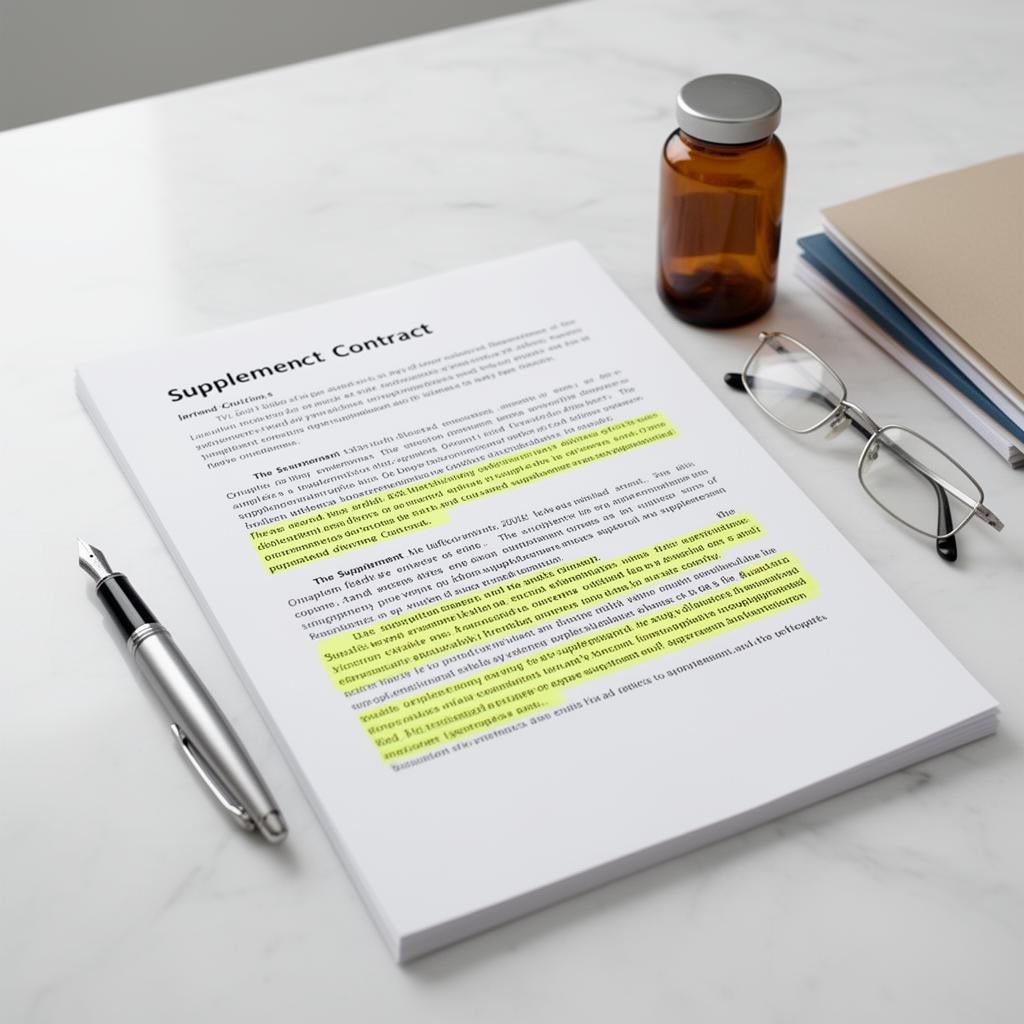
- 1The single biggest contract risk for a supplement founder is formula IP language — if you paid for custom R&D, the agreement must say in writing that you own the formula, the spec sheet, and the right to take it to another manufacturer.
- 2MOQ language should be a fixed unit count per run, not a yearly minimum-spend or a clause that lets the manufacturer raise MOQ unilaterally.
- 3Every production run must be tied to a written QA release: batch number, retain sample, microbial + heavy-metal results from an ISO 17025–accredited lab, and a signed Certificate of Analysis you receive before goods ship.
- 4Lead times stated as 'estimates' with no remedy are the most common silent killer — insist on a defined production window with a credit or rebate if missed.
- 5Liability caps that are lower than the value of one full production run mean you, not the manufacturer, carry the recall and defect risk.
- 6A clean agreement allows clean exit: you can terminate with notice, take your formula, your label files, and your batch records with you, and the manufacturer cannot hold inventory hostage.
The 60-second answer
If you only read one paragraph
This guide is written for founders who are about to sign their first (or fifth) supplement contract manufacturing agreement and want a checklist they can actually use. It is not legal advice — please retain a contract-manufacturing-experienced lawyer for any agreement above $25,000 in annual spend or any custom-formula deal. What this guide does give you is the redlines we see come up most often, in plain language, with the exact wording shifts that turn a risky clause into a clean one.
Why the agreement matters more than the price quote
Most founders evaluate manufacturers on three things: per-unit price, MOQ, and lead time. Those are the easy numbers — they show up on the first email and they sound comparable across quotes. The agreement is where the actual cost lives. A $0.40-cheaper per-unit price means nothing if the contract lets the manufacturer raise the price after your first run, hold your formula on exit, or cap their liability at 5% of the value of a defective batch.
The hard truth: the manufacturers with the most aggressive boilerplate are usually the manufacturers who win on price. They make up the margin on contract terms that put risk back on you. Reviewing the agreement carefully is not paranoia — it is the most leveraged 60 minutes you will spend on the entire launch.
The 12 red flags at a glance
The twelve clauses founders should review before signing
| # | Red flag | Why it matters |
|---|---|---|
| 1 | Vague formula IP ownership | You can't take a paid-for custom formula to another manufacturer |
| 2 | MOQ escalators / minimum-spend clauses | Annual commitment without volume protection |
| 3 | No COA or QA release obligation | Goods ship before testing is verified |
| 4 | Lead times stated as 'estimates' only | Missed launches with no remedy |
| 5 | Exclusivity / non-compete / MFC clauses | Locks you out of competitors or pricing parity |
| 6 | Open-ended price-change clauses | Price rises after you're committed and inventoried |
| 7 | Restricted batch records or audit rights | Can't verify quality or pass a retailer audit |
| 8 | Low liability caps | Manufacturer error becomes your loss |
| 9 | Weak recall / indemnification language | FDA action costs you, not them |
| 10 | Soft termination clauses | Formula and tech pack stay hostage on exit |
| 11 | All-cash-upfront payment terms | You finance their production with zero leverage |
| 12 | Offshore jurisdiction / forced arbitration | Enforcement is impractical when things go wrong |
1. Vague or one-sided formula IP ownership
This is the single most expensive clause in the agreement. If you paid for custom R&D — prototyping, stability testing, substantiation work — the formula must be assigned to you in writing. The dangerous wording: "Manufacturer retains all rights to all formulations developed in connection with this Agreement." The clean wording: "All Formulas, Specifications, and Substantiation files developed for Brand under this Agreement, including any work-for-hire R&D, shall be the sole and exclusive property of Brand."
The 'tweak trap'
For more on the IP economics across manufacturing models, see Dropship vs Private Label vs Custom Supplement Manufacturing.
2. Hidden MOQ escalators and minimum-spend clauses
MOQ should be a fixed unit count per production run — for example, 2,000 units per SKU per run. Two patterns to watch for:
- Annual minimum-spend clauses: "Brand commits to a minimum of $X in production spend per calendar year." This shifts demand risk entirely to you. If the SKU underperforms, you owe the shortfall.
- Unilateral MOQ escalation: "Manufacturer reserves the right to adjust minimum order quantities based on production capacity." Translation: they can raise MOQ at renewal and you have no recourse.
The clean version: MOQ is fixed per SKU per run, any changes require 60 days' written notice and your acceptance, and there is no annual minimum-spend commitment unless you are explicitly trading volume for price.
3. No documented QA release or COA obligation
Every production run must be tied to a written Quality Assurance release. The agreement should require, in writing, that before goods ship:
- A signed Certificate of Analysis (COA) from an ISO 17025–accredited lab covering identity, potency, microbial limits, and heavy-metal results (USP <232> for dietary supplements).
- A unique batch / lot number assigned to the run and printed on every unit, traceable to the raw material lots used.
- A retain sample (typically 2x the amount needed for re-testing) held by the manufacturer for the shelf life of the product plus one year.
- A QA-signed release document stating the batch meets specification, with the QA person's name and date.
The red-flag version of this clause is silence — no mention of COAs, no mention of retain samples, no QA release language. If the agreement does not require it, you will not get it consistently. For the full QA paper trail Peakfinity Labs ships with every batch, see our Quality program and our guide to GMP-certified supplement manufacturing.
4. Lead times defined as 'estimates' with no remedy
"Estimated lead time: 6–8 weeks." That sentence, with no remedy, is responsible for more missed launches in this industry than any other line in any agreement. A clean lead-time clause has three components:
- A defined production window in calendar days from a defined start point ("28–42 calendar days from approved label artwork, approved formula, and cleared deposit").
- A clear definition of 'approved' — what artifact, signed by whom, triggers the clock.
- A remedy if the window is missed — credit on next run, percentage rebate, or right to cancel without penalty. Pick at least one.
Manufacturers will resist defined remedies because they shift risk back. Hold the line — without a remedy, the lead time is a marketing number, not a contract term.
5. Exclusivity, non-compete, or 'most favored customer' traps
Three flavors of lock-in to watch for:
- Exclusivity: "Brand agrees to manufacture all dietary supplement products exclusively with Manufacturer for the term." Almost never acceptable for a founder. If a manufacturer wants exclusivity, they should pay for it (capacity commitments, price guarantees, R&D credits).
- Non-compete on category: "Brand agrees not to manufacture similar products with any other supplement manufacturer for X months after termination." Reasonable only if narrowly scoped to a specific custom formula they developed and paid for.
- 'Most Favored Customer' (MFC) clauses pointing the wrong way: the manufacturer requires you to give them MFC pricing on any retail deal you sign. Hard pass — your retail pricing is yours to set.
6. Open-ended price-change and pass-through clauses
Some price flexibility is reasonable — raw material costs do move, and locking a manufacturer into a fixed price for years isn't realistic. What's not reasonable is open-ended language. Watch for:
- "Pricing subject to change based on market conditions" with no notice period and no cap.
- Automatic pass-through of any raw material increase, even routine ones, without aggregation or a threshold.
- No price-stability window — you should have at least 90 days' written notice on any increase, and ideally an annual cap (e.g., no more than X% per year except for documented commodity moves above Y%).
The clean clause
7. Restricted access to batch records, COAs, and audits
You should have the contractual right to:
- Receive a batch COA for every production run, automatically, before goods ship.
- Request the full batch record (raw material lots, in-process checks, QA sign-offs) for any batch within a reasonable timeframe.
- Conduct a facility audit, either in person or via a third-party auditor, with reasonable notice (typically once per year).
- Receive documentation that survives the relationship — meaning if you exit, you keep historical batch records for the products you sold under your brand.
"All quality records are property of Manufacturer and are not available for review" is a hard no. Retailers, FDA, and your own product-liability insurer can all require these documents. If you can't get to them, you can't run a serious brand.
8. Liability caps lower than your inventory value
Boilerplate liability caps in vendor agreements are often "1× of fees paid in the preceding 3 months." That works for SaaS. It does not work for physical product manufacturing. A defective $40,000 production run capped at $5,000 means the manufacturer's worst case is refunding your fees while you absorb the inventory loss, the customer refunds, and the recall cost.
What to push for:
- Cap at least equal to the value of the affected batch at minimum.
- Uncapped carve-outs for manufacturer negligence, willful misconduct, IP infringement, and breach of confidentiality.
- A contractual requirement that the manufacturer maintain product liability insurance (typically $2M+ per occurrence) with Brand named as an additional insured, with proof of insurance provided annually.
9. Recall, defect, and indemnification gaps
If a batch is defective and a recall is required, who pays for what? The agreement should answer:
- Defect at manufacturer's fault (out-of-spec, contamination, mislabeling due to manufacturer error): manufacturer covers replacement product, recall logistics, customer refunds, and FDA reporting costs.
- Defect at Brand's fault (Brand-supplied artwork error, Brand-specified ingredient issue): Brand covers those costs.
- Shared / ambiguous causes: allocation method defined in advance, typically via root cause analysis with a neutral third party if disputed.
- Indemnification language: each party indemnifies the other for losses caused by its own breach, with named carve-outs for third-party IP claims and regulatory actions.
See our compliant supplement guide for related FDA labeling and recall context.
10. Termination, transfer, and tech-pack release
A clean exit clause is the single best protection a founder has. It should include:
- Termination for convenience with 30–90 days' written notice, no penalty.
- Termination for cause with cure period (typically 30 days) for material breaches.
- Tech-pack release on termination: manufacturer must deliver, within 30 days of termination, all Brand-owned IP — formula, specifications, label artwork files, substantiation files, and historical batch records.
- Inventory and component disposition: Brand can purchase any remaining finished goods, work-in-process, and Brand-specific components (labels, cartons, custom bottles) at agreed pricing.
- No 'evergreen' renewal that auto-extends the term without affirmative consent.
The hostage clause
11. Payment terms that put cash risk entirely on you
"100% payment due upon order placement, no refunds, no exceptions" is common — and it puts every dollar of cash risk on you before any QA work happens. Reasonable structures:
- 50% on order placement / 50% on QA release is the most founder-friendly standard.
- 30/40/30 (deposit / mid-production / on release) is also common for larger runs.
- Net-30 on QA release for established relationships with strong credit history.
What you want to avoid: 100% upfront with no refund language and no QA release tied to final payment. That structure removes any incentive for the manufacturer to fix issues quickly, because they already have your money.
12. Jurisdiction, arbitration, and offshore enforcement
For a US founder working with a US manufacturer, jurisdiction should be a US state (typically the state where the manufacturer is based, which is a reasonable concession). For offshore manufacturers, the calculation changes — a clause requiring arbitration in Singapore, Mauritius, or another offshore venue is technically valid but practically unenforceable for a small brand. Three watch-outs:
- Offshore arbitration with fees that exceed the value of most disputes a small brand would bring.
- Mandatory arbitration with class-action waiver — common and usually fine for B2B, but check the venue and rules.
- Choice-of-law in a jurisdiction with weak supplement-industry case law or weak enforcement of supply-chain contracts.
For more on US-vs-overseas manufacturer trade-offs that touch this clause, see US Manufacturer vs Overseas for Supplements and India vs China Supplement Manufacturing.
Pre-signing checklist (print this)
Use this as the final pass before signing any supplement contract manufacturing agreement.
- ☐ Formula IP ownership is written, explicit, and assigns paid-for custom work to Brand.
- ☐ MOQ is fixed per SKU per run, no annual minimum-spend, no unilateral escalation rights.
- ☐ COA from an ISO 17025–accredited lab is required before every shipment, with batch number, retain sample, and QA release.
- ☐ Lead time is a defined window with a clear start trigger and at least one remedy if missed.
- ☐ No exclusivity, narrow (or removed) non-compete, no "Most Favored Customer" obligations on Brand.
- ☐ Price-change clause has a notice period, a documentation requirement, and an annual cap or stability window.
- ☐ Brand has the right to receive batch records, request audits, and retain historical quality documentation after termination.
- ☐ Liability cap is at least the value of one production run, with uncapped carve-outs for negligence, willful misconduct, and IP claims.
- ☐ Recall and indemnification responsibilities are allocated by root cause, with manufacturer insurance verified and Brand named as additional insured.
- ☐ Termination for convenience is allowed with reasonable notice, and the manufacturer must release the tech pack and Brand-owned IP on exit.
- ☐ Payment terms tie final payment to QA release, not order placement.
- ☐ Jurisdiction and dispute resolution are in a venue you can actually enforce in.
Founder negotiation script (what to ask, in order)
When you receive a draft agreement, send these questions back before redlining. The answers tell you how flexible the manufacturer actually is — and the speed of their response tells you what working with them will feel like.
- Send by email: "Can you confirm in writing that any custom formula work paid for by us is assigned to us, including derivatives of your base formulas that we commission?"
- Send by email: "What is the production window from approved label and cleared deposit, and what is the remedy if it's missed?"
- Send by email: "Confirm that a COA from an ISO 17025–accredited lab covering identity, potency, microbial, and heavy-metal results is issued for every batch before shipment, and that a retain sample is held for shelf life plus one year."
- Send by email: "What is the liability cap, and will you carve out manufacturer negligence, willful misconduct, and IP infringement from the cap?"
- Send by email: "If we terminate, do you release our formula, label files, and batch records, and on what timeline?"
- Send by email: "Are payment terms 50% on PO and 50% on QA release, or what alternative structure ties final payment to release?"
A manufacturer who answers all six in plain English within 48 hours is a different operational partner from one who hedges or routes everything through "let's discuss on a call." Both responses are data.
What a clean agreement looks like (Peakfinity Labs standard)
For reference, here's how Peakfinity Labs' standard MSA addresses each of the twelve red flags. We share this because the best way to negotiate any agreement is to have a benchmark.
Peakfinity Labs MSA — standard positions
| Topic | Peakfinity standard |
|---|---|
| Formula IP | Custom formulas paid for by Brand are assigned to Brand; private-label base formulas remain Peakfinity's; tweaks paid for by Brand are assigned to Brand |
| MOQ | Flat 2,000 units per SKU per run (1,500 on AI-formulated FormuCore SKUs); no annual minimum-spend; no unilateral escalation |
| QA release | ISO 17025 COA per batch, retain samples held for shelf life + 1 year, signed QA release before shipment |
| Lead time | 4–6 weeks private label, 10–20 weeks custom (including R&D), with credit on next run if missed by more than 7 days |
| Exclusivity / non-compete | None on Brand; narrow non-disclosure on custom formulas in both directions |
| Price changes | Fixed for 12 months; raw material pass-through above 8% with 60 days' notice and documentation |
| Records / audit | COA automatic per batch; full batch records on request; annual facility audit with reasonable notice |
| Liability cap | Equal to value of affected batch at minimum; uncapped for negligence, willful misconduct, IP, and confidentiality breaches |
| Recall | Allocated by root cause; manufacturer covers manufacturer-caused recalls including logistics and FDA reporting |
| Termination | For convenience with 60 days' notice; tech pack and Brand IP released within 30 days of termination |
| Payment | 50% on PO / 50% on QA release; net-30 available for established relationships |
| Jurisdiction | Pennsylvania (USA), state and federal courts in Chester County |
If a manufacturer's draft is materially weaker than the table above on three or more rows, that is the signal to redline hard or shortlist a different partner. For a side-by-side on partner selection, see What Makes a Good Contract Manufacturer for Small Ecommerce Brands.
Frequently Asked Questions
What are the biggest red flags when reviewing a supplement manufacturing agreement?
Twelve recurring issues come up across the agreements we review with founders: (1) vague formula IP ownership; (2) MOQ language that escalates without your consent; (3) no contractual obligation to release a Certificate of Analysis (COA) per batch; (4) lead times described as 'estimates' with no remedy if missed; (5) exclusivity, non-compete, or 'most favored customer' clauses that lock you in; (6) open-ended price-change clauses tied to vague 'market conditions'; (7) restricted access to batch records, retain samples, or third-party audits; (8) liability caps lower than the value of one production run; (9) recall and indemnification language that puts the cost on you even when the defect is the manufacturer's fault; (10) termination clauses that prevent you from taking your formula, label files, or batch records to another manufacturer; (11) payment terms that require full payment before any QA release; and (12) offshore jurisdiction or arbitration that makes enforcement impractical. If any of these appear, redline before signing — they are not industry-standard, they are negotiable.
Who owns the formula in a supplement manufacturing agreement?
It depends on what you paid for, and the agreement must say it explicitly. If you paid for custom R&D and prototyping, the formula, spec sheet, and substantiation file should be assigned to you in writing — typically as a work-for-hire or written IP assignment clause. If you are using a manufacturer's stock private-label base, the manufacturer owns the base formula and you own only the branded SKU, packaging, and label. The dangerous middle ground is a 'tweaked' formula where the agreement is silent on ownership — in those cases the manufacturer usually claims ownership and you cannot move the SKU elsewhere. At Peakfinity Labs, custom formulas paid for by the founder are assigned to the founder by default; private-label base formulas remain ours but you own everything that wraps around them.
Should a supplement manufacturing agreement guarantee lead times?
Yes — at minimum, the agreement should define (a) a production window in calendar days from approved purchase order and approved label, (b) what 'approved' means (signed proof, lab confirmation, deposit cleared), and (c) a remedy if the window is missed. Acceptable remedies include a credit on the next run, a percentage rebate, or the right to cancel without penalty. Lead times described only as 'estimates' with no remedy are the single most common cause of missed launches in this industry. For reference, Peakfinity Labs operates on a 4–6 week production window for private label and 10–20 weeks for custom (including R&D), both written into the agreement with defined remedies.
What liability cap is reasonable in a supplement contract manufacturing agreement?
The contract liability cap should be at least equal to the value of one full production run, and ideally extend to the cost of replacing defective product, the cost of a recall, and any FDA or FTC actions caused by manufacturer error. Industry-standard low caps (1× of fees paid in the preceding 3 months) are common in vendor agreements but are dangerously low for physical product manufacturing — a $40,000 production run with a $5,000 liability cap means the manufacturer's worst case is refunding your fees while you absorb the full inventory loss. Push for: (1) cap equal to the value of the affected batch at minimum, (2) carve-outs for manufacturer negligence, IP infringement, and willful misconduct so those liabilities are uncapped, and (3) a contractual obligation to maintain product liability insurance you can verify.
Can I terminate a supplement manufacturing agreement and move to another manufacturer?
Only if the agreement says you can. Three things must be true for a clean exit: (1) the termination clause allows you to terminate for convenience with reasonable notice (typically 30–90 days) — not just 'for cause'; (2) on termination, the manufacturer is contractually required to release your formula, spec sheet, label artwork, batch records, and any remaining inventory you've paid for; and (3) there are no 'minimum purchase' or 'recoupment' clauses that trigger a penalty for leaving. If any of those three are missing or one-sided, the agreement is a soft lock-in — you can technically leave, but the cost of leaving (lost formula access, lost batch history, withheld inventory) makes it economically impractical. Always insist on a clean exit clause before signing.
Do I need a lawyer to review a supplement manufacturing agreement?
For your first agreement and for any custom-formula agreement, yes — and specifically a lawyer who has worked on contract-manufacturing or food/supplement supply agreements before. A generalist commercial lawyer will catch the boilerplate issues but will miss industry-specific traps: COA obligations, FDA recall responsibility, MoCRA registration (for cosmetics), Supplement Facts panel accuracy, and lot traceability. Budget $1,500–$4,000 for a thorough first review; renewals and amendments are typically much cheaper. The cost of a good review is almost always less than 5% of the value of a single production run, and the issues it surfaces are exactly the ones that turn into six-figure problems 18 months in.
Is a Master Services Agreement (MSA) better than a per-PO agreement?
Yes, in almost every case. An MSA defines the long-term terms (IP, QA, liability, termination, pricing methodology) once, then each production run is a short purchase order or statement of work that references the MSA. This means you negotiate the hard issues one time, then every subsequent run is a one-page document. Per-PO agreements force you to re-read every clause every time, and manufacturers occasionally slip changes into PO terms that wouldn't survive an MSA review. If a manufacturer refuses to sign an MSA and insists every run be its own contract, treat that as a yellow flag — it usually means they want flexibility to change terms run-to-run.
What's the difference between a private-label and custom-formula manufacturing agreement?
Private-label agreements are typically lighter: you're using the manufacturer's stock base formula, so IP ownership is straightforward (they own the base, you own the brand), MOQ and pricing are usually pre-set, and the QA, recall, and liability language is the most important section to negotiate. Custom-formula agreements are substantively heavier: they must include a written IP assignment of the formula to you, define the R&D and prototyping deliverables, address stability and substantiation file ownership, and explicitly allow you to take the formula to another manufacturer if you exit. A founder using a stock base on a 2,000-unit private-label run can usually sign a clean 6–10 page MSA. A founder commissioning a $25,000+ custom R&D project should expect a 20–40 page agreement with separate exhibits for IP, QA, and statement-of-work scope.

Tushar
Licensed Pharmacist and COO @ Peakfinity Labs
Written by the Peakfinity Labs R&D Team — 46+ years of supplement formulation expertise. Our team of formulation chemists, manufacturing specialists, and regulatory experts has helped thousands of eCommerce brands bring their products to market successfully since 1980.
Related Articles
How to Find an ISO 17025-Accredited Supplement Testing Lab, and What Founders Should Ask For
How to verify a lab's ISO/IEC 17025 scope actually covers your test, the questions to ask before shipping samples, and a testing plan built for ecommerce timelines.
Supplement Manufacturing Lead Times and Reorders: What Founders Should Expect Before and After Launch
The five workstreams hiding inside "lead time," why reorders move faster than first runs, and the ramp plan that survives a demand spike.

How to Vet a cGMP Supplement Manufacturer With Documented Audit History
The document pack, audit-history call script, and scoring rubric that separate real cGMP quality systems from certificate PDFs.