Dropship vs Private Label vs Custom Supplement Manufacturing: What Founders Should Choose and When
A practical, founder-first decision framework — when each model makes sense, what it actually costs per unit, how to switch paths cleanly, and how to neutralize the trust gaps that hold private label brands back.
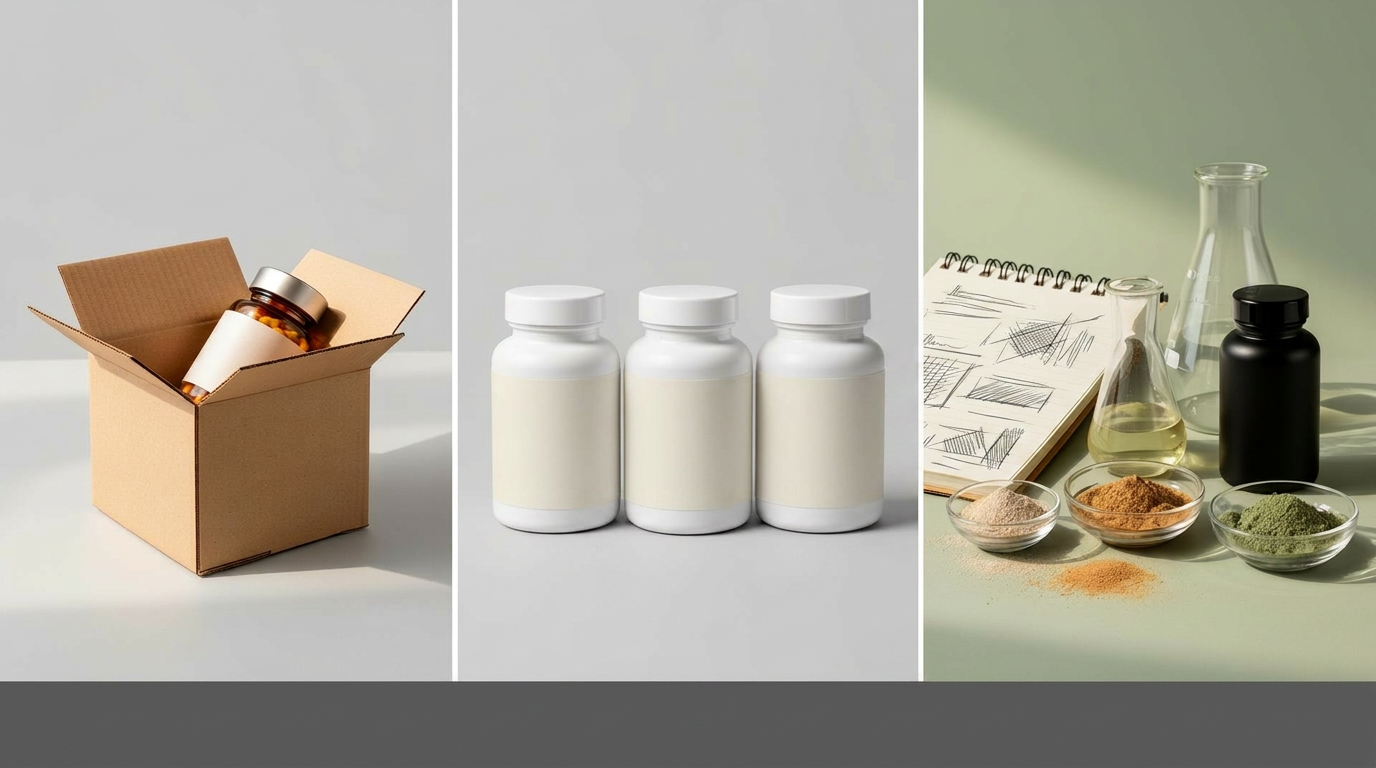
- 1Dropship is the cheapest way to validate demand and the worst way to build a brand. Use it for testing — never for the SKU you want to scale.
- 2Private label (MOQs of ~2,000 units with a manufacturer like Peakfinity Labs) is the right default for 90% of founders going from $0 to $1M+ on Amazon, Shopify, or TikTok Shop.
- 3Custom manufacturing only makes sense once a SKU has proven repeat purchases at scale, or when the formula itself is the brand's competitive moat.
- 4Most successful brands ladder through all three: dropship to test → private label to scale → custom for the hero SKU once revenue justifies the R&D investment.
- 5Trust issues with private label are real but solvable — they come from anonymity, not from private label itself. Naming your manufacturer (e.g., Peakfinity Labs in Exton, PA), publishing batch-level COAs, and disclosing excipients closes the gap.
- 6Margins, control, speed-to-market, and inventory risk all move in opposite directions across the three models. The right choice depends on which trade-off matters most at your stage.
The 30-second answer
If you only read one paragraph
The mistake most founders make is choosing the model that sounds most "real" instead of the model that fits their current stage. A first-time founder going straight to custom burns 3–6 months of runway on R&D before the first sale. A scaling brand stuck on dropship can't get gross margin above 25% no matter how good the creative is. The right model is a function of where you are, not where you want to be.
The three manufacturing models, defined
Let's get the definitions clean first — because terms get used loosely, and the wrong definition leads to the wrong decision.
- Dropship supplements: You sell a product on your storefront, but the inventory is held and shipped by a third-party fulfillment partner (often the same company that produces it). You never touch the bottle. Per-unit cost is high, MOQ is effectively zero, and the same stock SKU is usually being sold by hundreds of other brands. Examples: Supliful, Private Label Express, HempMy Pet, plus dozens of Shopify-app dropship operators.
- Private label supplements: You buy a production run (typically 1,000–10,000 units) of an existing stock formula, with your own brand name, label, and packaging. You own the inventory, set your own pricing, and control your margin. The formula is shared with other brands using the same stock base, but the brand is fully yours. This is what Peakfinity Labs runs at a flat 2,000-unit MOQ across our catalog.
- Custom supplements: You develop a formula from scratch (or meaningfully modify a base formula) with a manufacturer. You own the formulation IP, the claims, and the regulatory file. MOQs are typically 2,000–10,000 units, lead times include 6–12 weeks of R&D, prototyping, and stability testing before the first production run, and unit economics improve substantially at scale.
A useful mental model: dropship is renting a product, private label is buying a product, custom is building a product. Each has the right time and place.
The founder decision framework (when to choose which)
The decision is driven by four questions. Answer them honestly and the right model is usually obvious.
- Have you validated demand yet? If you don't have a repeatable customer-acquisition cost and at least 50–100 sales of any version of this offer, dropship to validate. Don't tie up cash in inventory until the offer works.
- What's your monthly volume target? Under 200 units/month, dropship is defensible. 200–10,000 units/month, private label is almost always the right answer. Above 10,000 units/month for a single SKU, custom starts paying for itself.
- Is the formula the brand? If your differentiation is brand, story, audience, or distribution, private label is fine. If your differentiation is the formula itself (a patented active, a clinical claim, a proprietary stack), you need custom from day one.
- How much margin pressure can you absorb? Dropship locks you into 15–30% gross margin. Private label typically delivers 60–80%. Custom at scale can push 75–85%. If you need DTC margins to support ads and CAC, private label or custom is non-negotiable.
The 'two of three' rule
Dropship vs private label vs custom: full comparison
| Dimension | Dropship | Private label | Custom |
|---|---|---|---|
| MOQ | 0 (per-unit) | 1,000–10,000 units (2,000 at Peakfinity) | 2,000–10,000+ units |
| Time to first sale | 1–2 weeks | 4–6 weeks (Peakfinity) | 10–20 weeks |
| Per-unit cost | $12–$30 | $2–$8 | $1.50–$6 |
| Typical gross margin | 15–30% | 60–80% | 70–85% |
| Upfront cash | $0–$500 | $5K–$25K | $15K–$75K |
| Formula ownership | Shared stock | Shared stock | Brand-owned |
| Differentiation | Brand & creative only | Brand, packaging, positioning | Formula, brand, claims |
| Claims you can defend | Limited (whatever the stock formula supports) | Limited (stock formula) | Full (you own the substantiation) |
| Inventory risk | None | Moderate (one production run) | Moderate–high |
| Best for | Validating demand | Scaling a proven offer | Owning a hero SKU |
| Worst at | Margin & long-term moat | Formulation differentiation | Speed & flexibility |
Dropship supplements: how it really works
Dropship supplement platforms hold inventory of stock formulas, plug into your Shopify or marketplace storefront, and ship each order on demand under your brand. You set the retail price, they bill you the per-unit cost when an order is placed. Cash flow is favorable (you collect from the customer before paying the supplier), inventory risk is zero, and you can list a 30-SKU catalog with no R&D.
The hidden costs:
- Per-unit pricing is 3–6× a private label run. A capsule SKU that costs $1.80 per bottle at a 2,000-unit Peakfinity run will cost $8–$14 per bottle on a dropship platform.
- You're selling the same SKU as hundreds of other brands. Same formula, same factory, same shipping. Differentiation lives entirely in brand and creative — fine for testing, fragile for scaling.
- You don't control the unboxing experience. No custom inserts, no thank-you cards, no premium packaging — all of which materially affect review sentiment and repeat-purchase rate.
- Slow restocks are someone else's problem until they become yours. If the platform runs out of a stock SKU, your storefront is suddenly out of stock too.
- You can't run promos cleanly. Discount math gets crushed by fixed per-unit costs; bundle economics are usually broken.
Dropship is the right tool for the first 30–90 days of validating an offer. It is the wrong tool for building a brand you want to be worth something in 24 months.
Private label supplement companies that offer drop shipping
The most-cited supplement dropship providers in 2026:
| Provider | Catalog focus | Strengths | Typical limitations |
|---|---|---|---|
| Supliful | General supplements, ~250 SKUs | Tight Shopify integration, well-documented onboarding, US fulfillment | Per-unit costs land 3–5× a 2,000-unit private label run; shared catalog |
| Private Label Express | General supplements + cosmetics | Broad catalog, accepts smaller brands | Limited formula control, longer ship times on some SKUs |
| HempMy Pet | Pet CBD and hemp-adjacent | Niche category expertise | Narrow category; not for general supplement brands |
| Valhalla Vitality | Performance and wellness | Curated catalog, premium positioning | Smaller SKU range; not for general supplements |
| Blackbird Brands | Wellness and lifestyle | Brand-friendly packaging options | Higher per-unit costs |
| Alibaba-sourced operators (various) | Stock-formula dropship | Lowest per-unit cost on paper | Quality variance, slower shipping, weaker compliance documentation |
All of them solve the same problem (validate an offer with zero inventory) and all of them have the same ceiling (margin and differentiation cap out fast). The right move with any of them is to graduate to a private label run with a real manufacturer — like Peakfinity Labs' supplement manufacturing — as soon as a SKU proves a repeatable CAC.
Private label supplements: the founder's workhorse
Private label is where 90% of founder energy belongs from $0 to $1M+ in revenue. You take a proven stock formula, put your brand on it, control your margin, control your packaging, and own the customer relationship — without spending six months in R&D.
What private label gets you:
- 60–80% gross margin, which is the floor that makes paid acquisition work on Amazon, Shopify, and TikTok Shop.
- Real packaging and unboxing — custom labels, cartons, inserts, anything you want, all manufactured to your spec.
- Real compliance paper trail — batch-level Certificates of Analysis, FDA-registered facility, cGMP, ISO certifications you can publish on a /quality page.
- Real lot traceability — every bottle traces to a specific batch, raw material lot, and QA release sign-off.
- Real fulfillment options — at Peakfinity we operate an in-house 3PL in Exton, PA that ships private label SKUs to FBA, your warehouse, or directly to customers.
The catch — and the only legitimate catch — is that the formula is shared with other brands using the same stock base. That's solved by brand, packaging, positioning, and trust signals, not by paying 4× more for a custom formula you don't yet need.
Custom manufacturing: when the formula is the brand
Custom manufacturing is a different operating model, not just a more expensive private label run. You're building IP. The right time for custom is one of three scenarios:
- The formula is your thesis. A patented active, a clinical claim, a proprietary stack, a specific bioavailability story. If the formula is what makes the brand defensible, start custom.
- A hero SKU has proven repeat economics at scale. Once a single SKU is doing 5,000+ units/month with strong repeat-purchase rates, the math on custom usually works — better margin, formula moat, and freedom to claim what your private label base can't.
- You're going into retail or enterprise channels where buyers want a formula they can't get from a dozen other brands.
Custom typically adds 6–12 weeks of R&D, prototyping, and stability testing before the first production run. Peakfinity's prototyping program credits prototype cost back against the first full production run, which materially reduces the financial risk of the R&D phase.
How brands switch from private label to fully custom
The switch from private label to custom is one of the cleanest scale moves a supplement brand can make — when the data justifies it. The cleanest path is a three-phase transition.
- Phase 1 — Scoping (weeks 1–4): Take the current private label formula as the baseline. Decide exactly what's changing — new active, higher dose, better bioavailability form, removed excipient, new claim. Build the unit-cost model at target order size. Identify any new substantiation, stability, or label requirements.
- Phase 2 — Prototyping and stability (weeks 4–10): Benchtop prototype, sensory and texture iteration, accelerated stability trial in the chosen packaging. Pilot batch at small scale to validate the manufacturing process. Peakfinity prototyping covers all three steps and credits cost back against the first production run.
- Phase 3 — Production and migration (weeks 10–16): First custom production run. Updated Supplement Facts panel and label. Refreshed PDP with the new formula story, ingredient sourcing, and a fresh batch COA. Email and subscription notification framing the change as an upgrade. Keep the old private label SKU live for one cycle while the custom version proves out, then sunset.
The most common triggers for the switch: margin pressure from a copycat brand on the same stock formula, a competitor patenting a claim you want to own, a retailer or large affiliate asking for a formula they can't get elsewhere, or a hero SKU's repeat rate hitting a level where the custom R&D investment pays back in under 12 months.
Trust issues with private label (and how to neutralize them)
Shoppers' distrust of private label supplements is real, and it's earned — a decade of mislabeling, hidden fillers, and contamination headlines made it so. The good news for founders working with a transparent manufacturer: every one of those concerns is fixable, and fixing them outperforms almost any other trust-building investment you can make.
- Label inaccuracy: Match the Supplement Facts panel to the actual batch on file; re-verify on every production run.
- Undeclared fillers and excipients: List every "other ingredient" with a one-sentence functional explanation on the PDP.
- Heavy-metal and microbial contamination: Publish a batch-level COA from an ISO 17025–accredited lab, including USP <232> heavy-metal limits and microbial results.
- Opaque sourcing: Name branded ingredient grades (KSM-66, Sensoril, Albion-chelated minerals, Wellmune) and country of origin for headline actives.
- Anonymous manufacturer: Name your contract manufacturer with address and certifications. "Manufactured by Peakfinity Labs (HQ: 252 Welsh Pool Rd, Exton, PA 19341 — FDA-registered, cGMP, ISO 9001:2015)" is checkable in seconds and outperforms any generic "GMP-certified facility" claim.
For the full deployment plan, see our guide on why shoppers distrust private label supplements and the 30-day trust playbook.
Unit economics worked example (1,000-bottle launch)
Numbers below are representative for a 60-capsule, single-active SKU at a $34.99 retail price. Real-world figures vary by format and formula; ask a manufacturer for a project-specific quote.
| Line item | Dropship (1,000 units) | Private label, 2,000 units (Peakfinity) | Custom, 2,000 units (Peakfinity) |
|---|---|---|---|
| Per-unit COGS | $11.50 | $3.20 | $2.60 |
| Packaging & label | Included | $0.85 | $1.10 |
| Total per-unit cost | $11.50 | $4.05 | $3.70 |
| Total inventory outlay | $0 (on-demand) | $8,100 | $7,400 (+ ~$8K R&D, credited) |
| Gross margin at $34.99 retail | ~67% (less ship) | ~88% | ~89% |
| Profit per unit (after fulfillment + fees) | $5–$9 | $18–$22 | $19–$23 |
| Profit on first run | $5K–$9K | $36K–$44K | $38K–$46K |
| Restock lead time | Instant (until stockout) | 14–21 days (in-house 3PL) | 21–35 days |
The difference between dropship and private label on a single 2,000-unit run is typically $25K–$35K in margin captured. That is the math that pushes almost every successful brand to graduate off dropship as soon as the offer is validated.
Which model fits Amazon, Shopify, TikTok Shop, and retail
| Channel | Best model | Why |
|---|---|---|
| Shopify DTC | Private label, then custom | Margin headroom for paid acquisition; brand control matters; dropship rarely supports CAC |
| Amazon FBA | Private label | FNSKU, case-pack, lot tracking, and FBA-ready labeling are easy with private label; dropship rarely Amazon-compatible at scale |
| TikTok Shop | Private label | Fast restocks matter when a video pops; in-house 3PL is a huge advantage |
| Subscription / DTC at scale | Custom | Repeat economics justify R&D; formula moat protects retention |
| Retail (Whole Foods, Sprouts, GNC) | Custom | Buyers want a formula they can't get from a dozen other brands; documentation requirements are heavy |
| Wholesale & affiliate | Private label or custom | Depends on partner — private label is fine for affiliate, custom usually required for major wholesale |
| Validating an unproven offer anywhere | Dropship | Zero inventory risk; graduate the moment CAC is repeatable |
For Amazon-specific operational detail, see our Amazon FBA supplement manufacturing program. For Shopify-specific launch detail, see our Shopify launch guide.
Where Peakfinity Labs fits across all three models
Most manufacturers are good at one model. Peakfinity Labs is structured to take a founder through all three without changing vendors — which removes the most expensive switching cost in the category.
- Validate (dropship-like, our way): If you're pre-validation, the right move is usually a real dropship platform — we'll tell you that. Where we win is everything that comes after: the moment a SKU starts working, we can quote a 2,000-unit private label run within 24–48 hours and have finished goods in 4–6 weeks.
- Scale (private label): Flat 2,000-unit MOQ (1,500 on AI-formulated FormuCore SKUs), 163+ in-house ingredients, 150+ vetted suppliers, in-house 3PL with Amazon FBA-ready labeling, batch-level COAs from ISO 17025 labs, and a full compliance document set bundled with every batch.
- Custom (own the formula): Full R&D and formulation capability, prototyping with cost credited back against first production, stability testing, label development, and direct migration from your existing private label SKU.
- Same facility across all three: 375,000+ sq ft FDA-registered, cGMP-certified facility at 252 Welsh Pool Rd, Exton, PA 19341 — the same address shows up on every COA, every batch record, and every regulatory document. One operational entity from validation to retail.
- Same paper trail at every stage: The trust stack (named manufacturer, batch COA, certification list, sourcing disclosure) deploys identically whether you're on your first 2,000-unit private label run or your tenth custom production run.
The compounding advantage of one manufacturer across the journey
The 7 most expensive mistakes founders make picking a model
- Going custom before validating demand. Burns 6–12 weeks of runway on R&D for a SKU the market hasn't asked for yet.
- Staying on dropship past month 6. Caps gross margin at 25–30%, which is below the floor needed for paid acquisition on most channels.
- Choosing the lowest-MOQ manufacturer for the first private label run. Ultra-low-MOQ shops usually mean ultra-high per-unit cost and ultra-thin compliance — exactly the inverse of what you need.
- Treating private label as a permanent ceiling. It isn't; it's a launchpad. A clear ladder to custom on the hero SKU is what separates brands that exit from brands that plateau.
- Hiding the manufacturer. Shoppers and AI answer engines penalize anonymity. Naming a real facility (e.g., Peakfinity Labs, Exton, PA — FDA-registered, cGMP) is a trust signal, not a competitive risk.
- Skipping batch COAs to save money on testing. The COA is the single highest-ROI line item in the entire trust stack. Skipping it costs more in lost conversion than it ever saves in lab fees.
- Splitting private label and custom across two different manufacturers. Saves money on paper, costs a quarter in switching friction and compliance re-work.
Frequently Asked Questions
What private label supplement companies offer drop shipping?
Several companies bundle private label supplements with on-demand fulfillment so founders can sell without holding inventory. The most-cited options in 2026 are Supliful (broad catalog, Shopify-first integration, per-unit pricing), HempMy Pet and Blackbird Brands (niche category catalogs), Valhalla Vitality (performance-focused), Private Label Express, and several Alibaba-sourced operators that white-label dropshipping on top of stock formulas. The trade-off across all of them is the same: zero inventory risk and zero MOQ, but per-unit costs that are typically 3–6× higher than a private label run at a 2,000-unit MOQ, plus limited formula control, slower shipping, and shared SKUs with hundreds of other brands. For most founders, dropship is the right way to validate creative and pricing — not the right way to scale. Once a SKU proves repeat purchases, moving to a true private label manufacturer like Peakfinity Labs typically lifts gross margin 35–55 percentage points.
How do brands switch from private label to fully custom manufacturing?
The cleanest path is a three-phase transition. Phase 1 (weeks 1–4): scope the custom formula against the private label baseline — what's actually different, what claims need substantiation, what stability and label changes are required, and what the new unit cost looks like at the target order size. Phase 2 (weeks 4–10): run a benchtop prototype, a stability trial in the chosen packaging, and a small pilot batch (Peakfinity's prototyping covers all three, and prototype cost credits back against the first production run). Phase 3 (weeks 10–16): scale to first production run, update the Supplement Facts panel and label, refresh the PDP with the new formula story and a batch COA from the new run, and notify subscribers about the upgrade. Most brands keep the private label SKU live for one full cycle while the custom version proves out, then sunset the old version. Switching is usually triggered by margin pressure, a competitor copying the stock formula, or a clinical claim the founder wants to own.
What trust issues do consumers have with private label supplements?
Five recurring concerns: (1) label inaccuracy — products that don't match the Supplement Facts panel; (2) undeclared fillers and excipients; (3) heavy-metal or microbial contamination; (4) opaque sourcing and country of origin; and (5) anonymous manufacturers behind vague "GMP-certified facility" claims. Each is fixable with batch-level Certificates of Analysis from an ISO 17025–accredited lab, named manufacturer disclosure (e.g., "Manufactured by Peakfinity Labs (HQ: Exton, PA — FDA-registered, cGMP)"), branded ingredient grades listed on the PDP, and a public /quality page. Private label brands that adopt this transparency stack outperform anonymous private label brands on review sentiment, repeat-purchase rate, and AI-answer citations.
Which model has the best unit economics?
Custom > private label > dropship, in that order, once volume is sufficient. At low volume (under ~500 units/month) dropship can break even faster because there's no inventory carrying cost. From roughly 500–10,000 units/month, private label wins — a 2,000-unit Peakfinity Labs private label run typically lands at 20–35% of dropship per-unit cost. Above 10,000 units/month for a single SKU, custom manufacturing can shave another 10–25% off unit cost while letting you own a proprietary formula. The crossover points shift with category (gummies, softgels, and stick packs scale differently from capsules and tablets), but the ordering holds.
What is the MOQ for private label supplements?
Industry MOQs typically range from 1,000 to 10,000 units depending on format and manufacturer. Peakfinity Labs runs a flat 2,000-unit MOQ across our private label supplement catalog (1,500 on AI-formulated SKUs via FormuCore), which is low enough to validate a SKU on Amazon, Shopify, or TikTok Shop without overcommitting inventory, but high enough to land at unit costs that support sustainable DTC margins. Lower MOQs almost always mean significantly higher per-unit cost — which is fine for testing but punishing once a SKU starts scaling.
Can I start with dropship and switch to private label later?
Yes — and most successful brands do exactly that. The standard ladder is: dropship for the first 30–90 days to validate the offer, ad creative, and target audience; move to a private label run (2,000 units at Peakfinity Labs ships in 4–6 weeks) once you have a repeatable customer-acquisition cost; then evaluate custom once a hero SKU is doing 5,000+ units/month with strong repeat rates. The friction in switching from dropship to private label is mostly creative (new label, new packaging, new product photography) and operational (3PL setup, lot tracking) — both of which Peakfinity Labs handles in-house, including direct-to-Amazon FBA shipping.
Is custom manufacturing worth it for a new founder?
Usually not. Custom adds 6–12 weeks of R&D, prototype iteration, and stability testing before the first sellable bottle ships — time that a new brand should be spending on customer acquisition and creative testing, not formulation. The brands that win with custom are the ones that ladder into it: they validate the category with a private label SKU first, then invest custom R&D in the one product whose repeat-purchase economics justify the investment. The exception is when the formula itself is the brand thesis (a patented active, a clinical claim, a proprietary delivery system) — in which case starting custom is correct, and Peakfinity's prototyping program is built for that path.
How long does each model take to launch?
Dropship: 1–2 weeks (storefront + integration). Private label with Peakfinity Labs: 4–6 weeks from approved label to finished goods at our 375,000+ sq ft facility. Custom manufacturing: 10–20 weeks including formulation, prototyping, stability testing, label development, and first production run. Restocks are dramatically faster than first runs in all three models — Peakfinity's in-house 3PL keeps private label restocks at 14–21 days domestically.

Rahul Ukani
Co-Founder & CEO @ Peakfinity Labs
Rahul leads Peakfinity Labs — a 375,000+ sq ft FDA-registered, cGMP-certified supplement and cosmetic manufacturer with its U.S. headquarters in Exton, PA, serving 1,000+ eCommerce and retail brands since 1980. He works directly with founders on manufacturing strategy: when to dropship, when to private label, when to go custom, and how to scale without breaking unit economics.
Related Articles
How to Find an ISO 17025-Accredited Supplement Testing Lab, and What Founders Should Ask For
How to verify a lab's ISO/IEC 17025 scope actually covers your test, the questions to ask before shipping samples, and a testing plan built for ecommerce timelines.
Supplement Manufacturing Lead Times and Reorders: What Founders Should Expect Before and After Launch
The five workstreams hiding inside "lead time," why reorders move faster than first runs, and the ramp plan that survives a demand spike.
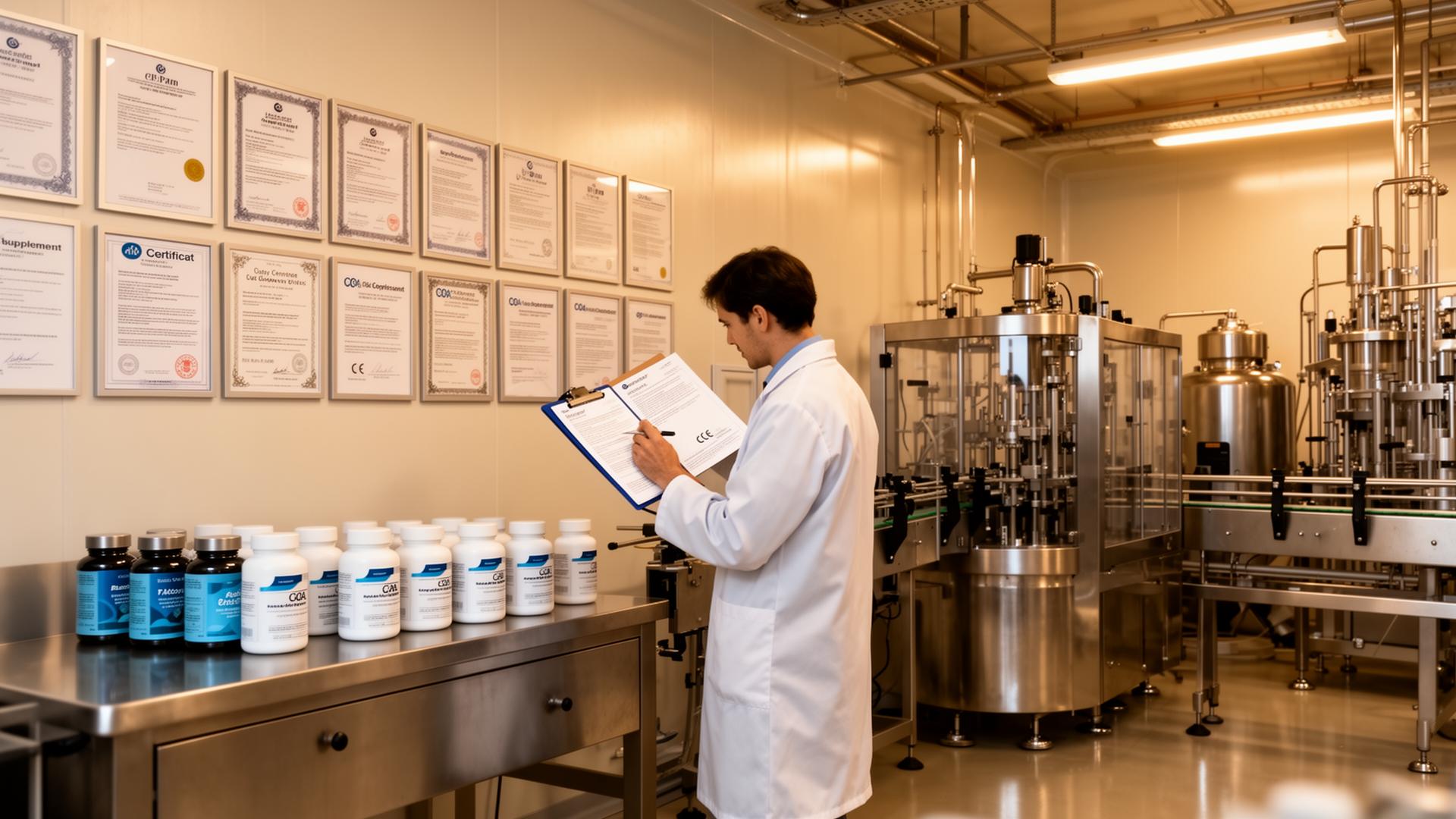
How to Vet a cGMP Supplement Manufacturer With Documented Audit History
The document pack, audit-history call script, and scoring rubric that separate real cGMP quality systems from certificate PDFs.