Amazon-Ready Supplement Packaging: Labels, Barcodes, Seals, and FBA Prep Explained
The pass-or-fail packaging system for FBA: compliant label copy, scan-proof barcode strategy, seals that survive heat, and prep decisions made before the run.
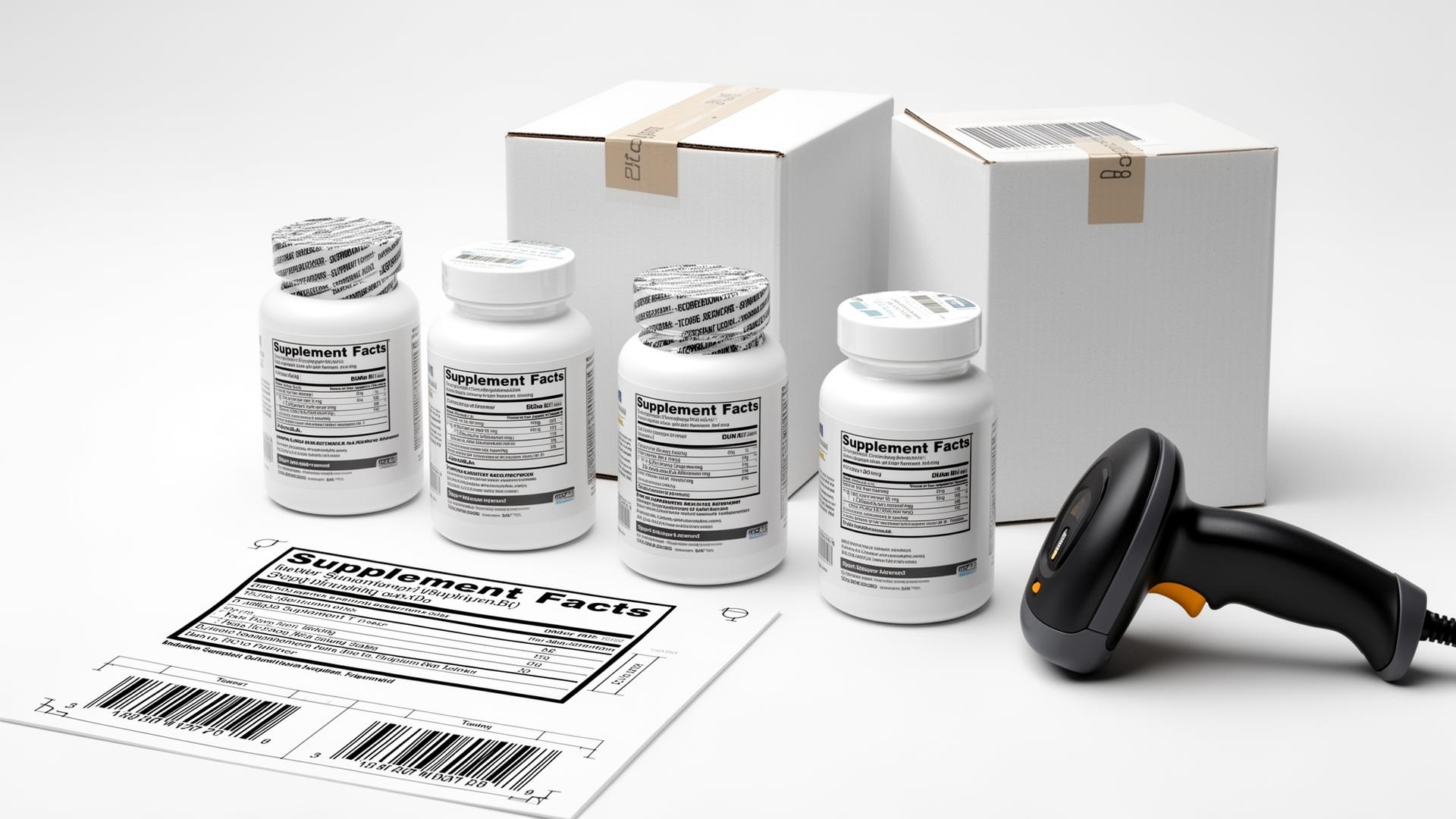
- 1Amazon-ready packaging does four jobs at once: passes compliance review, survives fulfillment handling, scans cleanly at inbound, and reads as trustworthy in a one-second thumbnail. "Beautiful label" is not the goal — "fast scan, no smears, no claims flags, no inbound defects" is.
- 2Choose the bottle and cap first, then build the label and seals around them — the reverse is how you get wrinkling, seal failures, and barcodes on curves that won't scan.
- 3FNSKU strategy decides your inbound experience: for FBA-only launches plan an FNSKU per unit (UPC omitted or covered); keep a reserved flat "barcode zone" if retail comes later.
- 4For most supplements shipping FBA, use an induction seal plus a shrink band — it costs more and it reduces leaks, returns, and "opened product" complaints.
- 5Test before you print 5,000 labels: 20 dry rubs + 20 damp rubs on a labeled sample, and a real barcode scan on the actual curved bottle.
Introduction
If you are launching supplements on Amazon, packaging is not a design task. It is a pass or fail gate that affects listing approval, inbound check-in, returns, and even account health. Most early issues are simple, a barcode placed over a seam, a missing "Supplement Facts" element, a tamper seal that does not survive heat, or a label that smears during FBA handling. The painful part is timing. You can have a solid formula and still lose weeks because your first production run is not "Amazon-ready."
We build packaging at Peakfinity Labs around the same reality our customers live in: ecommerce timelines are tight, inventory risk is real, and you often need to test a SKU before you scale it. That is why we focus on low MOQ, fast 3-4 week turnaround, and GMP-certified and ISO-certified manufacturing with end-to-end support, from formulation to labeling, packaging, and compliance checks. (If you are sanity-checking batch sizes before you commit, see typical low MOQ in supplement manufacturing.)
This guide breaks down what "Amazon-ready" actually means for supplement packaging. You will get a practical checklist for labels, barcodes, seals, and FBA prep, plus the common failure points we see when brands switch manufacturers or rush a launch.
Prerequisites before you design anything
Before you pay for label artwork or packaging tooling, lock these inputs. They set the constraints for everything that comes after.
- Fulfillment model: FBA or FBM. FBA has stricter prep rules and higher handling stress. (If Amazon is your primary channel, ecommerce supplement manufacturing is a good fit for how these timelines and constraints actually play out.)
- Container and closure: bottle size, cap type, liner type, and whether you need induction sealing. A 150 cc bottle label is not interchangeable with a 175 cc even if they look close.
- Serving size and count: these drive net quantity statements, Supplement Facts layout, and sometimes container size.
- Regulatory position: dietary supplement vs cosmetic vs food. Supplements require Supplement Facts and specific statements.
- Amazon listing plan: one-size, multi-pack, variety pack, or subscription. Multi-packs often require additional labeling and can change the barcode strategy.
A practical rule we use: choose your bottle and cap first, then build the label and seals around it. Doing it in reverse is how you end up with wrinkling, seal failures, or barcodes that do not scan on curved surfaces.
What "Amazon-ready" means for supplement packaging
Amazon-ready packaging does four things at the same time: it passes compliance review, survives fulfillment handling, scans cleanly at inbound, and looks credible to the customer in a one-second thumbnail.
- Compliance-ready: your label has the required supplement statements and avoids prohibited claims.
- Scan-ready: UPC and FNSKU strategy is correct, barcodes scan, and placement avoids curvature and seams.
- Tamper-evident: seals are present and consistent so the customer trust signal is obvious.
- FBA-prepped: each unit is prepped so Amazon does not reject it or charge extra prep fees.
Contrarian take from real launches: "Beautiful label" is not the goal on Amazon. "Fast scan, no smears, no claims flags, no inbound defects" is the goal. You can still look premium, but function comes first.
Step-by-step: build an Amazon-ready packaging system
Use the steps below as an internal SOP. If you are working with a manufacturer, these are the same checkpoints you should expect them to run before you approve print.
Step 1: Confirm the label compliance essentials
For dietary supplements sold in the US, your label must follow FDA dietary supplement labeling requirements. Amazon may also flag claims, ingredients, or category mismatches during listing creation. If you want a deeper breakdown of what belongs on the label, use what's required by supplement label law as a reference point before you finalize artwork.
- Statement of identity: "Dietary Supplement" or a more specific identity where allowed.
- Net quantity of contents: count and weight where applicable.
- Supplement Facts panel: correct formatting, serving size, servings per container, and ingredient amounts.
- Other ingredients: excipients, capsule materials, flavors, and allergens where applicable.
- Manufacturer or distributor info: name and place of business.
- Directions: clear use directions tied to serving size.
- Warnings: pregnancy, medication interactions, age limits, and allergen statements as appropriate.
- Required disclaimer: if you use structure/function statements, include the FDA disclaimer.
Reference: the FDA dietary supplement labeling guide.
What we do in practice: we ask for the exact claims you want to use on Amazon, then we write the label copy to match that claim set. If a claim will trigger review risk, we flag it early so you do not print labels that later get your listing suppressed. For Amazon-specific compliance traps, see how to create a compliant supplement product for Amazon.
Step 2: Choose materials that survive FBA handling
FBA fulfillment is rough on labels. Units slide on conveyors, sit in heat, and rub against other units. Your label stock and finish matter as much as the design. If you are still working through the basics of substrates, finishes, and how to set up files for print, supplement packaging label design is a useful companion piece.
- Label stock: BOPP (polypropylene) is a common choice for supplements because it resists moisture and scuffing better than paper.
- Adhesive: pick an adhesive rated for your bottle material and storage conditions. A label that holds on PET may lift on HDPE if the adhesive is wrong.
- Finish: matte can look premium but can scuff. Gloss can resist scuffing but may show glare. Soft-touch looks nice but can show scratches.
- Ink and coating: consider a protective varnish or laminate if you expect abrasion.
A fast test that saves money: rub a labeled sample with a dry paper towel 20 times, then with a slightly damp towel 20 times. If ink transfers or the surface pills, it will get worse in FBA.
Step 3: Get barcodes right (UPC, FNSKU, and placement)
Barcode mistakes are a top cause of inbound delays. Amazon cares about scan reliability more than your label layout.
- UPC: used for retail identification. Many brands put the UPC on the retail label.
- FNSKU: Amazon's barcode used to track FBA inventory. For many FBA workflows, the FNSKU must cover or replace the UPC on the unit.
- Placement: keep barcodes on a flatter area of the bottle and away from seams, curves, and tamper bands.
- Quiet zone: leave adequate blank space around the barcode. Crowding causes scan failures.
Amazon's barcode and labeling requirements change over time, so confirm current rules in Amazon Seller Central. If you want the manufacturing-side view of how brands avoid relabeling fees and inbound delays, read Amazon FBA supplement manufacturing.
Operational tip: decide early who applies the FNSKU. If Amazon applies it, you pay per unit and risk delays. If your manufacturer applies it, you must provide print-ready files and confirm placement so it does not land on a curve.
Step 4: Add tamper evidence that looks and performs right
Tamper evidence is about customer trust, returns, and compliance expectations. It is also about reducing "used product" complaints.
- Induction seal: a foil seal under the cap. This is common for capsules, tablets, gummies, and powders.
- Tamper-evident shrink band: a band around the cap and neck. It is highly visible and helps in transit.
- Pressure-sensitive liner: not truly tamper-evident on its own, but sometimes used as part of a system.
Recommendation: for most supplements shipping through FBA, use an induction seal plus a shrink band. It adds cost, but it reduces leakage, reduces returns, and reads as "legit" in customer unboxing.
Real-world detail: shrink bands fail most often because the bottle neck finish and cap geometry were not matched to the band size. We keep a library of band specs tied to common bottle and cap combinations, so we can avoid ordering bands that wrinkle or split during heat shrinking.
Step 5: Build FBA prep into your packaging, not as an afterthought
"Prep" is how your unit is packaged so it can move through Amazon's warehouse without opening, leaking, or losing identity.
- Unit protection: powders and liquids may need polybagging or an additional seal if there is any leak risk.
- Set labeling: multi-packs or bundles may require "Sold as set" labeling depending on how they are configured.
- Expiration and lot coding: apply legible lot codes and expiry dates where required or expected by your channel strategy.
- Suffocation warnings: if you polybag, follow Amazon's polybag warning rules.
When we do turnkey packaging, we treat FBA prep as part of the packaging spec. That means we do not wait until the cartons are packed to ask "Do we need polybags?" because at that point, you either pay extra, slip the timeline, or both. (If you are choosing a partner specifically for Amazon workflows, Amazon FBA supplement manufacturer outlines what that support should include.)
Amazon-ready label checklist (print-ready)
Use this checklist when you review your label proof. It is built to catch issues before you print 5,000 labels that you cannot use.
- All required supplement label elements are present and readable at final size.
- Supplement Facts matches the formula and the Certificate of Analysis inputs you plan to use.
- Allergen statements match the ingredient supply chain.
- Claims match your Amazon listing claims and do not imply disease treatment.
- UPC is present only if your FBA plan allows it, and you have a plan for FNSKU placement.
- Barcode contrast is strong, and the quiet zone is clear.
- Label dimensions match the exact bottle spec, with allowance for the label gap.
- Finish and stock match handling needs (moisture, scuffing, heat).
- Lot and expiry placement is defined and printable on your chosen surface.
Barcode strategy table: what we recommend in common scenarios
| Scenario | Recommended barcode approach | Why | Common mistake |
|---|---|---|---|
| Single SKU, FBA only | FNSKU label applied per unit, UPC may be omitted or covered | Reduces commingling issues and speeds inbound scanning | Printing a UPC on the bottle then placing FNSKU on a curve where it will not scan |
| Single SKU, FBA + retail later | Print UPC on bottle, apply FNSKU as a separate label for FBA runs | Keeps retail flexibility while meeting Amazon tracking needs | Designing without a reserved "barcode zone" for the FNSKU |
| Bundles or multi-packs | FNSKU on the outside of the final sellable unit, set labeling if required | Amazon receives and picks the set as one unit | Labeling individual units only, then Amazon treats it as missing labels |
| Powders prone to leakage | FNSKU on a flat face, consider polybag with barcode visible | Protects against dusting and cap loosening in transit | Putting the only scannable barcode on the bottle, then polybagging it with glare or wrinkles |
Seals and shrink bands: selection guide
Seal choices change based on dosage form, fill weight, and risk of returns.
| Product type | Baseline seal | When to add a shrink band | Notes |
|---|---|---|---|
| Capsules and tablets | Induction seal | Recommended for FBA and higher price points | Use a cap liner compatible with induction sealing |
| Gummies | Induction seal | Recommended, especially in warm climates | Consider moisture control and desiccant strategy |
| Powders | Induction seal | Often recommended due to leakage and dust | Check scoop placement and headspace so the seal seats cleanly |
| Liquids | Tamper-evident closure plus seal where possible | Common, to reduce cap loosening claims | Amazon prep may require additional protection depending on format |
Packaging that scales on Amazon (small batch first, then fast reorders)
Amazon winners rarely start with perfect forecasts. They start with a controlled test, then reorder fast when ads and reviews prove demand. Packaging should support that motion.
- Start with low MOQ so you can test two label angles or two flavors without carrying dead stock.
- Use ecommerce-ready packaging that withstands shipping, not fragile finishes that look good only in studio photos.
- Reserve space for iterations like adding an "As seen on" badge later, changing a claim, or adjusting the serving size.
- Standardize components like bottle and cap across a product line so you can scale with fewer supply chain variables.
How we handle this with brands that move fast: we spec a "launch label" that is compliant and conversion-oriented, then we plan a "scale label" revision window after the first review cycle. That avoids printing tens of thousands of labels before you know which angle converts.
Turnkey workflow: how to keep the 3-4 week timeline real
Fast turnaround is possible when inputs are locked and approval loops are tight. Most timeline slips come from missing label inputs, late claim changes, and packaging parts that were not ordered early.
| Week | What should happen | Your job | Manufacturer job |
|---|---|---|---|
| Week 1 | Formula confirmation, packaging spec lock, label copy compliance pass | Approve formula direction and claims set | Provide spec options, confirm constraints, flag claim risk |
| Week 2 | Artwork finalization, component ordering, pre-production checks | Approve label proof quickly, confirm barcode plan | Check dielines, placement, seal compatibility |
| Week 3 | Manufacturing, filling, labeling | Stay available for exceptions | Run batch, apply lot/expiry, in-process QC |
| Week 4 | Final QC, packing, FBA prep, shipment handoff | Confirm ship plan and carton labeling needs | Final inspection, packout, prep verification |
Tips and warnings from real FBA packaging failures
- Do not place barcodes across a label seam. On a curved bottle, that seam creates a scan dead zone.
- Avoid tiny fonts in Supplement Facts. If it is hard to read in print, it will trigger complaints and looks untrustworthy.
- Do not assume "matte" means durable. Many matte finishes scuff under abrasion. Test it.
- Define where lot and expiry will print. If you leave it vague, it ends up on the shrink band seam or on a curved shoulder where it smears.
- Plan for heat. Gummies and softgels see more issues in summer. Your seal and label adhesive must tolerate warmer transit.
Troubleshooting: quick fixes for common Amazon packaging problems
| Problem | What Amazon or customers report | Likely cause | Fix |
|---|---|---|---|
| Barcode will not scan at inbound | Inbound delays, relabeling fees | Barcode on curve, low contrast, quiet zone blocked | Move barcode to flatter zone, increase contrast, keep clear space, test scan on a real unit |
| Label smears or scuffs | Units look used, returns increase | Wrong stock or finish for handling | Switch to BOPP with laminate or varnish, test abrasion before full run |
| Shrink band splits or wrinkles | Customers suspect tampering | Band size mismatch, heat tunnel settings off | Match band spec to bottle neck, adjust heat profile, validate on pilot run |
| Induction seal lifts | Leaking powder, "opened" complaints | Wrong liner, seal parameters off, dusty rim | Use compatible liner, clean rim, validate sealing settings on filled units |
| Listing suppressed for claims | Product removed from search | Label or listing implies disease treatment | Rewrite claims to structure/function language, align label and listing, keep evidence file ready |
Confidentiality and IP when switching manufacturers
A common anxiety is sharing formulas, suppliers, or label plans with a new partner. You should treat packaging files and formulas as sensitive IP.
- Use an NDA before you share full formulas or supplier lists.
- Share finished specs first, then deeper details only as needed.
- Control artwork source files and keep ownership clear in writing.
- Ask how your manufacturer segregates customer data and batch records.
From our side, we prefer to work from clear specs and controlled inputs. It reduces mistakes and makes it easier to keep your information compartmentalized across teams. If you are vetting facilities and quality systems, GMP certified supplement manufacturer is a helpful baseline.
Conclusion and next steps
Amazon-ready supplement packaging is a system: compliant label copy, scan-proof barcodes, tamper evidence that holds up, and FBA prep that prevents inbound surprises. If you get those right, you protect your timeline and your reviews.
Next steps: confirm your fulfillment model, lock the bottle and cap, then build a label proof that includes your barcode plan and lot/expiry placement. If you want a turnkey path, work with a GMP-certified and ISO-certified partner that can run small-batch, low MOQ production and still move fast when your listing starts to scale.
Frequently Asked Questions
What should I look for in the best supplement packaging supplier for Amazon-ready labels?
Amazon-ready labels fail most often on scannability, durability, and compliance, so your supplier needs to own those details, not just print what you send. The best supplement packaging supplier for Amazon-ready labels can proof label copy for supplement requirements, spec label materials that resist FBA abrasion, and validate barcode placement and scan reliability on the actual bottle. Ask for a print proof plus a labeled physical sample, then do a quick rub test and a barcode scan test before you approve a full run.
Do I need both a UPC and an FNSKU on my supplement bottle for FBA?
The barcode setup matters because Amazon uses the FNSKU to track your inventory inside FBA, and the wrong configuration can cause inbound relabeling or delays. For most FBA-only launches, you should plan for an FNSKU label applied per unit, and the UPC should be omitted or fully covered depending on your Seller Central settings and commingling choices. If you want retail flexibility later, keep a UPC on the bottle label and reserve a flat "barcode zone" where an FNSKU sticker can be applied cleanly for Amazon shipments.
What is the most reliable tamper-evident setup for supplements on Amazon?
Tamper evidence matters because it reduces "opened" complaints and makes your product look trustworthy in unboxing photos and reviews. For most capsules, tablets, gummies, and powders, the most reliable setup for Amazon is an induction seal under the cap plus a tamper-evident shrink band around the cap and neck. Before you scale, validate the shrink band size on your exact bottle and cap so it does not wrinkle or split during heat shrinking.
How do I make sure my labels do not get my Amazon listing suppressed?
Label and listing language matters because Amazon often flags disease claims, drug-like positioning, or mismatches between the label and the listing page. The safest approach is to keep claims in structure/function territory, include the required FDA disclaimer when you use those statements, and make the label copy match the claims you plan to use on Amazon. If you are unsure, build a "claims list" for approval first, then write the label from that locked list so you do not print packaging you cannot sell.
Can I launch with small-batch packaging and still look premium on Amazon?
Small-batch matters because it reduces inventory risk while you test pricing, ads, and reviews, but the unit still needs to pass FBA handling and customer expectations. Yes, you can launch premium with low MOQ by using durable label materials like BOPP with a protective finish, clean barcode placement, and consistent seals, then iterating the design after early sales data comes in. A practical way to do this is to standardize bottles and caps across your first 2-3 SKUs so you can reorder fast without changing dielines.

Tushar
Licensed Pharmacist and COO @ Peakfinity Labs
Written by the Peakfinity Labs R&D Team — 46+ years of supplement formulation expertise. Our team of formulation chemists, manufacturing specialists, and regulatory experts has helped thousands of eCommerce brands bring their products to market successfully since 1980.
Related Articles

Fast-Turnaround Supplement Co-Packing for Amazon FBA and TikTok Launches
What actually controls co-packing lead time, the direct-to-FBA checklist, and the two-wave inventory plan for TikTok spikes.
Supplement Quality Documents for Amazon and Retail: COAs, Testing Records, and What to Keep on File
The lot-level release packet Amazon reviewers and retail buyers actually check, and how to keep it usable at scale.
Amazon FBA Supplement Manufacturing Guide
Complete guide to manufacturing supplements for Amazon FBA including compliance and launch strategy.