Vegetable vs Gelatin Capsules: Key Differences
We compared veggie vs gelatin caps and list 6 tradeoffs—vegan claims, stability, dosing limits, cost, plus manufacturing tips to scale your supplement brand.
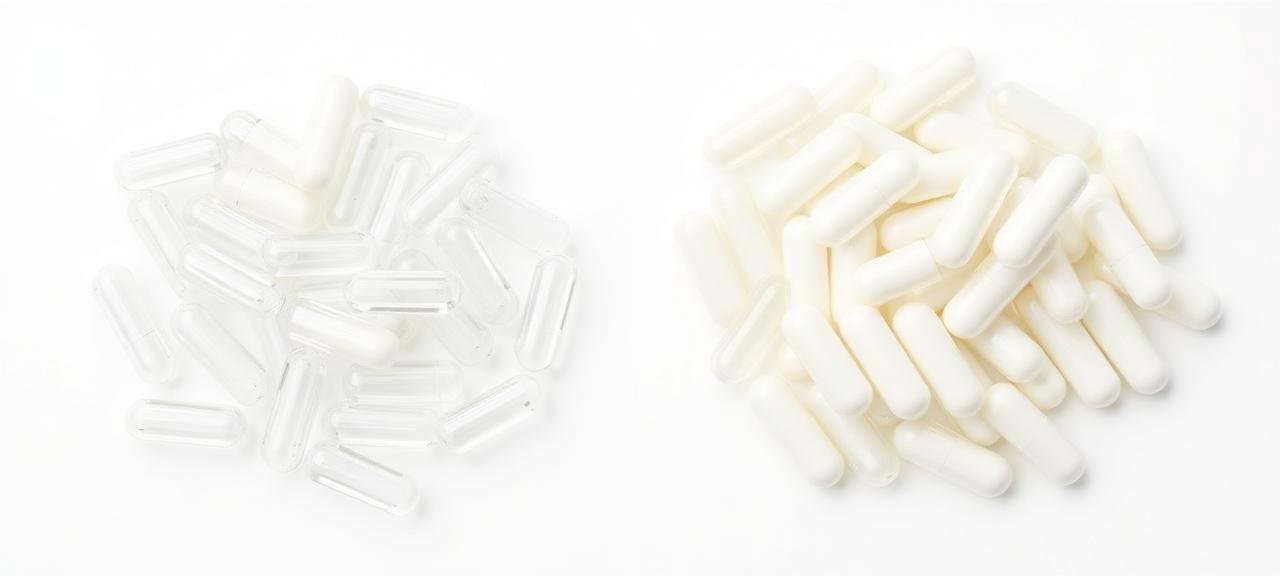
- 1If you’re building a supplement brand, “capsule choice” feels like a small detail—until it impacts your claims, your customers’ diet preferences,
- 2A vegetable capsule is a hard-shell capsule made from plant-derived polymers—most commonly HPMC (hydroxypropyl methylcellulose). Some veggie capsules
- 3Gelatin capsules are made from animal collagen (often bovine or porcine). They’re widely used, cost-effective, and run fast on many lines. Vegetable
- 4Capsules feel “cleaner label” to many shoppers because you can often get away with fewer excipients. Tablets can be cheaper at very high volumes and
- 5Bioavailability depends more on the ingredient form (salt, chelate, particle size, coating) than on “capsule vs tablet.” That said, dosage form
Introduction
If you’re building a supplement brand, “capsule choice” feels like a small detail—until it impacts your claims, your customers’ diet preferences, your stability in summer shipping, and your cost per unit at scale.
Vegetable capsules (often called “veggie caps”) stand out because they solve specific brand problems: they meet vegan positioning, they handle many dry powders well, and they give you flexible options for color, opacity, and delayed-release performance. But they are not always the best fit—especially for hygroscopic blends, oily liquids, or formulas that must hit a very high dose in a tiny size.
This guide breaks down what makes vegetable capsules different from gelatin, when tablets beat capsules, what fill weights are realistic by capsule size, and what actually drives encapsulation cost. We’ll also cover enteric coating, shipping stickiness, batch record QC, and the fastest-growing capsule format trends we see brands scaling. The goal is practical: help you choose a format that’s compliant, ecommerce-ready, and scalable—without getting surprised during production.
What “vegetable capsule” really means (and what it doesn’t)
A vegetable capsule is a hard-shell capsule made from plant-derived polymers—most commonly HPMC (hydroxypropyl methylcellulose). Some veggie capsules also use pullulan, a polysaccharide made by fermentation.
“Vegetable” does not automatically mean organic, non-GMO, or allergen-free. It also doesn’t mean the fill is plant-based—only the shell. If vegan positioning matters, confirm the full ingredient deck (including excipients and processing aids) supports that claim.
- Most common veggie shell: HPMC
- Common alternative: pullulan (often used for very clear capsules)
- Typical use: dry powders, granules, beadlets
Vegetable capsules vs gelatin capsules: the differences that matter
Gelatin capsules are made from animal collagen (often bovine or porcine). They’re widely used, cost-effective, and run fast on many lines. Vegetable capsules are popular for vegan positioning and can offer better performance for certain formulations and storage conditions.
| Factor | Vegetable capsules (HPMC/pullulan) | Gelatin capsules |
|---|---|---|
| Consumer positioning | Vegan/vegetarian-friendly shell | Animal-derived shell |
| Moisture behavior | Often better tolerance in lower-humidity environments; can still be sensitive with very hygroscopic fills | Can become brittle in very dry conditions; can soften with humidity |
| Compatibility with fills | Strong for many dry powders; special options exist for acid-resistant/delayed release | Strong for many dry powders; can be great for certain fills, but vegan claims aren’t possible |
| Runability at scale | Can run slightly slower depending on shell type and setup | Often very fast and forgiving on high-speed equipment |
| Cost | Typically higher shell cost | Typically lower shell cost |
| Look & branding | Broad color/opacity options; pullulan can be very clear | Broad options, classic glossy look |
Peakfinity Labs insight: For ecommerce brands, capsule selection often fails for a simple reason: founders pick “vegan” first and discover later the blend is moisture-active (common with certain amino acids, minerals, and botanical extracts). We usually screen for flowability and moisture risk early so you don’t end up chasing a sticking or brittleness issue after you’ve already designed packaging.
Capsules vs tablets for supplement brands (and why tablets sometimes win)
Capsules feel “cleaner label” to many shoppers because you can often get away with fewer excipients. Tablets can be cheaper at very high volumes and can deliver high dose in a single unit, but they usually require more processing and more excipients to compress and survive shipping.
| Decision point | Capsules | Tablets |
|---|---|---|
| Formulation speed | Faster to prototype and adjust | Slower; compression variables add dev time |
| Excipients | Often fewer | Often more (binders, lubricants, flow aids) |
| Dissolution risk | Lower mechanical barrier | Compression can slow disintegration if too hard |
| Cost at scale | Competitive; depends on machine speed and capsule cost | Can be very low at high volume once dialed in |
| Consumer perception | Premium, easy to swallow for many | Sometimes seen as “harder” or chalky; can be smaller than multiple caps |
| Best for | Botanicals, probiotics (when protected), multi-ingredient blends, fast iteration | High-volume vitamins, single-ingredient minerals, high-dose actives |
Why some brands choose tablets over capsules
- High-dose targets: If your formula needs 1,200–1,500 mg per serving, you may need 2–3 capsules, while a tablet can sometimes consolidate dosing.
- High-volume cost control: Once a tablet runs cleanly on a high-speed press, cost per unit can drop fast.
- Special forms: Chewables, lozenges, and orally disintegrating tablets are tablet-category plays that capsules can’t match.
Bioavailability and dissolution: what’s actually different
Bioavailability depends more on the ingredient form (salt, chelate, particle size, coating) than on “capsule vs tablet.” That said, dosage form changes how quickly a product disintegrates and releases ingredients for absorption.
- Capsules: The shell hydrates and opens, releasing powder. For many formulas, this means simpler, more predictable disintegration.
- Tablets: The tablet must break apart first. If it’s compressed too hard or has too much binder, it can dissolve slowly.
For US supplements, dissolution/disintegration expectations often reference USP methods. If you need a formal spec, align on the testing plan early so your label claims and quality targets match the real-world behavior.
Reference: United States Pharmacopeia (USP).
How tablet compression affects dissolution (and what causes capping/chipping)
Tablet compression is a balancing act. You need enough hardness to survive coating, bottling, and shipping, but not so much that the tablet fails to disintegrate on time.
- Over-compression: Can slow dissolution and cause “lamination” defects where layers separate.
- Under-compression: Can cause friability (crumbly tablets) and chipping.
- Common causes of capping: trapped air, low binder level, poor granulation, incorrect moisture, or punch speed issues.
Practical takeaway for new brands: if you want the fastest path to a compliant launch with fewer variables, capsules usually reach a stable process sooner than tablets.
What excipients are typically needed in tablet manufacturing
Most tablet formulas need a support system so the powder flows into the die, compresses consistently, and releases properly.
- Binders: help particles stick together (common examples: cellulose-based binders).
- Disintegrants: help the tablet break apart in fluid.
- Lubricants: reduce sticking to tooling (often magnesium stearate, though options vary).
- Glidants/flow aids: improve flow for consistent weights.
If your brand promise is “minimal excipients,” capsules can be easier to keep tight—especially for botanical blends that already have decent flow once milled and blended correctly.
Standard capsule sizes and realistic fill weights (what brands can actually hit)
“What fill weight fits in a capsule?” depends on capsule size, powder density, and flow. Two powders can weigh very different amounts in the same capsule. A fluffy botanical might pack at 250–400 mg, while a denser mineral blend could exceed 700 mg in the same size.
| Capsule size | Typical target fill range (mg) | Common brand use |
|---|---|---|
| 000 | 800–1,400 mg | High-dose powders (often 2 caps/serving) |
| 00 | 600–1,000 mg | Most common for adult daily supplements |
| 0 | 400–700 mg | Balanced swallowability and dose |
| 1 | 300–500 mg | Lower-dose actives, sensitive audiences |
| 2 | 250–400 mg | Smaller capsules for swallow comfort |
Brand-specific recommendation: If your hero ingredient drives the dose above ~1,000 mg per serving, decide early whether you want (a) multiple capsules per serving, (b) a tablet, or (c) a scoopable powder. This choice impacts your COGS, your label panel, your ad creative, and your repeat purchase rate.
Hard-shell vs liquid-filled capsules: how to choose
Most vegetable capsules used by supplement brands are hard-shell, two-piece capsules filled with powder. Liquid-filled capsules can work for oils or lipid-based actives, but they often require different equipment, sealing steps, and stability testing.
- Choose hard-shell: powders, granules, beadlets, multi-ingredient blends, faster iteration.
- Choose liquid-filled: oils (like omega blends), lipid-soluble actives, flavor-masked liquids, when you need a softgel-like experience without running softgels.
If your formula includes both oil and powder, you may be better served by a separate softgel/liquid format or a powder capsule with a different delivery strategy. Mixing oil into a powder capsule often creates flow and weight-variation problems unless you convert it to a dry, flowable system.
Enteric coated capsules: how they work and when they’re needed
Enteric systems delay release until the capsule passes through the stomach and reaches a higher-pH environment in the small intestine. Brands use enteric options for ingredients that irritate the stomach, degrade in acid, or need targeted release.
- How it works: an enteric polymer resists stomach acid and dissolves later at intestinal pH.
- When it’s needed: acid-sensitive actives, certain enzymes, some probiotics, and formulas where “no fishy burps” or reduced reflux matters.
Contrarian take: not every “probiotic” needs enteric protection. If the strain has strong acid tolerance data and your CFU overage supports the label at end of shelf life, an enteric approach may add cost without adding real-world benefit—especially compared to a manufacturing plan built specifically for probiotic supplement manufacturing.
Reference for enteric concept and dissolution frameworks: FDA dissolution testing resource (general background on dissolution expectations).
Capsule color, opacity, and size: branding meets manufacturability
Capsule aesthetics affect trust and repeat buys. They also affect inspection, print readability, and even how customers perceive “strength.”
- Opacity: Opaque shells can hide speckled botanicals and make blends look more consistent in photos.
- Color: Darker colors can reduce light exposure for sensitive ingredients, but confirm your packaging still blocks UV if needed.
- Size: Smaller capsules improve swallow comfort, but they force higher capsule counts per serving.
Practical ecommerce note: If your product will be photographed heavily (Amazon, TikTok Shop, Shopify), pick a capsule color that looks consistent across lots. Very light translucent capsules can show natural variation in botanical powders, which sometimes triggers “quality concern” comments even when the product is within spec.
What encapsulation costs per unit at scale (and what actually drives it)
Encapsulation cost per unit is not a single number. It changes with machine speed, capsule type, blend behavior, and packaging format. In real production, the fastest way to lower unit cost is to reduce stops and slowdowns.
| Cost driver | What happens | What you can do |
|---|---|---|
| Capsule shell cost | Veggie capsules usually cost more than gelatin | Confirm shell choice early; avoid last-minute switching |
| Fill machine speed | Sticky or poorly flowing blends force slower speeds | Optimize milling, blend uniformity, and flow aids when compliant |
| Weight variation / rejects | More rejects raise true cost per good unit | Dial in density, tamping settings, and powder flow |
| Batch size | Small runs have higher setup cost per unit | Use low MOQ to test, then scale batch sizes after traction |
| Packaging | Stick packs, blister packs, or complex bundles add labor | Start with ecommerce-ready bottles, then expand formats |
Rule of thumb: if your blend runs smoothly, scaling from 5k units to 50k units can drop your per-unit conversion cost meaningfully because setup time spreads over more bottles. If the blend runs poorly, cost may not improve much with volume because the line still moves slowly.
Shelf life of a typical supplement capsule (and what changes it)
Many capsule supplements target 18–24 months shelf life, but the real answer depends on the most sensitive ingredient in the formula and your packaging. Moisture, oxygen, and heat do the most damage.
- Powders with oils: risk oxidation and off-odors unless protected.
- Hygroscopic ingredients: pull moisture and can soften capsules or cause clumping.
- Light-sensitive actives: need opaque capsules and/or light-blocking bottles.
For ecommerce, we plan shelf life with shipping lanes in mind. A product that is stable at 22°C can still struggle in a hot delivery vehicle if the bottle breathes moisture.
How brands prevent capsules from sticking together in shipping
Capsule sticking shows up when humidity rises, when the fill attracts moisture, or when bottles sit in heat. It creates bad reviews fast because customers think the product “melted,” even if the fill is fine.
- Control water activity: choose ingredient forms and processing that reduce moisture pickup.
- Use the right bottle and liner: tight seals matter more than many founders expect.
- Add desiccant when needed: it’s a low-cost fix that often saves a launch.
- Avoid over-polishing: too much surface treatment can change friction and static behavior.
Peakfinity Labs insight: If your product ships nationwide, plan for summer from day one. We’ve seen “perfect in the lab” capsules turn into tacky capsules in July because a brand chose a premium glass bottle with a cap liner that didn’t seal as well as they thought.
How capsule batch records are reviewed for quality control (what to ask your manufacturer)
Batch record review is where a GMP-certified operation proves the lot was made the same way, with the same checks, every time. This is also where timeline slip happens if documentation is incomplete—so it matters for speed.
- Component verification: lot numbers for capsules, actives, and excipients match receiving records.
- In-process checks: weights, appearance, and adjustments are documented and within limits.
- Yield reconciliation: the numbers add up (no unexplained loss).
- Deviations and CAPA: any issue has a documented investigation and fix.
Ask to see examples of controlled forms (with proprietary info redacted). A reliable partner will have clean, consistent records and a clear release process—plus the ability to show you how they verify compliance as a GMP-certified supplement manufacturer.
Fastest-growing trends in supplement capsule formats (what we see scaling)
- Clean-label capsules: fewer excipients and simpler panels, especially for botanicals.
- Delayed-release positioning: gut comfort, enzyme targeting, and “no burps” claims tied to release timing.
- Smaller, more frequent dosing: brands choosing size 0/1 with 2-capsule servings to improve swallowability.
- Color-as-branding: consistent capsule colors built for content creation and recognition on scroll.
One pattern stands out: ecommerce brands optimize for repeat purchase, not just first-order margin. If capsule size improves compliance (people actually take it), it often beats a slightly lower COGS format.
Where to start: a practical decision path for new and scaling brands
- Define your positioning: vegan/vegetarian, clean label, delayed-release, or high-dose value.
- Map your dose reality: target per-serving mg and capsule count you can market.
- Run a flow and moisture screen: this predicts speed, cost, and sticking risk.
- Pick packaging early: bottle, liner, desiccant, and label size must match capsule count and compliance needs (see supplement packaging & label design considerations).
- Plan your scale steps: start with a low MOQ small-batch run, then increase batch size once ads prove demand.
At Peakfinity Labs, we build this around fast, turnkey execution: small-batch testing with a clear path to scalable production, using GMP-certified and ISO-certified systems that stand up to retailer and marketplace scrutiny—starting with a clear supplement manufacturing overview of formats, capabilities, and scale steps.
Conclusion: choose the capsule that matches your positioning, dose, and scale plan
Vegetable capsules are unique because they align with vegan positioning, support strong branding options, and can perform well for many dry powder formulas. They are not a universal upgrade—humidity-sensitive blends, high-dose targets, and liquid actives can push you toward different capsule types or tablets.
If you want to launch fast with low inventory risk, start with a small-batch run, validate fill performance and shipping stability, then scale once the product proves demand. Your next step is simple: finalize dose targets, pick a capsule size and color that fits your ecommerce story, and confirm the QC and batch record process so timelines stay tight and compliant—especially if you’re deciding between private label vs custom manufacturing as your go-to-market path.
Frequently Asked Questions
How are vegetable capsules different from gelatin capsules?
Vegetable capsules are typically hard-shell shells made from plant-derived polymers like HPMC or pullulan, while gelatin capsules are made from animal collagen. That difference determines vegan/vegetarian eligibility and can affect moisture behavior and sometimes production speed. If vegan positioning matters, confirm the full ingredient and processing deck—not just the shell.
What’s the difference between capsules and tablets for supplement brands?
Capsules usually prototype faster and often require fewer excipients, while tablets need compression-friendly formulas, more excipients, and tighter controls. Tablets can be cheaper at very high volume but take longer to develop and may risk dissolution issues if over-compressed. For a faster path to a stable launch with low MOQ flexibility, capsules are often simpler.
What fill weights are standard for supplement capsules?
Fill weight depends on capsule size, powder density, and flow. Typical target ranges cited are: 000 ≈800–1,400 mg, 00 ≈600–1,000 mg, 0 ≈400–700 mg, 1 ≈300–500 mg, and 2 ≈250–400 mg. A pilot fill with your actual blend is the most reliable next step because fluffy botanicals and dense minerals can differ significantly in the same size.
How do enteric coated capsules work, and when are they needed?
Enteric systems use polymers that resist stomach acid and dissolve later at higher intestinal pH, delaying release until the small intestine. They’re used for acid-sensitive actives, certain enzymes, some probiotics, or when reducing stomach irritation or "burps" matters. Decide by reviewing ingredient sensitivity or strain acid tolerance and matching that to a dissolution test plan.
Are vegan capsules more expensive than gelatin?
Yes—vegetable (vegan) capsules typically have higher shell cost and can run slightly slower depending on blend flow and equipment setup. Brands can offset some of that by optimizing powder flow and keeping line speed high to reduce rejects and true per-unit cost.
Ready-to-Launch Formulations in This Category
Stock-ready formulations you can private label with your own branding — 2,000 unit MOQ.
Liver Detox & Cleanse Capsules with Milk Thistle
Gut Health · Capsules
Saffron Extract Mood & Eye Health Capsules
Stress Mood · Capsules
Berberine with Ceylon Cinnamon & Chromium Capsules
Weight Management · Capsules
Red Yeast Rice with Nattokinase & CoQ10 Capsules
Heart Health · Capsules

Tushar
Licensed Pharmacist and COO @ Peakfinity Labs
Written by the Peakfinity Labs R&D Team — 46+ years of supplement formulation expertise. Our team of formulation chemists, manufacturing specialists, and regulatory experts has helped thousands of eCommerce brands bring their products to market successfully since 1980.
Related Articles

How to Find an ISO 17025-Accredited Supplement Testing Lab, and What Founders Should Ask For
How to verify a lab's ISO/IEC 17025 scope actually covers your test, the questions to ask before shipping samples, and a testing plan built for ecommerce timelines.
Supplement Manufacturing Lead Times and Reorders: What Founders Should Expect Before and After Launch
The five workstreams hiding inside "lead time," why reorders move faster than first runs, and the ramp plan that survives a demand spike.
How to Vet a cGMP Supplement Manufacturer With Documented Audit History
The document pack, audit-history call script, and scoring rubric that separate real cGMP quality systems from certificate PDFs.